

‘The king’s disease,’ gout can be a royal pain
Advertisement
Read this article for free:
or
Already have an account? Log in here »
To continue reading, please subscribe:

Digital Subscription
One year of digital access for only $205*
- Enjoy unlimited reading on winnipegfreepress.com
- Read the E-Edition, our digital replica newspaper
- Access News Break, our award-winning app
- Play interactive puzzles
*First annual payment billed as $205.00 + GST for one year. This annual subscription will automatically renew at $233.00 + GST every 52 weeks (10% off the regular annual price of $259.35). Offer available to new and qualified returning subscribers only. Cancel any time.
To continue reading, please subscribe:
Add Free Press access to your Brandon Sun subscription for only an additional
$1 for the first 4 weeks*
- Enjoy unlimited reading on winnipegfreepress.com
- Read the E-Edition, our digital replica newspaper
- Access News Break, our award-winning app
- Play interactive puzzles
*Your next Brandon Sun subscription payment will increase by $1.00 and you will be charged $17.95 plus GST for four weeks. After four weeks, your payment will increase to $24.95 plus GST every four weeks.
Read unlimited articles for free today:
or
Already have an account? Log in here »
Hey there, time traveller!
This article was published 20/03/2015 (4155 days ago), so information in it may no longer be current.
At least three times a month, someone walks into my office and complains about a sharp pain in their big toe.
Some have no idea what could be causing their discomfort. Others appear resigned to their fate.
“Is it gout?” they ask.
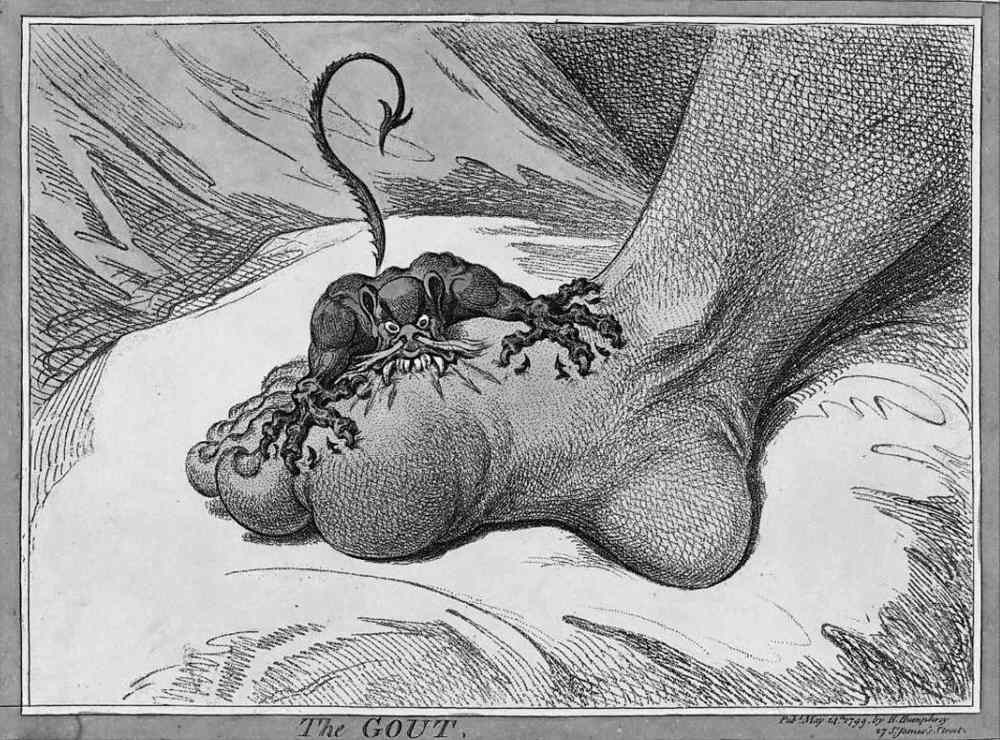
“Well,” I say, “we won’t know for sure until we run the tests.”
But, of course, symptoms of gout are well-known, and many patients know this — a lot of folks have an uncle who once had a sharp pain in their toe that later turned out to be gout.
What most of these patients have in common is they aren’t sure what causes this condition or what to do about it.
As it turns out, gout is one of the oldest forms of arthritis known to humankind. The odd-sounding name actually comes from the Latin gutta. As noted in a paper written by rheumatologists George Nuki and Peter A. Simkin, the word means “drop” and is thought to have referred to a notion it occurs when one of the four “humours” needed to maintain health would “drop” into a joint to cause pain.
Over the years, the condition has had many nicknames. In medieval times, for example, it was known as “the king’s disease” because it was associated with rich foods and drink only the well-to-do could afford. Of course, gout knows no social-class distinction today. It is estimated as many as two in 100 Canadians, from all walks of life, will develop gout at some point in their lives, usually over the age of 50.
Gout is caused by a buildup of uric acid crystals in a joint. Uric acid, which causes inflammation in the joint, is a chemical created when the body breaks down substances called purines. Purines are found in some foods and drinks. These include liver, red meat, anchovies, mackerel and several types of alcohol.
While it usually attacks one joint at a time, most often the joint of the big toe, gout can affect any joint in the body. The pain can be so extreme even the weight of a bedsheet is excruciating. The pain and swelling are the worst at the beginning of a gout attack. The symptoms then get better within a few days to weeks. Usually, the joint also turns red and swells.
To test for gout, your doctor or nurse can take a sample of fluid from the joint that is in pain. If confirmed, there are a few medicines that can alleviate the symptoms. They include:
— NSAIDs: This group of medicines includes ibuprofen and indomethacin. NSAIDs might not be safe for people with kidney or liver disease or for people who have bleeding problems.
— Colchicine: This medicine helps with gout, but it can also cause diarrhea, nausea, vomiting and stomach pain. It is usually given to people who cannot take NSAIDs.
— Steroids: Your doctor or nurse might suggest these medicines if you cannot take NSAIDs or colchicine. These steroids are not the kind athletes take to build up muscle. They reduce swelling and pain and come in shots or pills.
There are also medicines that can cut the risk of future gout attacks by reducing the amount of uric acid in the blood. But they are usually only given to people who have had several gout attacks. If you take one of the medicines to prevent gout, your doctor or nurse will want to make sure you use it safely. He or she might also want to check your uric-acid level gets low enough to dissolve the gout crystals. These drugs can actually increase gout attacks when you first start taking them. To prevent these attacks, your doctor or nurse might suggest you take low doses of colchicine when you start the medicines. This will give the gout crystals time to dissolve, and that will put a stop to the attacks.

There are other things you can do to prevent gout. If you are overweight, losing weight can help relieve gout. Plus, you can make changes to your diet that might help prevent future attacks.
Try cutting down on red meat and seafood, beer, wine and hard alcohol and foods and drinks that have high-fructose corn syrup (that includes most sodas and store-bought cakes and cookies). Instead, eat lots of low-fat dairy products, such as low-fat milk, cheese, and yogurt as well as whole grains and vegetables.
That may not be the diet of kings, but chances are it will help keep you pain-free.
Dr. Harold Nyhof is medical director of primary care clinics for the Northern Health Authority.