

School zones called speed traps
CAA wants flashing lights, painted curbs
Advertisement
Read this article for free:
or
Already have an account? Log in here »
To continue reading, please subscribe:
Monthly Digital Subscription
$1 per week for 24 weeks*
- Enjoy unlimited reading on winnipegfreepress.com
- Read the E-Edition, our digital replica newspaper
- Access News Break, our award-winning app
- Play interactive puzzles
*Billed as $4.00 plus GST every four weeks. After 24 weeks, price increases to the regular rate of $19.95 plus GST every four weeks. Offer available to new and qualified returning subscribers only. Cancel any time.
Monthly Digital Subscription
$4.99/week*
- Enjoy unlimited reading on winnipegfreepress.com
- Read the E-Edition, our digital replica newspaper
- Access News Break, our award-winning app
- Play interactive puzzles
*Billed as $19.95 plus GST every four weeks. Cancel any time.
To continue reading, please subscribe:
Add Free Press access to your Brandon Sun subscription for only an additional
$1 for the first 4 weeks*
*Your next subscription payment will increase by $1.00 and you will be charged $16.99 plus GST for four weeks. After four weeks, your payment will increase to $23.99 plus GST every four weeks.
Read unlimited articles for free today:
or
Already have an account? Log in here »
Hey there, time traveller!
This article was published 22/04/2015 (3926 days ago), so information in it may no longer be current.
CAA Manitoba says poor signage in school zones is contributing to an increase in the number of speeding tickets since the limit was reduced to 30 km/h last fall.
With better visual cues, CAA Manitoba says drivers would be less likely to go over the limit.
“I’m not sure there is anyone around here that would say ‘I consciously wanted to speed,’ or was careless enough to speed through a school zone, but they might miss a sign,” said Mike Mager, president of CAA Manitoba.
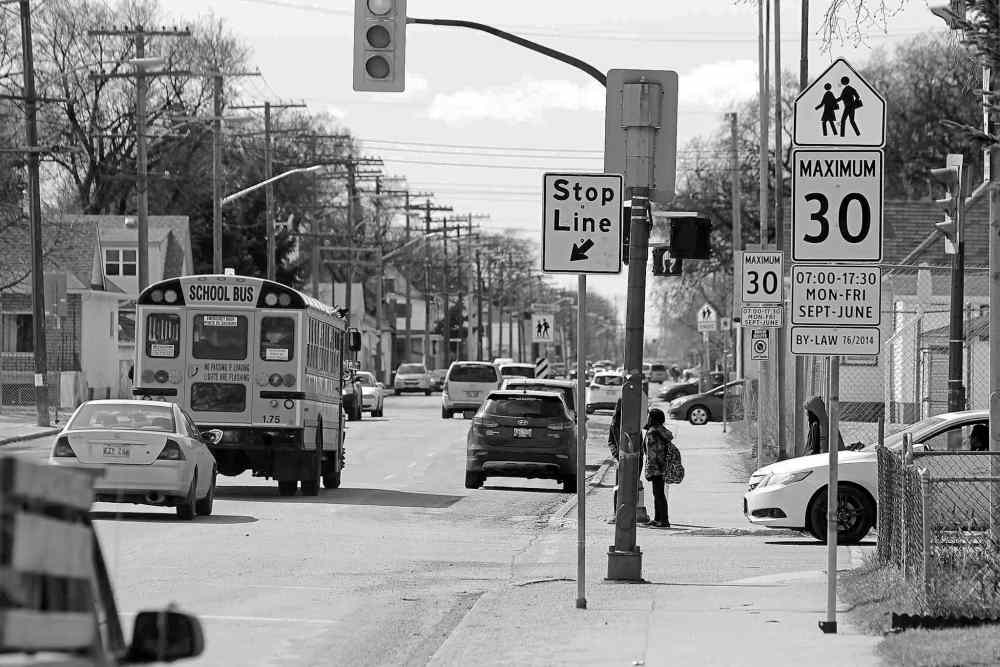
The association supported the province’s move to lower school zone speed limits. But the organization says amber flashing lights (such as in Ontario and Quebec), painted curbs and more signs beside the road would help reduce drivers’ speeds.
“The reality is, if you’re speeding, then you deserve a ticket. But the qualification is that there is an onus to properly monitor roadways and provide proper signage,” Mager said.
Lisa Fraser, communications officer at the City of Winnipeg, said the city must first comply with a provincial mandate, which does not include these measures.
“All municipalities in Manitoba, including the City of Winnipeg, must comply with the signing requirements set out in the provincial regulation pertaining to reduced-speed school zones,” Fraser wrote in an email.
Fraser said Winnipeg is not poised to make any changes to current school-zone signs unless the provincial mandate changes.
“We encourage citizens to comply with all road signage for the safety of the public,” she said.
Lori Walker, who owns Merits of Manitoba, a firm that fights traffic tickets for drivers, said her clients frequently have school-zone violations.
She said the problem usually comes down to not enough signs, or signs placed in inconvenient places so even the most well-meaning driver might miss it.
“If they’re truly concerned about children’s safety, and they should be, as we all should be, the signage should be proper so that people can understand it,” Walker said.
Curt Pankratz, an assistant professor of sociology at the University of Winnipeg, said the city needs alternative solutions to help reduce speeding.
Pankratz said measures such as plastic signs and speed bumps could easily be used, but aren’t implemented because police regard school zones as a money-maker.

“The fact that we are not using these other, better methods to slow people down is the problem,” Pankratz said. “So we don’t have a sign in the middle of the road, that’s a problem. The question is why aren’t we doing it? It’s easy.”
The provincial government said in a statement that local officials are in the best position to understand where additional signage is needed.
“The Manitoba government gave municipalities the ability to protect children by lowering speed limits in their school zones because local officials know their communities and what is needed to keep kids safe going to and from school,” the statement said.
“A school in Winnipeg may need different protection than a school in Brandon.”
kathleen.saylors@freepress.mb.ca