

Groups seek input on pipeline project
Question silence of Hydro, province
Advertisement
Read this article for free:
or
Already have an account? Log in here »
To continue reading, please subscribe:
Monthly Digital Subscription
$0 for the first 4 weeks*
- Enjoy unlimited reading on winnipegfreepress.com
- Read the E-Edition, our digital replica newspaper
- Access News Break, our award-winning app
- Play interactive puzzles
*No charge for 4 weeks then price increases to the regular rate of $19.95 plus GST every four weeks. Offer available to new and qualified returning subscribers only. Cancel any time.
Monthly Digital Subscription
$4.99/week*
- Enjoy unlimited reading on winnipegfreepress.com
- Read the E-Edition, our digital replica newspaper
- Access News Break, our award-winning app
- Play interactive puzzles
*Billed as $19.95 plus GST every four weeks. Cancel any time.
To continue reading, please subscribe:
Add Free Press access to your Brandon Sun subscription for only an additional
$1 for the first 4 weeks*
*Your next subscription payment will increase by $1.00 and you will be charged $16.99 plus GST for four weeks. After four weeks, your payment will increase to $23.99 plus GST every four weeks.
Read unlimited articles for free today:
or
Already have an account? Log in here »
Hey there, time traveller!
This article was published 08/05/2015 (3892 days ago), so information in it may no longer be current.
The Selinger government and Manitoba Hydro aren’t doing enough to protect the province from TransCanada’s plan to build the proposed Energy East pipeline, environmentalists claim.
They say that silence might be due to the likelihood Energy East will become Hydro’s biggest customer. It will need to buy electricity to power eight pumping stations in Manitoba so it can deliver crude bitumen oil from Alberta to Eastern Canada.
“So what we have is a huge network of transmission lines being run across the province, very large, and those are explicitly to power Energy East,” Eric Reder of the Wilderness Committee said Thursday.
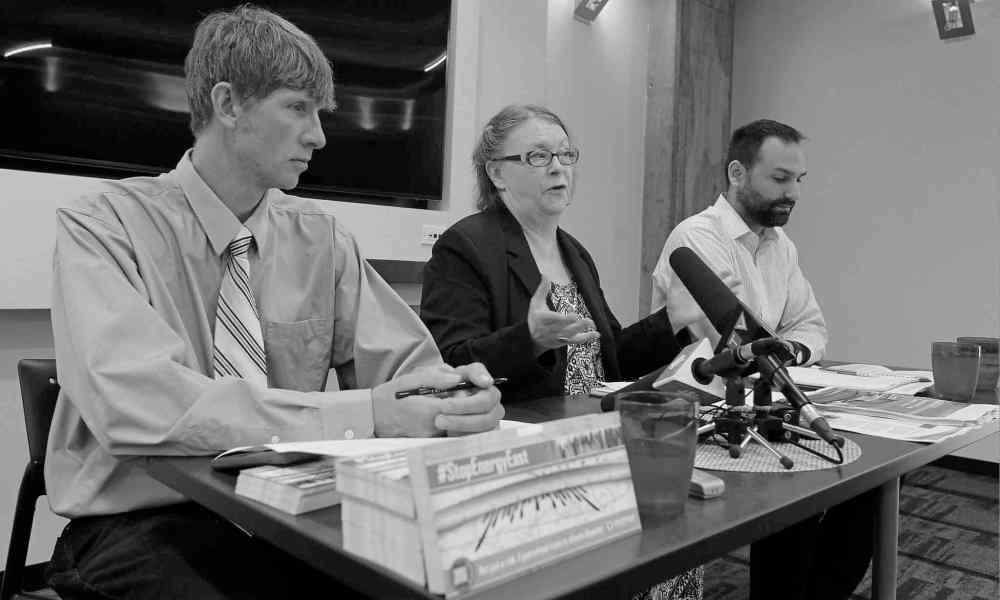
“Manitoba Hydro has to own these transmission lines. Of course, Manitobans own Manitoba Hydro. So that by extension means Manitobans have to own Energy East, or a portion of Energy East. That means Manitobans have to make a decision to invest in this fossil-fuel infrastructure.”
Conservation and Water Stewardship Minister Tom Nevakshonoff said the province has applied for intervener status on the pipeline project at upcoming hearings before the National Energy Board.
Hearings could begin next year.
“We’re compiling a comprehensive list of concerns which we will take forward to them,” Nevakshonoff said.
“We will do our utmost to focus on public safety and environmental integrity.”
TransCanada spokesman Tim Duboyce said the company has made public thousands of pages of information on the proposed pipeline.
“We’ve been anything but under a cone of silence since we started promoting this project more than two years ago,” he said.
That includes public meetings, meeting with landowners, government officials and First Nations and Métis leaders.
Duboyce said the electricity demand for the proposed pumping stations will be small compared with what Manitoba Hydro produces and exports.
He said the pipeline’s peak requirement would be about 150 megawatts, about three per cent of the total capacity of Manitoba Hydro.
The environmental groups called on the NDP government to order the province’s Clean Environment Commission to hold public hearings on project.
‘Manitobans have to make a decision to invest in this fossil-fuel infrastructure’ — Wilderness Committee’s Eric Reder
Energy East and other pipelines were discussed at last year’s hearing into Manitoba Hydro’s plan to build the Keeyask generating station and a new transmission line to Minnesota.
Hydro has said the hydro power needed by the pipelines would require just under 2,000 gigawatt hours of energy, roughly half the dependable energy of the 695-MW Keeyask station on the Nelson River.

Gaile Whelan Enns of Manitoba Wildlands said the information about what is planned for Energy East has been scant.
“We’re really overdue to know exactly what’s going on,” she said.
Alex Paterson of the Manitoba Energy Justice Coalition said what’s missing in the debate over Energy East is how Manitoba Hydro fits into the building of a national oil pipeline.
“We have a right to clear and informed information about the implications of our energy decisions in the province,” Paterson said. “It also means that Manitobans of any stripe collectively deserve a right to say no to any energy project.”
bruce.owen@freepress.mb.ca