

Pipe ceremony dress code ‘uncalled for’
Advertisement
Read this article for free:
or
Already have an account? Log in here »
To continue reading, please subscribe:
Monthly Digital Subscription
$1 per week for 24 weeks*
- Enjoy unlimited reading on winnipegfreepress.com
- Read the E-Edition, our digital replica newspaper
- Access News Break, our award-winning app
- Play interactive puzzles
*Billed as $4.00 plus GST every four weeks. After 24 weeks, price increases to the regular rate of $19.95 plus GST every four weeks. Offer available to new and qualified returning subscribers only. Cancel any time.
Monthly Digital Subscription
$4.99/week*
- Enjoy unlimited reading on winnipegfreepress.com
- Read the E-Edition, our digital replica newspaper
- Access News Break, our award-winning app
- Play interactive puzzles
*Billed as $19.95 plus GST every four weeks. Cancel any time.
To continue reading, please subscribe:
Add Free Press access to your Brandon Sun subscription for only an additional
$1 for the first 4 weeks*
*Your next subscription payment will increase by $1.00 and you will be charged $16.99 plus GST for four weeks. After four weeks, your payment will increase to $23.99 plus GST every four weeks.
Read unlimited articles for free today:
or
Already have an account? Log in here »
Hey there, time traveller!
This article was published 17/06/2015 (3972 days ago), so information in it may no longer be current.
A request that women wear long skirts to an indigenous ceremony at the University of Winnipeg Wednesday ignited debate, with at least one academic questioning the dress code.
U of W political science Prof. Joanne Boucher said a long skirt is a dress code and is discriminatory against women.
“It seems to me there are three issues. The smoking issue, which I don’t have an opinion on. Then there’s the religion issue and the gender issue,” Boucher said.
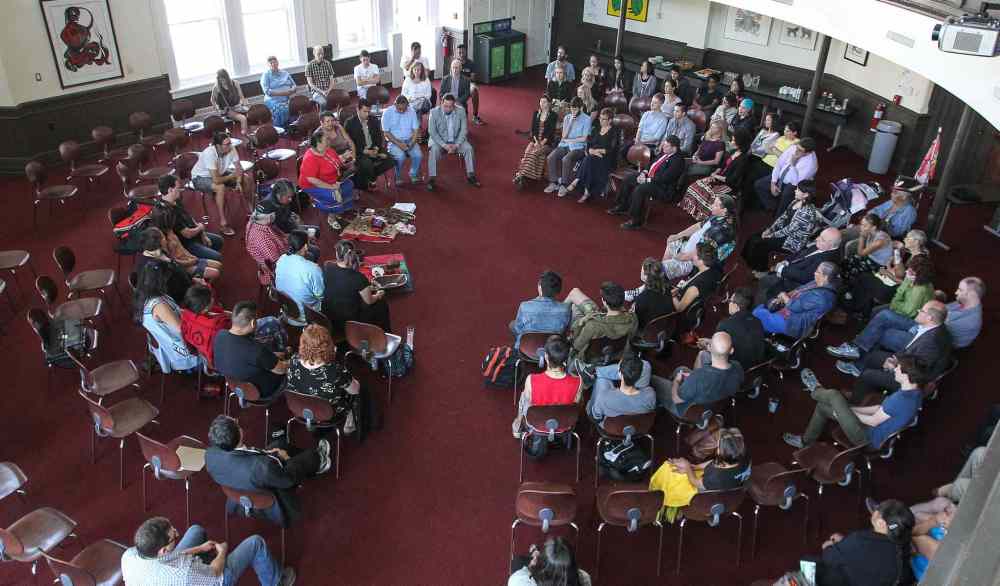
Women were asked to wear long skirts at Wednesday’s pipe ceremony. Most did and no one who didn’t was turned away. No one saw Boucher attend the event but her views were ran in a Free Press column Wednesday.
“The issue I’m most concerned with is the gender issue. I’ve worked here almost 20 years and I’ve never heard of anything like this. That, to me, is unprecedented and uncalled for… to me it’s like inviting a priest in and telling the women to dress in black or modestly,” Boucher said prior to the event.
The pipe ceremony was conducted by elders Dan Thomas and Myra Laramee.
A talking circle followed the pipe ceremony. The discussion afterward offered a relaxed forum for students, faculty, administration and the public to discuss the university’s new requirement for mandatory indigenous courses.
About 50 attended, mostly were non-university indigenous people who appeared familiar and comfortable with the culture and the ceremonies.
They urged university administrators to listen to indigenous people and seek out elders and scientists from among them for advice.
The issue about skirts came up briefly, when the elder Myra Laramee told people during the ceremony that the tradition isn’t intended to exclude people but rather to remind them that women wear skirts to represent the tipi or Miikiwaap (a Cree word that means home). It’s a choice, she said.
She declined an interview but she was heard to ask a faculty member to forward a handout on the tradition to Boucher.
The university administration cast the setting in a cultural context.
“We’re moving ahead with our plan for an indigenous course requirement and starting the process. What we did here today is carry out a consultation in a culturally appropriate manner for indigenous people so we had a pipe ceremony and a conversation. People said a lot a different views about the course requirements,” said Wab Kinew, the university’s associate vice president of indigenous affairs.
Manitoba Grand Chief Derek Nepinak and Southern Chiefs Grand Chief Terry Nelson both attended the event.
“I encourage you as you design this course (to remember) we’re not forcing ourselves on anyone,” Nepinak said, stressing the need to design a course that encourages people’s interest in indigenous culture and history.
“The first thing to do when you’re talking about understanding the history is to develop a curriculum that speaks the truth,” Nelson said, briefly outlining the fact there were sophisticated indigenous civilizations and millions of people in North America before European contact.
Most were wiped out or decimated and restoring that body of knowledge is a task indigenous people are undertaking on their own, Nelson said.

Kinew added afterward, “There are different ways of seeing the world, right and part of the indigenous course requirement started with a movement with the students. It’s in keeping with the spirit of that student led initiative for the consultation process to be grounded in indigenous world views.”
Student association president Peyton Veitch said before the event that the most important thing he brought to the pipe ceremony was an open mind.
“This (is) about respect for sacred teachings, it’s about respect for cultural practices, it’s about respect for the elder,” Veitch said.
“When we talk about respect, that is fundamental to the process of reconciliation, which is ultimately the road we are heading down.”