

Welcome to the jungle
22 years of fan anger washed away by jubilation at Jets' street party

Advertisement
Read this article for free:
or
Already have an account? Log in here »
To continue reading, please subscribe:

Digital Subscription
One year of digital access for only $205*
- Enjoy unlimited reading on winnipegfreepress.com
- Read the E-Edition, our digital replica newspaper
- Access News Break, our award-winning app
- Play interactive puzzles
*First annual payment billed as $205.00 + GST for one year. This annual subscription will automatically renew at $233.00 + GST every 52 weeks (10% off the regular annual price of $259.35). Offer available to new and qualified returning subscribers only. Cancel any time.
To continue reading, please subscribe:
Add Free Press access to your Brandon Sun subscription for only an additional
$1 for the first 4 weeks*
- Enjoy unlimited reading on winnipegfreepress.com
- Read the E-Edition, our digital replica newspaper
- Access News Break, our award-winning app
- Play interactive puzzles
*Your next Brandon Sun subscription payment will increase by $1.00 and you will be charged $17.95 plus GST for four weeks. After four weeks, your payment will increase to $24.95 plus GST every four weeks.
Read unlimited articles for free today:
or
Already have an account? Log in here »
Hey there, time traveller!
This article was published 11/04/2018 (3085 days ago), so information in it may no longer be current.
Wait for it.
It was deep into the second period Wednesday night, and the combined stress of a scoreless game, 2 1/2 hours of standing in the cold, and one too many hard lemonades was taking its toll on the 6,000 or so fanatics gathered on Donald Street. And then, a break.
Power play. Wait for it.

There had only been a few good chances at that point in the first game of the Winnipeg Jets’ first-round NHL playoff series against the Minnesota Wild. So when the Jets’ got their second chance on the power play, a hush fell over the throng gathered outside Bell MTS Place.
Need a goal, need it now.
Then, there they were, like old friends who arrived late for their own party: Byfuglien to Wheeler to Scheifele.
That first goal exploded like a grenade on Donald Street, and washed over the street party crowd like a wave, hands and arms undulating with a frantic rhythm. It seemed like a long time coming, and when it finally arrived, the celebration was an odd mix of emotions.
There is a deep and sincere affection between the Jets and their fans, and you could feel it as soon as the puck hit the twine. But there was something else.
Call it anger. Or maybe contempt is a better word.
When Jets fans are not lavishing love on their beloved team, they are spewing venom at the on-ice officials any time they have the temerity to penalize the Jets players.
They’ve also got a full-throated disdain for opposing players and the poor fools who show up at the Bell MTS Centre to cheer for the other team. The Winnipeg arena is a hard place for hardcore fans. The weak and meek need not attend.
Why all the anger?
This is a city that cannot look at this hockey team without thinking about its greatest humiliation: the relocation of its first NHL franchise to Phoenix in 1996.
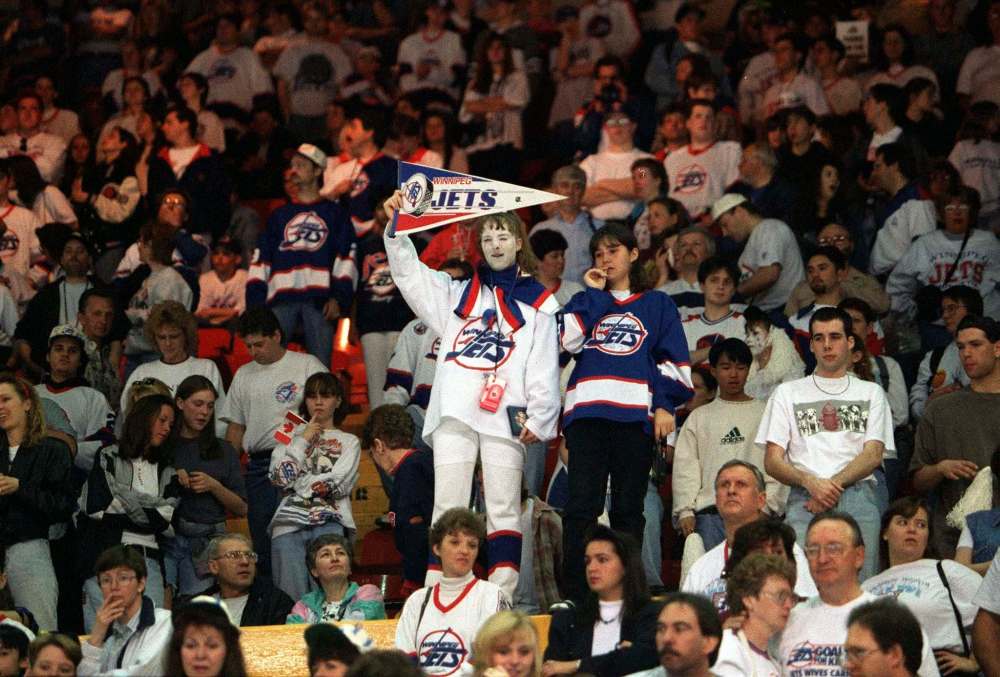
You could see all that unfolding Wednesday on Donald Street: a joyous celebration marked with an undercurrent of anger and contempt. It was as if several thousand people were doing a happy dance that involved flashing their middle fingers at the rest of the world.
The outdoor street party that accompanied Game 1 sent a clear message to the rest of the league: welcome to the jungle.
***
To understand the psychology of Winnipeg hockey fans, you really need to study the mythology around the demise of the first iteration of the Jets.
According to many lifelong fans, the departure of the franchise was a violent act brought upon the city by a greedy league bent on squeezing out small- and middle-market teams. Unfortunately, the theory ignores a lot of the problems Winnipeg had as a professional hockey market.
The team’s finances were so shaky the provincial government was forced to finance operating losses. On ice, its performance was a triumph of mediocrity. The team made the playoffs in 11 of its 17 NHL seasons, but never got beyond the second round.
There was no salary cap and no economic mechanisms such as revenue sharing, currency compensation and ancillary revenue sources such as pay-per-view and specialty TV channels.
However, Jets 1.0 was also a story about a team that had consistent but unremarkable support from its fans.
From 1979 (the team’s first year in the NHL) until 1996 (the year the team relocated), the old Winnipeg Arena near Polo Park never sold out an entire regular season. With a total capacity of 15,393, average attendance was just above 13,000 over those 17 years.

The best season, attendance-wise, was 1981-82, with an average of 13,620 (88 per cent of capacity); the worst was 1995-96, when some 11,300 tickets (74 per cent of capacity) were sold for each home regular-season game.
Among Canadian-based NHL teams over those years, only the Quebec Nordiques had a worse attendance record – and we know what happened there.
The post-season, oddly, suffered from even less support. The 11 times the Jets made the playoffs, only four home playoff games were sell-outs.
In the May 2011 news conference, where it was confirmed NHL hockey was coming back to Winnipeg, league commissioner Gary Bettman repeated an observation he had made in 1996 when the team left.
When asked about how he felt about the NHL coming back to Winnipeg, Bettman said he was thrilled, because it meant a return to a city “where we know people love NHL hockey.” However, he also reminded people the team left because “no one at that time simply wanted to own the Jets.”
That was a hard pill to swallow in 1996, and it wasn’t any easier to choke down in 2011. However, it explained why the NHL demanded Winnipeg sell 13,000 season-ticket packages before it would consider seeking approval for the relocation of the Atlanta Thrashers.
Local hockey fans bristled at the idea they be forced to prove Winnipeg was a viable NHL city, but the league knew from the first go-around.
My, how things have changed.
The city is a much different place. The population is larger and more diverse, and the economy is more refined. And perhaps most importantly, after having lost something valuable, fans are showing their support for NHL hockey in ways and levels never before seen in this community.
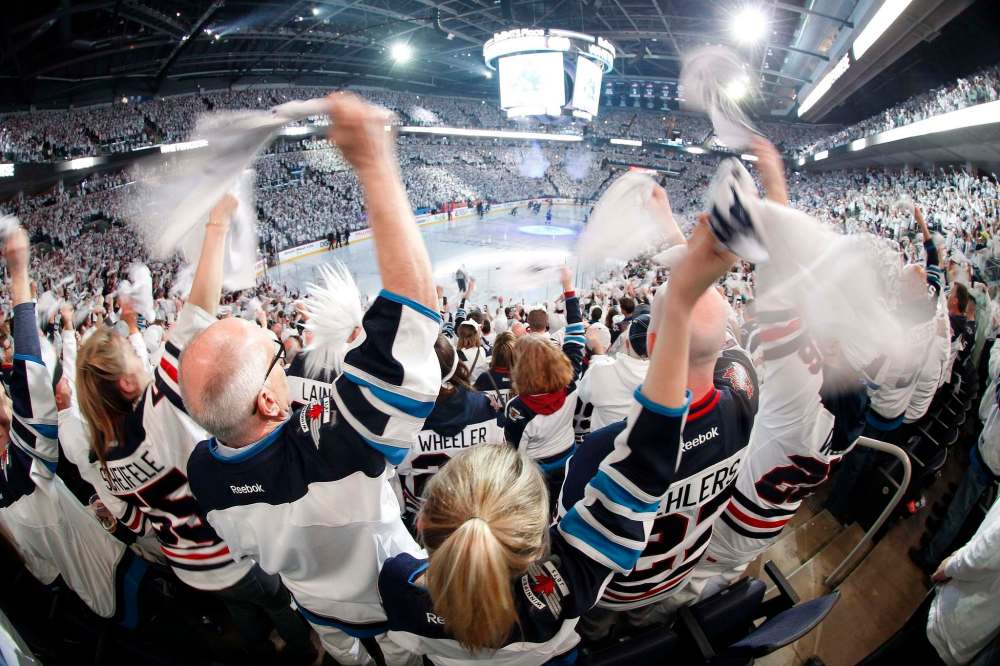
Since the repatriation in 2011, the Jets have only made the playoffs twice. And yet, the team has effectively sold-out every regular-season. Ticket prices started high, and have only got more expensive. Nothing – not the modest performance of the team nor the exorbitant price of tickets and rink refreshments – have dulled this city’s desire.

The wealthiest families in the province gathered in 1996 and passed on an opportunity to buy the team and keep it here, concerned about the league’s economics and a community that talked a big game about being a true hockey town but largely did not walk the talk.
If the mood and the level of support seen now are any indication, Jets fans have embraced their team like never before.
You never appreciate something until it’s gone. Now that it’s back, no one looks like they’re going to take the Jets for granted, ever again.
Not convinced? Visit the jungle on Donald Street and see if it doesn’t change your mind.
dan.lett@freepress.mb.ca
Dan Lett is a columnist for the Free Press, providing opinion and commentary on politics in Winnipeg and beyond. Born and raised in Toronto, Dan joined the Free Press in 1986. Read more about Dan.
Dan’s columns are built on facts and reactions, but offer his personal views through arguments and analysis. The Free Press’ editing team reviews Dan’s columns before they are posted online or published in print — part of the our tradition, since 1872, of producing reliable independent journalism. Read more about Free Press’s history and mandate, and learn how our newsroom operates.
Our newsroom depends on a growing audience of readers to power our journalism. If you are not a paid reader, please consider becoming a subscriber.
Our newsroom depends on its audience of readers to power our journalism. Thank you for your support.
Dan Lett is a columnist for the Free Press, providing opinion and commentary on politics in Winnipeg and beyond. Born and raised in Toronto, Dan joined the Free Press in 1986. Read more about Dan.
Dan’s columns are built on facts and reactions, but offer his personal views through arguments and analysis. The Free Press’ editing team reviews Dan’s columns before they are posted online or published in print — part of the our tradition, since 1872, of producing reliable independent journalism. Read more about Free Press’s history and mandate, and learn how our newsroom operates.
Our newsroom depends on a growing audience of readers to power our journalism. If you are not a paid reader, please consider becoming a subscriber.
Our newsroom depends on its audience of readers to power our journalism. Thank you for your support.
Related Articles
Wild storm is brewing in Winnipeg



Advertisement Advertise With Us
Advertisement Advertise With Us
History
Updated on Wednesday, April 11, 2018 8:49 PM CDT: Adds edits