

Stroke of luck
Art masterpieces sometimes turn up in unlikely places
Advertisement
Read this article for free:
or
Already have an account? Log in here »
To continue reading, please subscribe:
Monthly Digital Subscription
$1 per week for 24 weeks*
- Enjoy unlimited reading on winnipegfreepress.com
- Read the E-Edition, our digital replica newspaper
- Access News Break, our award-winning app
- Play interactive puzzles
*Billed as $4.00 plus GST every four weeks. After 24 weeks, price increases to the regular rate of $19.95 plus GST every four weeks. Offer available to new and qualified returning subscribers only. Cancel any time.
Monthly Digital Subscription
$4.99/week*
- Enjoy unlimited reading on winnipegfreepress.com
- Read the E-Edition, our digital replica newspaper
- Access News Break, our award-winning app
- Play interactive puzzles
*Billed as $19.95 plus GST every four weeks. Cancel any time.
To continue reading, please subscribe:
Add Free Press access to your Brandon Sun subscription for only an additional
$1 for the first 4 weeks*
*Your next subscription payment will increase by $1.00 and you will be charged $16.99 plus GST for four weeks. After four weeks, your payment will increase to $23.99 plus GST every four weeks.
Read unlimited articles for free today:
or
Already have an account? Log in here »
Hey there, time traveller!
This article was published 28/09/2019 (2382 days ago), so information in it may no longer be current.
It’s become something of a cliché — a masterpiece worth millions of dollars is accidentally discovered hanging in the home of an unsuspecting elderly person.
In this case, the story is absolutely true, and it’s generating headlines around the world.
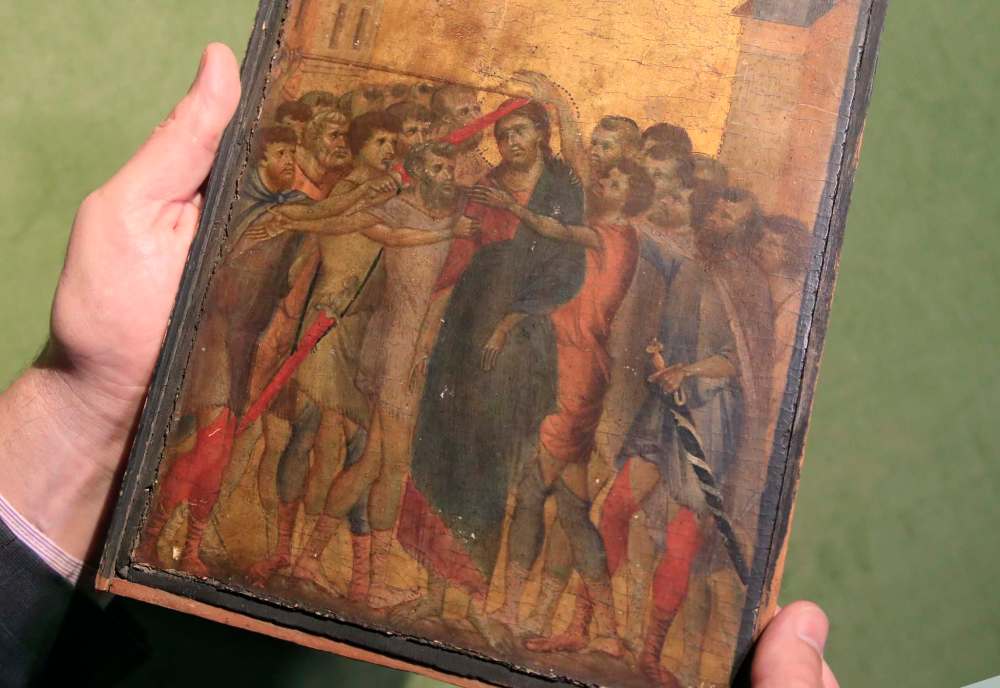
Dozens of news reports this week revealed a rare painting by the Italian master Cimabue was found hanging in the kitchen of an elderly woman living outside Paris.
Experts say Christ Mocked, a work by the pre-Renaissance painter, was part of a diptych made in 1280 when the artist painted eight scenes centred on the passion and the crucifixion of Christ. It is expected to fetch between US$6.59 million and US$8.7 million when it hits the auction block.
The 25.8-by-20.3-centimetre painting was found hanging above a hot plate, where it gathered years of dust and grease. An auctioneer saw the work, which the woman thought was a Greek religious icon, and advised her to have it appraised.
“It didn’t take long for us to see that it was an artwork by Italian painter Cimabue. He’s a father of painting, so we know his work very well,” Jerome Montcouquil of art specialists Cabinet Turquin, which tested the painting after its discovery earlier this summer, told CNN. “There are only eleven of his paintings in the world — they are rare.”
It’s far from the first time breathtaking artwork has surfaced in this manner, as we see from today’s exquisite list of Five Famous Art Treasures Found in Unlikely Places:
5) The long-lost treasure: A possible Jackson Pollock canvas
The estimated value: It was pegged at US$50 million
The fascinating find: Maybe it’s a Jackson Pollock worth US$50 million. Maybe it’s not. Even if it’s not an original work by the late American abstract expressionist known for his “drip and splash” style, this story is too good not to share. In 1992, bargain hunter Teri Horton, a retired trucker, was perusing a thrift store in San Bernardino, Calif., for a gift to cheer up a friend. She found a large canvas covered in colourful paint drips and spatters, thought it was ugly, but paid US$5 for the painting.
It turned out her friend thought it was ugly, too, and when it wouldn’t fit through the front door of her friend’s trailer, Horton tried to sell it at a yard sale, which is when a local art teacher happened by and suggested the painting might be an original by Pollock.
“Who the f— is Jackson Pollock?” Horton replied, a response that became the title of a 2006 documentary film about her campaign to prove the painting, for which she sought US$50 million, was from the hand of the master. She began her authentication quest by hiring Paul Biro, a forensic art specialist from Canada, who used fingerprint recognition and a side-by-side comparison to the painter’s work “No. 5, 1948” — which sold for US$140 million in 2006 — to conclude the painting was real. “However, Biro’s scientific findings weren’t enough to convince art connoisseurs or the International Foundation for Art Research that the painting was authentic. Among the obstacles was the fact that it had been purchased at a thrift shop, was unsigned and was without a record of its history,” according to the L.A. Times.
The debate rages unabated, with experts on either side. “I’m not gonna stay around forever,” Horton said in 2018, “but I’d like to see the painting sold and give some of it to the people who have helped me over the years.” Horton, who declined an offer of US$9 million for the work, died in July at age 86.
4) The long-lost treasure: A version of Caravaggio’s Judith Beheading Holofernes
The estimated value: Up to US$171 million

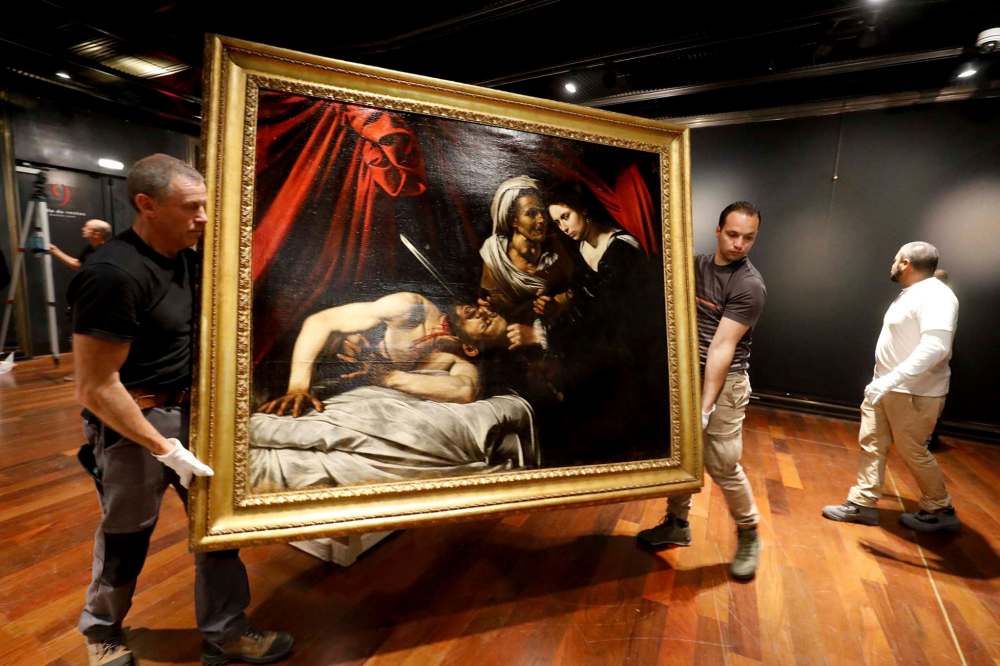
The fascinating find: In 2014, French homeowners in Toulouse popped up into their attic to try and fix their leaky roof. Tucked away in the rafters, hidden under an old mattress for more than 100 years, they found something a lot more exciting than a puddle — a painting believed to be the work of Italian master artist Caravaggio.
The painting, which has been estimated to be worth up to US$171 million, reportedly dates from 1607 and depicts biblical heroine Judith beheading the Assyrian general Holofernes. “Thieves who broke into the attic only a few years before it was discovered took bottles of perfume and several other items, but left the Caravaggio behind because they thought it ‘inadequate’ and worthless,” auctioneer Marc Labarbe said earlier this year. The remarkable find was cleaned and analyzed in Paris, where experts began fiercely debating its true origins.
Art expert Eric Turquin, who authenticated the painting, has staked his reputation on the work being the Renaissance master’s lost Judith Beheading Holofernes. “Not only is it a Caravaggio, but of all the Caravaggios that are known today, this is one of the great pictures,” Turquin, France’s leading authority on Old Masters paintings, told reporters this summer. But a minority of specialists — particularly in Italy — have expressed their doubts. They believe it is a copy made by the 17th-century Flemish baroque artist Louis Finson, who worked alongside Caravaggio and both studied and imitated his style. The painting was set to hit the auction block this summer, but was snapped up by a mystery buyer. Before bidding could start, a foreign buyer “close to a major museum” stepped in, said Labarbe, the local auctioneer who discovered the painting when he was asked to value some “old things in the attic” five years ago.
“The fact that the offer comes from a collector close to a major museum convinced the seller to accept (the offer),” he said. Labarbe said he could not reveal the name of the buyer or the price paid because of a confidentiality agreement.
3) The long-lost treasure: Van Gogh’s Sunset at Montmajour
The estimated value: More than US$50 million
The fascinating find: In 1908, Norwegian industrialist Nicolai Mustad bought a 19th-century painting of the French countryside at sunset. It was called Sunset at Montmajour and Mustad believed it to be the handiwork of the legendary Dutch artist Vincent van Gogh, arguably the world’s most famous painter. But after the French ambassador to Sweden visited Mustad’s home and suggested the painting was a fake, the work was relegated to the attic.
The “banishment was permanent; he never wanted to see the landscape again, and later photographs of his home confirm that it didn’t hang among his other pictures,” Van Gogh Museum experts wrote in a 2013 article in the art publication The Burlington Magazine. After Mustad’s death in 1970, an art dealer also concluded the painting was bogus. In 1991, another owner contacted the Van Gogh Museum, but again the work was deemed a fake.
In 2011, however, the museum decided to give it another try after identifying the place depicted in the painting. With more-sophisticated scientific tools at their disposal this time, they were able to determine that the pigments used for Sunset at Montmajour correspond with those of Van Gogh’s palette from Arles, France, the museum said, according to the Wall Street Journal. In 2013, more than 120 years after the famed painter’s death, the painting was authenticated.
“A discovery of this magnitude has never before occurred in the history of the Van Gogh Museum,” the museum’s director, Axel Ruger, said in a statement. Ruger said the museum attributed the painting to van Gogh after “extensive research into style, technique, paint, canvas, the depiction, van Gogh’s letters and the provenance.”
The work was created in the same period as van Gogh’s iconic Sunflowers painting. In a letter to his brother, Theo, van Gogh described the day he painted the landscape. It is the first full-sized van Gogh to be authenticated since 1928. It’s value is hard to predict, but has been pegged at over US$50 million.
2) The long-lost treasure: One of Rembrandt’s earliest works
The estimated value: US$4 million
The fascinating find: After their mom died in 2010, New Jersey brothers Ned, Roger and Steven Landau held a garage sale, but hung on to a few items they didn’t want to give away. One of those items was a tiny, dilapidated painting that was stuffed under the ping-pong table in Roger’s basement. Four years later, the Landau brothers reached out to a local estate guy, John Nye, owner of Nye and Co. auction house in Bloomfield, N.J., to get estimates on the value of items from their mom’s estate, including the 22-by-18-centimetre painting.
“The picture was remarkably unremarkable,” Nye told Reuters, recalling the oil painting was flaking. “It looked like a dark, discoloured portrait of three people, one of whom is passed out.” When the painting went up for auction, Nye estimated it would fetch a measly US$800, having spent two weeks on display on the auction house wall and in its online catalogue.
“It was a wall painting and it never looked like much,” Roger Landau told reporters. “My parents had larger paintings that we considered much more valuable.” Things began to change when three people from England, France and Germany requested to bid on the artwork over the phone while other bidders gathered in the sales room. The bidding began at US$250 and quickly exceeded Nye’s predicted US$800. After a caller from France bid US$5,000, the guy from German countered and the bidding reached US$100,000.
When the winning bid of US$1.1 million came from the French caller, the German backed off and explained to Nye what was going on. “You just sold a Rembrandt,” the caller told Nye. “I have been looking for this painting my whole professional life.” Later, when the painting was cleaned up, Rembrandt’s monogram became visible.
It turns out the painting was one of the Dutch master’s earliest works, painted when he was a teenager. Called The Unconscious Patient (An Allegory of the Sense of Smell), it depicts two men wafting a rag under the nose of a third man who is swooning, and dates to 1624. It was one of five Rembrandts highlighting the human senses. The brothers have no idea how their parents obtained the work. It was eventually sold to Thomas Kaplan, a New York art collector, for a reported US$4 million.
1) The long-lost treasure: The so-called Gurlitt Hoard
The estimated value: US$1.15 billion
The fascinating find: In 2012, German authorities broke into a grubby Munich apartment owned by a reclusive, mysterious octogenarian named Cornelius Gurlitt. Inside, they made a breathtaking find — the most extraordinary stash of art uncovered since the end of the Second World War.
German police confiscated roughly 1,500 incredible works of art, including Picassos, Matisses, Chagalls and Renoirs, to name just a few. According to the Guardian newspaper, inside the three-bedroom, fifth-floor apartment, police found “homemade shelves stacked with hundreds of juice cartons and tinned food with a 1980s sell-by date. The artworks were simply piled on top of one another. Windows and the balcony door were barricaded shut, fresh air crept into the flat through a single window.”
Gurlitt first drew attention in 2010 when he had been stopped on a train from Switzerland to Munich carrying 9,000 euros in cash — below the legal requirement for declaration, but enough to raise suspicions of money laundering. It turned out Gurlitt was selling artworks without paying taxes.
“The trove was seized by Bavarian officials and taken away for inspection. It was also kept quiet for more than a year, until the German magazine Focus published a breathy report about the discovery, alleging that the value of the secret masterpieces could total one billion euros,” the Atlantic magazine reported.
The Guardian noted Gurlitt inherited the works from his father, Hildebrand Gurlitt, who amassed his personal collection while operating as an art dealer for the Nazis, including buying art for Adolf Hitler. Many works in his collection were seized from museums and collectors when the artists were condemned by the Nazis as “degenerate.”
In the only interview he gave in his life, Gurlitt told Der Spiegel, “I never had anything to do with acquiring the pictures, only with saving them.” Gurlitt died in 2014, leaving his property to the Museum of Fine Arts in Bern, Switzerland, which agreed to accept the collection, minus any works suspected of being looted. Some pieces have since been returned to their original owners.
doug.speirs@freepress.mb.ca
