

Turning Leaf changing lives
Organization helps people with mental illness, intellectual challenges at risk of falling through holes in social safety net

Advertisement
Read this article for free:
or
Already have an account? Log in here »
To continue reading, please subscribe:
Digital Subscription
One year of digital access for only $1.44 a week*
- Enjoy unlimited reading on winnipegfreepress.com
- Read the E-Edition, our digital replica newspaper
- Access News Break, our award-winning app
- Play interactive puzzles
*Billed as $5.77 plus GST every four weeks. After 52 weeks, price increases to the regular rate of $19.95 plus GST every four weeks. Offer available to new and qualified returning subscribers only. Cancel any time.
To continue reading, please subscribe:
Add Free Press access to your Brandon Sun subscription for only an additional
$1 for the first 4 weeks*
- Enjoy unlimited reading on winnipegfreepress.com
- Read the E-Edition, our digital replica newspaper
- Access News Break, our award-winning app
- Play interactive puzzles
*Your next Brandon Sun subscription payment will increase by $1.00 and you will be charged $17.95 plus GST for four weeks. After four weeks, your payment will increase to $24.95 plus GST every four weeks.
Read unlimited articles for free today:
or
Already have an account? Log in here »
Hey there, time traveller!
This article was published 29/02/2020 (2305 days ago), so information in it may no longer be current.
When people ask Turning Leaf Services founder and CEO Barkley Engel what his company is all about, he has two answers.
First, he tells them that Turning Leaf is a crisis-intervention treatment organization that helps people in Manitoba and Saskatchewan with mental illness and intellectual challenges. Second, he tells them that the non-profit organization is a group of amazing people that share the same common values and want to help people who might otherwise fall through the gaps in the social system.
The values at the core of Turning Leaf’s work are unconditional acceptance, empathy and compassion.

“I’d like to think that’s what differentiates us from other services. We lead with those three values,” Engel says. “Sometimes people just need unconditional acceptance to get started on their path to healing.”
Engel started Turning Leaf 15 years ago with a few people working out of his basement. Today, the organization has 370 employees serving 400 participants in Winnipeg, Selkirk, Winkler, Morden, Portage la Prairie, Regina and Moose Jaw, Sask.
“We go where there is a need and we try to design a service with our values based on the need there,” Engel says.
The organization offers a variety of services. The Community Support Program helps participants manage their at-risk or high-risk behaviour, overcome challenges and learn how to meet their needs. This means helping people with everything from advocacy with legal issues, employment or living arrangements, to everyday living habits such as meal planning, grocery shopping, basic hygiene and personal presentation.
Turning Leaf also offers a residential support service, and a day service that offers life skill-building activities, social skill-building opportunities and vocational skills training.
One of the organization’s newest efforts is its Harm Reduction Program, which helps people struggling with intravenous drug behaviours. The harm-reduction team goes into the community, finds Turning Leaf participants and works to keep them as safe as possible by providing things such as medical attention, safety planning, clean injection kits, food and clothing.
Rather than taking a one-size-fits-all approach, Turning Leaf offers support services that are tailored to the individual, says Meaghan Granger, a case manager with the organization. She adds that participants include people who are experiencing homelessness, who are involved in street gangs and who are in custody.
“I have staff who go out and seek out participants in the community, even if they don’t have a home,” Granger says. “It’s really about meeting people where they are at and letting them dictate what their supports are going to look like.”
Helping people is personal for Engel, whose interest in social work stems from his own experience with mental illness. He struggled with depression while studying music at Minot State University in North Dakota in the early ’90s.
“In one way, it was very alienating,” he remembers. “I didn’t know where to go. I didn’t feel I could talk to friends about it, because… I honestly didn’t want to jeopardize the relationships I had with them.”
After eventually seeking treatment for his depression, Engel wondered: If even he, an educated person with access to services, had trouble asking for help, what must life look like for people struggling with mental illness who aren’t as well off as he was?
“I think that was the beginning of me thinking about people who don’t have the same resources or starting point I did,” he says.
Engel changed his major to sociology. Eventually, he earned a master’s degree in sociology from the University of Manitoba as well as a master’s of marriage and family therapy from the University of Winnipeg.
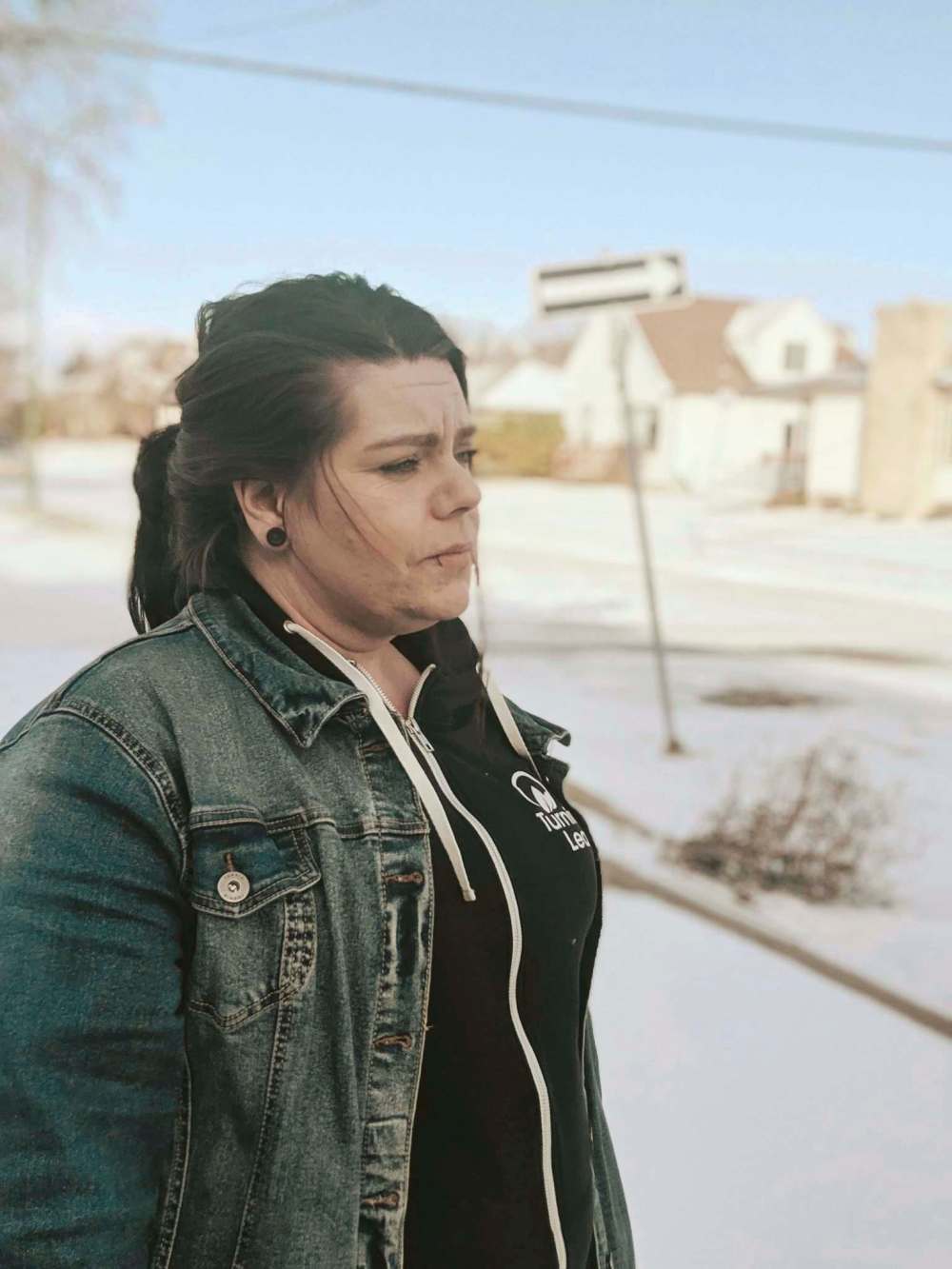
After starting Turning Leaf in 2005, the organization grew quickly. Today, Engel still works to ensure that as many people as possible know about Turning Leaf — either so that they can use available services, or so that they can support the organization.
“We are a charity,” Engel says. “We’re trying to engage people to think about being partners with us and that seems to be working well.”
For Granger, the best part about working at Turning Leaf is seeing participants succeed. She recalls assisting a young woman with a traumatic background and unhealthy family relationships. The woman was pregnant with her second child when Granger met her, and her goal was to finish high school.
Five years ago, Granger sat with the woman’s children at her graduation ceremony.

“It was an incredible moment of just pure joy to see her know that she can be what her children need, and that she can break the cycle of what her family was,” Granger says.
Those kinds of stories are what Turning Leaf is all about, adds Engel.
“We believe everyone can make the choice to change for the better, and we’re here to help them make those choices,” he says. “We’re here to help them turn over that new leaf.”
Visit turningleafservices.ca.
aaron.epp@gmail.com
Aaron Epp reports on business for the Free Press. After freelancing for the paper for a decade, he joined the staff full-time in 2024. Read more about Aaron.
Every piece of reporting Aaron produces is reviewed by an editing team before it is posted online or published in print — part of the Free Press‘s tradition, since 1872, of producing reliable independent journalism. Read more about Free Press’s history and mandate, and learn how our newsroom operates.
Our newsroom depends on a growing audience of readers to power our journalism. If you are not a paid reader, please consider becoming a subscriber.
Our newsroom depends on its audience of readers to power our journalism. Thank you for your support.
Student group hosting fundraiser
The University of Manitoba’s chapter of World University Service of Canada, a non-profit aimed at providing education, employment and empowerment to youth across the world, is hosting a fundraising event March 7 at the Canadian Museum for Human Rights. The event will feature professor Lori Wilkinson alongside former refugees Louise Simbandumwe and Daniel Mach, speaking about Canada’s response to global forced migration and their own experiences with the subject. There will be an opportunity for questions and discussion, as well as appetizers, drinks and raffle prizes. Tickets range from $25 to $40, plus fees, and are available at www.bit.ly/WUSCfundraiser.
The Duhks, Al Simmons helping to make poverty history
Make Poverty History Manitoba’s fourth annual fundraising concert takes place March 12 at the West End Cultural Centre. Hosted by Al Simmons, the concert will feature performances by the Duhks, Double the Trouble and Lana Winterhalt. All proceeds go to support the work of Make Poverty History Manitoba, which works toward a province without poverty through public education and advocating policy change. Advance tickets are available for $20 at ticketfly.com, the WECC or the Social Planning Council of Winnipeg. Tickets are available to people of limited means by visiting the Social Planning Council of Winnipeg or calling 204-943-2561.
Gluten-free information class
If you’ve been newly diagnosed with celiac disease, DH or just want help navigating a gluten-free lifestyle, you’re in luck. A free Gluten Free 101 information class is being held by the Manitoba chapter of the Canadian Celiac Association at the SMD Building, 203-825 Sherbrook St., March 12 from 7 p.m. to 9 p.m. Parking is free at the SMD lot on McDermot Avenue at Sherbrook. For information, call 204-772-6979 or email office@manitobaceliac.com.
Art auction fundraiser
The CNIB Foundation is holding its annual 20/20 Insight Gala and Art Auction on March 12. The event, being held at the RBC Convention Centre, will also honour Dr. Marilyn Ekins and Dr. Paul Shuckett and includes dinner, and live and a silent auction of artwork donated by local and national artists. Tickets start at $150, and can be purchased by contacting Glenda Gascoigne at 204-789-0947 or glenda.gascoigne@cnib.ca.
Fashion show to help ill children, families
It will be fashion in a Roaring Twenties environment helping seriously ill children and their families March 12. The 34th annual Hope Couture Fashion gala fundraiser for Ronald McDonald House Charities Manitoba is being held at the RBC Convention Centre. The evening features dinner, fast-dancing flappers with bob cuts, and a fashion runway show featuring outfits from local stores. For more information: Jolie-Anne Horn at 204-229-2724 or email jolie-anne@rmhmanitoba.org.
Laugh to help animals
You can laugh and help animals at the Brandon Humane Society. The Human Condition spring comedy tour features three comedians — Scott Porteous, Scott Belford and Adam Mac — performing in Brandon March 12, Oakbank on March 13 and Binscarth on March 14. For more information and tickets, visit facebook.com/thccomedytour.
BudSpud Fundraiser benefits autism programs
Enjoy a meal and help support programs for youth on the autism spectrum at the same time at the ninth annual BudSpud Fundraiser in support of OHEYS Autism Programs. The event takes place at Cowboys Roadhouse (1034 Elizabeth Rd.) on March 14 and supports the charity’s activity programs and summer camps. Tickets are $22 each and include a chicken dinner and drink. There will also be a silent auction, 50/50 draw and cookie sale. For tickets, email Leslie Candy at ccandygiants@hotmail.com or Bennetta Benson at OHEYSAutismPrograms@gmail.com.
Mood Disorders fundraiser
The 11th annual In the Mood fundraiser for the Mood Disorders Association of Manitoba is being held March 21. The fundraiser, in the Hotel Fort Garry’s Grand Ballroom, features dinner, dancing and an award honouring lawyer Maria Mitousis, who volunteers with numerous organizations. Tickets cost $200 and can be purchased by contacting executive director Colleen McDuff at 204-560-1462.
An evening with the King
Put on your blue suede shoes and head to Grace Christian Church on April 4 for Pembina Active Living’s fundraising concert. The event features Corny Rempel, an award-winning Elvis Presley tribute artist and comedian who is also known for his Johnny Cash impersonation. Pembina Active Living is a charitable organization in south Winnipeg that is committed to enhancing the lives of older adults. Tickets are $25 (cash or cheque) and can be reserved by emailing linda.rz@icloud.com, or purchase them online at pal55plus.ca.
Save date for Variety gala
Save the date for the 2020 Gold Heart fundraising gala for Variety, the Children’s Charity of Manitoba. The gala, honouring longtime Variety volunteer and supporter Louis Trepel, is taking place at the RBC Convention Centre May 2. Tickets are $300, and can be purchased by contacting atavares@varietymanitoba.com or going to varietymanitoba.com.
Rex Murphy speaking at JFM luncheon
Social commentator, editorialist and distinct Canadian voice Rex Murphy will be the keynote speaker at the 2020 Jewish Federation of Manitoba Luncheon at the RBC Convention Centre May 7. The event supports the JFM’s Women’s Endowment Fund, which generates financial resources for the benefit of organizations helping Manitoba women. Tickets for the event are $200 each and can be purchased by phoning 204-477-7520 or at JewishFoundation.org.
Aaron Epp reports on business for the Free Press. After freelancing for the paper for a decade, he joined the staff full-time in 2024. Read more about Aaron.
Every piece of reporting Aaron produces is reviewed by an editing team before it is posted online or published in print — part of the Free Press‘s tradition, since 1872, of producing reliable independent journalism. Read more about Free Press’s history and mandate, and learn how our newsroom operates.
Our newsroom depends on a growing audience of readers to power our journalism. If you are not a paid reader, please consider becoming a subscriber.
Our newsroom depends on its audience of readers to power our journalism. Thank you for your support.
Advertisement Advertise With Us
Advertisement Advertise With Us