

Essential service
Library visit offers powerful reminder about people and places, budgets and blunders

Advertisement
Read this article for free:
or
Already have an account? Log in here »
To continue reading, please subscribe:

Digital Subscription
One year of digital access for only $205*
- Enjoy unlimited reading on winnipegfreepress.com
- Read the E-Edition, our digital replica newspaper
- Access News Break, our award-winning app
- Play interactive puzzles
*First annual payment billed as $205.00 + GST for one year. This annual subscription will automatically renew at $233.00 + GST every 52 weeks (10% off the regular annual price of $259.35). Offer available to new and qualified returning subscribers only. Cancel any time.
To continue reading, please subscribe:
Add Free Press access to your Brandon Sun subscription for only an additional
$1 for the first 4 weeks*
- Enjoy unlimited reading on winnipegfreepress.com
- Read the E-Edition, our digital replica newspaper
- Access News Break, our award-winning app
- Play interactive puzzles
*Your next Brandon Sun subscription payment will increase by $1.00 and you will be charged $17.95 plus GST for four weeks. After four weeks, your payment will increase to $24.95 plus GST every four weeks.
Read unlimited articles for free today:
or
Already have an account? Log in here »
Hey there, time traveller!
This article was published 14/03/2020 (2308 days ago), so information in it may no longer be current.
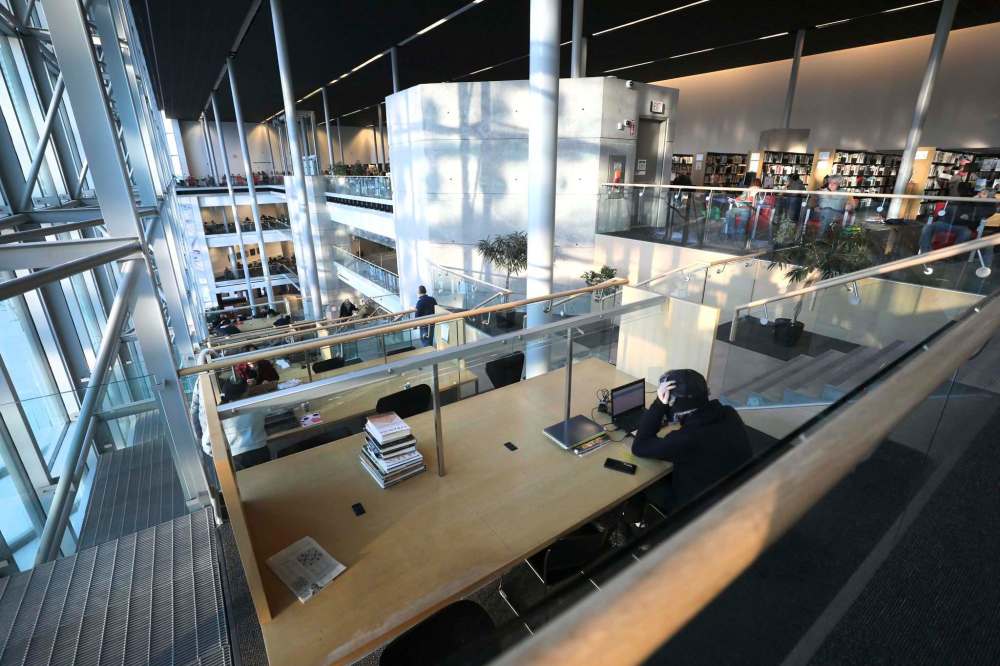
By any measure, the inner sanctum of the Millennium Library is beautiful. There is a clarity to the place, a sense of calm illuminated by the light that streams in from the four-storey glass panes, marking a juxtaposition of the orderly shelves of books and the contemplative open spaces where its users sit, and read, and linger.
It is beautiful and, also, so fragile. Each year, the Millennium Library alone records about a million visits, and yet somehow the folks in charge and many in the general public seem to not grasp its true value, or that of the wider library system. What a tragedy for something so useful to be so easily threatened.
This year, the city is proposing to chop $4.7 million from community services spending, a decision that includes slashing closing times by an hour and axing Sunday hours entirely at the six libraries that now keep them. It’s a walkback of a plan floated during consultations to close three libraries entirely. It still stings.
To understand what what will be lost, you can’t just think about a library. You have to visit. So after passing through the new security screening — a procedure that makes what is intended to be a warm public space feel only slightly more welcoming than a prison — I wander through the Millennium Library’s rows of books, thinking.
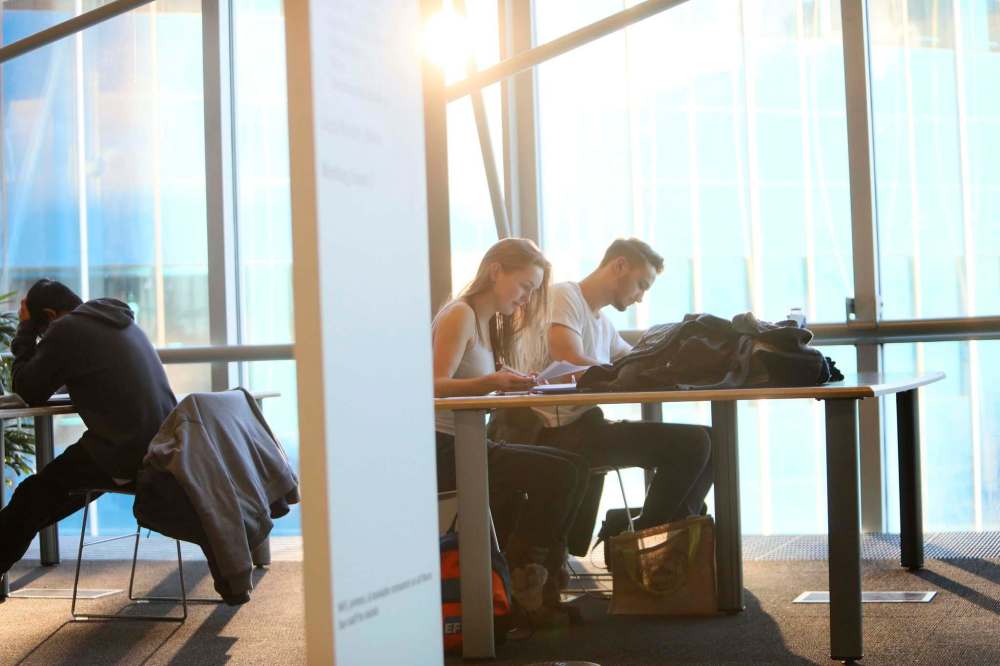
It is just after 3 p.m. on a Wednesday afternoon, and the library is busy. Nearly every seat at the tiers of desks that line the stairs is taken; so are all but five of 20 fourth-floor computers. There is a gentle music to the place: a shuffle of paper, the tickety-tack of fingers on keyboards, a murmur of voices from the floor below.
Everyone who comes here uses the library a little differently, it seems, but they all sink into it like a home.
A student hunches over her homework, nursing a thermos of coffee. A man with a wispy white beard chuckles as he watches a comedy movie on his laptop. A woman in her 20s curls up on a chair, absorbed in her iPad, her mukluks dangling over the armrest. A couple whispers as they share lunch from Tupperware containers.
In every corner of every floor, there are people reading, gathering, thinking, meeting. People print out resumés from computers; new Canadians peruse books for English-language learners. In the children’s area, a mother keeps her eye on a wandering toddler, while giant teddy bears in fantastical costumes pose on the shelves above.
All of this is, when you think about it, a remarkably orderly intersection of space and purpose, of use and potential. There are few public spaces that serve as many functions as a library, or meet as many key needs for such a wide range of people. It can be recreational, it can be informational, it can be a lifeline for vulnerable people.
Yet there is, perhaps, no public space that seems to be less understood, or less appreciated by non-users, or by the people who hold a city’s purse strings. That libraries across North America are so often threatened by cutbacks is a revealing statement about how non-users are completely in the dark about the value the institutions hold.
In 2017, a New York Observer columnist named Andre Walker learned this the hard way when he crafted what is arguably one of the most ignorant tweets of all time, a remarkable achievement in a very crowded field: “Nobody goes to libraries anymore,” he wrote. “Close the public ones and put the books in schools.”
He would come to regret this statement, and quickly. Thousands of users swarmed the tweet, from angry parents to even angrier librarians, and bombarded him with facts about libraries’ popularity. Faced with such overwhelming and evidence-based condemnation, Walker conceded defeat.
“Dear #Library users, I surrender!” he wrote, and deleted his original tweet.
The episode was, while entertaining, illustrative of the problem libraries face when it comes to their survival. To those who don’t use libraries, it is entirely too easy to slip into the conviction that “nobody” else does, either; ergo, they must be a useless space, or parasitic or at least one that shouldn’t be given priority for resources.
I understand this in a way, because though I’ve always supported strong library funding, I’d once forgotten them, too.
It’s hard to pinpoint when my passion for libraries ebbed. As a child, I camped out at the Pembina Trails Library for hours. My parents allowed me to take out adult books and so, at a questionably young age, I’d load my arms with paperback sci-fi and Stephen King novels: The Stand made an odd dent on my eight-year-old brain.
Back then, the library was a source of endless wonder. Without it, I may not have become a writer. Curiosity served as my compass and guide through the stacks, hopping from one interest to the next, lighting torches that still flicker inside me today. I soaked up books about space flight, and philosophy, and linguistics.
Yet as an adult, my interest in the library fell away. I’d started reading fewer books in my early 20s, drawn instead to the churn of magazine and newspaper journalism that arrived in my mailbox and, later, my phone every day. After a while I simply stopped going to the library and, eventually, I didn’t often think about them at all.
But in the spring of 2019, I signed up to take Japanese lessons from a tutor, who lived downtown and suggested meeting at the Millennium Library on Tuesday nights. It was a revelation; every time I walked up the stairs, I was fascinated to realize just how out-of-touch I’d become with its popularity, its purposes, its vitality.

Because to spend even one hour in a library is to have one’s eyes opened to how critical it is to our well-being. For every dollar spent, a library returns an immense benefit to a city and its people, including in ways that won’t always show up in the cold, hard math of budgets. To chip away at them is to chip away at our own potential.
Yet the libraries are now, if not on the chopping block, at least facing the chisel: a tightening of hours, a whole weekend day gone, which will especially impact working folks and families with kids in school. And in the same breath, the city plans to pump a extra $25 million into the road-repair budget.
Yeah, the roads in Winnipeg can be rocky. Yet we allow them to sprawl outwards each year, guaranteeing an ever-increasing drain on our resources, as if such a thing cannot be avoided. Yet these are choices made, and choices enabled by the public’s will — or lack thereof — to interrogate and resist them.
Given a choice, I’ll choose letting the libraries flourish, and hope that others won’t forget them.
melissa.martin@freepress.mb.ca
Melissa Martin
Reporter-at-large
Melissa Martin reports and opines for the Winnipeg Free Press.
Every piece of reporting Melissa produces is reviewed by an editing team before it is posted online or published in print — part of the Free Press‘s tradition, since 1872, of producing reliable independent journalism. Read more about Free Press’s history and mandate, and learn how our newsroom operates.
Our newsroom depends on a growing audience of readers to power our journalism. If you are not a paid reader, please consider becoming a subscriber.
Our newsroom depends on its audience of readers to power our journalism. Thank you for your support.
Melissa Martin
Reporter-at-large
Melissa Martin reports and opines for the Winnipeg Free Press.
Every piece of reporting Melissa produces is reviewed by an editing team before it is posted online or published in print — part of the Free Press‘s tradition, since 1872, of producing reliable independent journalism. Read more about Free Press’s history and mandate, and learn how our newsroom operates.
Our newsroom depends on a growing audience of readers to power our journalism. If you are not a paid reader, please consider becoming a subscriber.
Our newsroom depends on its audience of readers to power our journalism. Thank you for your support.
Advertisement Advertise With Us
Advertisement Advertise With Us