Building on bravery Canadians among those coming together to help Ukrainian villagers salvage their homes — and hope — from the wreckage of war
Read this article for free:
or
Already have an account? Log in here »
To continue reading, please subscribe:

Digital Subscription
One year of digital access for only $205*
- Enjoy unlimited reading on winnipegfreepress.com
- Read the E-Edition, our digital replica newspaper
- Access News Break, our award-winning app
- Play interactive puzzles
*First annual payment billed as $205.00 + GST for one year. This annual subscription will automatically renew at $233.00 + GST every 52 weeks (10% off the regular annual price of $259.35). Offer available to new and qualified returning subscribers only. Cancel any time.
To continue reading, please subscribe:
Add Free Press access to your Brandon Sun subscription for only an additional
$1 for the first 4 weeks*
- Enjoy unlimited reading on winnipegfreepress.com
- Read the E-Edition, our digital replica newspaper
- Access News Break, our award-winning app
- Play interactive puzzles
*Your next Brandon Sun subscription payment will increase by $1.00 and you will be charged $17.95 plus GST for four weeks. After four weeks, your payment will increase to $24.95 plus GST every four weeks.
Read unlimited articles for free today:
or
Already have an account? Log in here »
Hey there, time traveller!
This article was published 21/04/2023 (1265 days ago), so information in it may no longer be current.
HORENKA, Ukraine — When the war came to Horenka, a quiet village on the outskirts of Kyiv, Nataliya Sheynich fled her home, but she didn’t go far. For 20 days, she lived in a basement in a neighbouring town, sheltering from the battles that raged as Russian troops pushed towards Ukraine’s capital. Sometimes, when the shelling subsided, she would venture out of hiding and walk for hours back to her house, passing incredulous Ukrainian soldiers.
“Why are you going there?” they’d say. “There’s no point. The fighting is bad.”
Still, Sheynich pushed forward. She needed to check on her cats, she told them, and also on her property, which is all she has in the world. It’s been home to her family since 1874, just a narrow strip of land with a long garden that slopes toward a verdant valley. It had been partly destroyed in the Second World War when the Nazis invaded; but her father rebuilt it, raising a cosy house, a cottage, and several small barns with his own hands.
MELISSA MARTIN / WINNIPEG FREE PRESS Nataliya Sheynich cleans up debris around her home in the Kyiv region, as volunteers with Brave to Rebuild work on tearing down and removing rubble of buildings destroyed last year by shelling.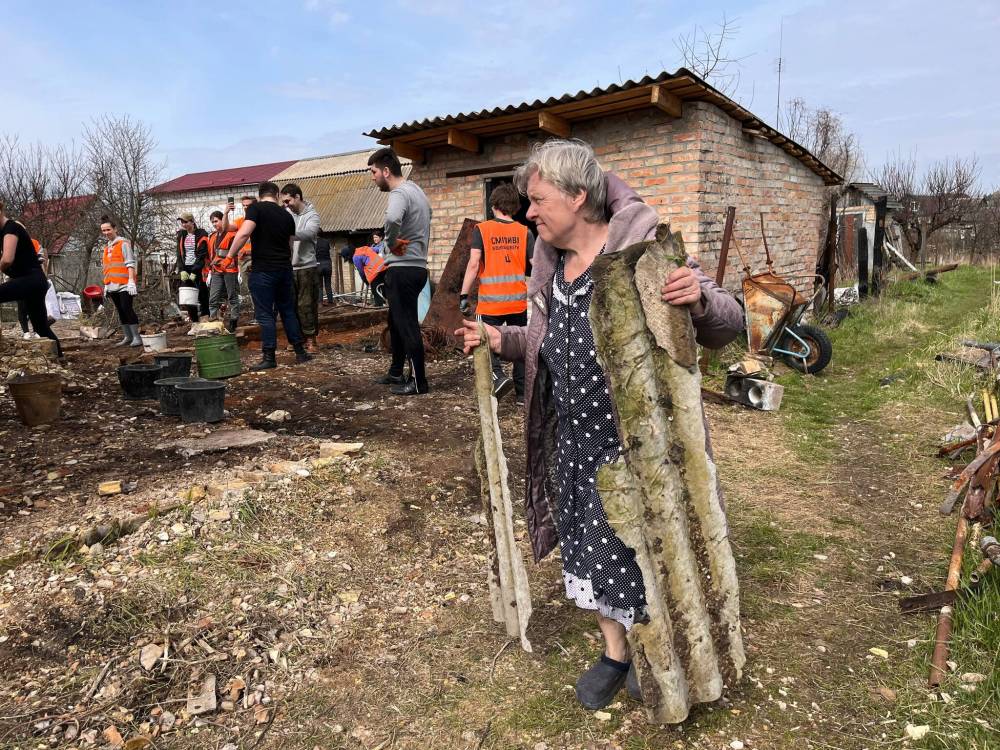
Now, war had ravaged that home again. When Russian troops retreated from the Kyiv region in April 2022, Sheynich returned to a scene of destruction. The humble house where she lives had survived, but the rest lay blasted by shelling, a swath of broken glass and scorched rubble. The first time Sheynich saw the damage, she felt strangely calm: it was what she expected.
For the next year, Sheynich lived alone in the wreckage. Her neighbours complained about the eyesore — their property had not been so badly affected — but there was little Sheynich could do. She would never rebuild, she thought: she’s too old, and she doesn’t have money, and the Ukrainian government, strained by the massive resource demands of war, can’t offer much.
Besides, she decided, she was lucky. She had a house, where some of her neighbours did not. Still, every day, she walked past the mangled remains of the things her father had built and felt grief tying a knot in her throat: she lived in a museum of the violence that had struck her home.
Then this spring, a ray of hope arrived on her property, by the name of Brave to Rebuild.
It’s a sunny Saturday afternoon in early April. In Sheynich’s yard, 20 volunteers in bright orange work vests pick through the rubble, bashing at ruined walls with sledgehammers and scooping debris with shovels and gloved hands. They save what little they can, setting twisted metal and undamaged bricks into piles to be recycled. But most of the wreckage is heaved onto the back of an old Soviet-made truck, to be dumped somewhere outside of town.
The volunteers are young, mostly in their early 20s, so the mood in Sheynich’s yard is upbeat. A portable speaker blasts ’80s British rock and Ukrainian pop, and the volunteers dance with shovels and tease each other about how hard — or not — they’re working. Most of them are Ukrainian, except two: there is Tonko Ihnat, a 58-year-old Toronto man who has spent the last year running humanitarian aid in Ukraine, and Will Lazarenko, a 22-year-old Winnipegger who is making his eighth outing with Brave to Rebuild.
MELISSA MARTIN / WINNIPEG FREE PRESS Nataliya Sheynich and Brave to Rebuild coordinator Alyona pause to consider an object found buried in the rubble of Sheynich’s home. Volunteers were initially concerned the object appeared to be an unexploded mortar shell, but it was soon found to be safe and work resumed.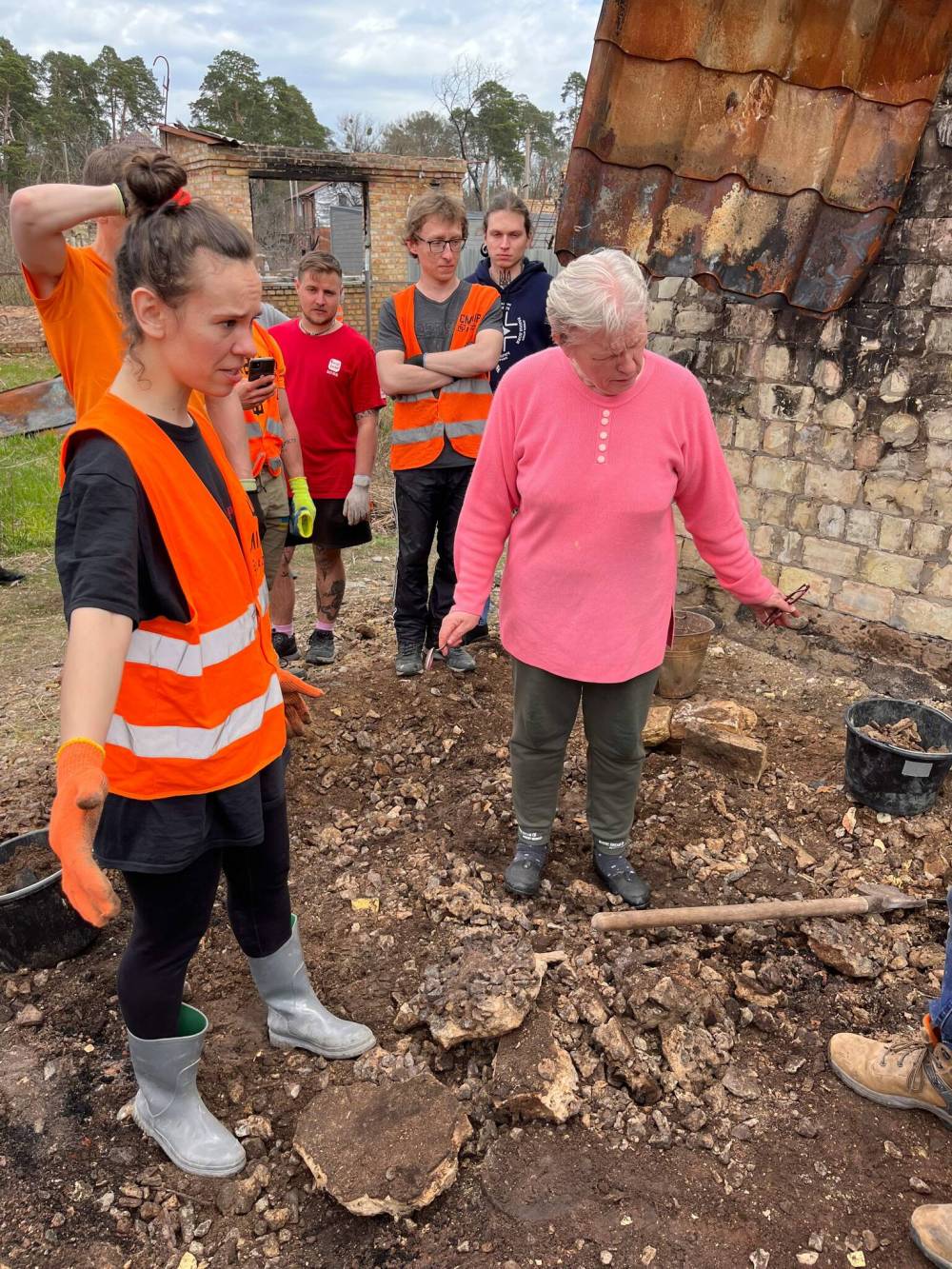
Lazarenko, a University of Manitoba student, found the group through word of mouth. He’d spent a month in Poland, volunteering at a shelter for displaced Ukrainians near the border, before coming to Kyiv in mid-March to help out with Dobrobat, another Ukrainian rebuilding charity. As he chatted with volunteers there, they told him about another way to help, a fun group that went out mostly on weekends.
What he found, in Brave to Rebuild, is as much a community as a work crew. Every Saturday and Sunday morning, dozens of volunteers meet near a metro station on the western edge of Kyiv, waiting to squeeze into buses that will drive them to the villages. They greet each other warmly, recognizing new friends from past trips. The young Ukrainians are eager to practise English with the handful of foreigners; they often meet for drinks after the work day is over.
“It was nice to be able to talk with almost everyone there, which is important for me because as much as I’m volunteering to help and rebuild, I do have my own personal curiosity,” says Lazarenko, whose grandparents immigrated from Ukraine. “Volunteering alongside the Ukrainians who are in my age group is special, because it almost feels like my people in a way, but also people who have lived totally different lives than me. It’s really easy to connect right away, and start a conversation, and really feel like you’re a part of that community.”
“Volunteering alongside the Ukrainians who are in my age group is special, because it almost feels like my people in a way, but also people who have lived totally different lives than me.”–Will Lazarenko, volunteer with Brave to Rebuild
That youthful energy, Brave to Rebuild co-founder Alyona Krytsuk says, is key to the organization’s success, both with volunteers and the people whose homes they repair.
“When you have damaged house and you don’t have any help, it’s very demotivating, it’s very depressive,” Krytsuk says. “Especially if all your life you were in that house. Now… we (hear) from them that they felt hope. They felt hope that ‘young people came to my home. They were active, they were smiling, there was this atmosphere.’ And they thought, ‘I believed and I want to stay here.’ They were more motivated to do something.”
The seed of that hope was planted in May 2022, as Kyiv’s residents came to grips with the sheer scale of destruction around the capital. At the time, Krytsuk, a 34-year-old marketing executive, and a colleague wanted to find a way to help, but the bombed apartment towers they saw in the suburban cities of Bucha and Irpin loomed overwhelming.
“We thought everything was so bombed you can do nothing, because it was so dramatic,” Krytsuk says. “I thought that everything can be cleaned only by (Ukraine’s State Emergency Service) or some other official structures with (heavy machinery).”
But as they passed through ravaged villages like Horenka — mostly clusters of simple brick-and-plaster homes, often built by the residents themselves — they had an idea. That rubble could be cleaned up without cranes or engineers, but with so much of Ukraine’s labour tied up with the country’s infrastructure and defence, nobody was coming to help the villagers.
Yet there are a lot of young people in Kyiv who are struggling with the emotional weight of the war, trying to find their role in a traumatized country. And since it was those villages where the battle of Kyiv was decided, Krytsuk thought, then the capital’s youth should restore them.
“We feel very responsible for this, because we were not damaged. Kyiv was damaged only by missiles. There was no invasion in Kyiv, because all these people stopped it by their houses.”–Alyona Krytsuk, Brave to Rebuild co-founder
“We feel very responsible for this, because we were not damaged,” Krytsuk says. “Kyiv was damaged only by missiles. There was no invasion in Kyiv, because all these people stopped it by their houses.”
Their first mission was small, just four people piled into Krytsuk’s car, clearing rubble from a damaged home. But word spread quickly, driven by youthful volunteers who took to running active social media accounts, including a TikTok and Instagram pages in both Ukrainian and English. By October, Brave to Rebuild had around 200 volunteers each weekend, working on as many as 15 ruined objects — houses, barns or schools — at once.
As the organization grew, they kept that easygoing spirit. Most of Brave to Rebuild’s outings are on weekends, to fit around school or work schedules. The sign-up is casual, designed to be accessible both to Ukrainian youth and visiting foreigners: folks can go on as many, or as few, trips as they want. Some come out just once, while others have done 15 or more trips.
Today, over 4,500 people subscribe to Brave to Rebuild’s volunteer channel on Telegram, and around 2,000 have worked on at least one object. Last year, they repaired or cleared out over 400 objects, which sounds like a lot, until you remember that Ukraine’s government estimates that over 147,000 private houses have been destroyed in the full-scale invasion, and cleaning just one can take hundreds of person-hours of manual labour.
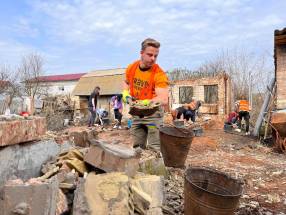
MELISSA MARTIN / WINNIPEG FREE PRESS University of Manitoba student William Lazarenko, 22, clears rubble from the ruins of Nataliya Sheynich’s home, which was partly destroyed last year during battles in the Kyiv region of Ukraine. Lazarenko was volunteering with Brave to Rebuild, a Ukrainian NGO. 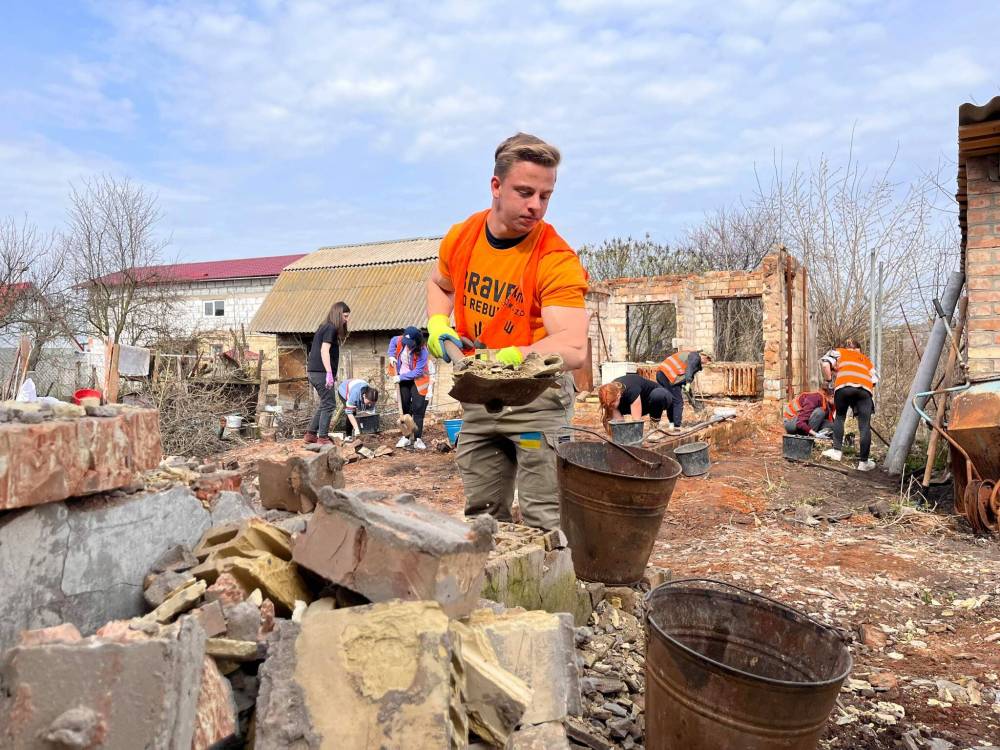
To meet that challenge, Brave to Rebuild needs more money, and more people. They are about to expand to other regions, planning chapters in Chernihiv, Kharkiv, Mykolaiv, and — when it is safer — Kherson. Each chapter will need to buy supplies, such as shovels and gloves, and pay for transportation. Krytsuk hopes more foreigners will come; as long as you can wield a shovel or carry a bucket, you can help a Brave to Rebuild crew.
Krytsuk is also interested in connecting with members of the Ukrainian diaspora who can offer professional guidance “to do things the right way,” she says. Because in what Brave to Rebuild has started, she sees potential that goes beyond clearing rubble. It’s about crafting a future for a generation that came of age in a pandemic, and must now inherit a nation battered by war.
“There are a lot of things they can’t do,” she says. “They don’t have the (activities) in their universities, they don’t have the parties that we had in our youth, they are living in a totally different situation. So we want… to build a community of people who want to be involved in the rebuilding of Ukraine. We need not only people from government and big organizations… we need local initiatives.
“Something that is talked about at the highest levels needs to be done at the local levels to work. Starting from these ruins is a good platform to develop that community, and develop these youth, because they will grow up in a Ukraine that will be recovering. We can prepare a generation who can be responsible for that rebuilding.”
Back at Sheynich’s house, the afternoon is growing long. The volunteers break for lunch, which Sheynich brings out in big pots: there is homemade chicken soup and rice, and slices of sweet paska Easter bread. Despite working for six hours, the crew will not finish clearing all the rubble today; there are several walls and piles of charred debris left for another group to cart away.
Still, Sheynich says, as she watches the scars of war fade from her home, she feels happy.
Anyone interested in supporting Brave to Rebuild, or volunteering, can contact them through social media, including @brave.to.rebuild (Ukrainian) and @brave.to.rebuild_eng (English) on Instagram. Donations can be sent via PayPal to selykv@gmail.com.
doubleemmartin@gmail.com

Melissa Martin
Reporter-at-large
Melissa Martin reports and opines for the Winnipeg Free Press.
Every piece of reporting Melissa produces is reviewed by an editing team before it is posted online or published in print — part of the Free Press‘s tradition, since 1872, of producing reliable independent journalism. Read more about Free Press’s history and mandate, and learn how our newsroom operates.
Our newsroom depends on a growing audience of readers to power our journalism. If you are not a paid reader, please consider becoming a subscriber.
Our newsroom depends on its audience of readers to power our journalism. Thank you for your support.