

Ever-changing labour laws make Manitoba unstable place to invest

Advertisement
Read this article for free:
or
Already have an account? Log in here »
To continue reading, please subscribe:

Digital Subscription
One year of digital access for only $205*
- Enjoy unlimited reading on winnipegfreepress.com
- Read the E-Edition, our digital replica newspaper
- Access News Break, our award-winning app
- Play interactive puzzles
*First annual payment billed as $205.00 + GST for one year. This annual subscription will automatically renew at $233.00 + GST every 52 weeks (10% off the regular annual price of $259.35). Offer available to new and qualified returning subscribers only. Cancel any time.
To continue reading, please subscribe:
Add Free Press access to your Brandon Sun subscription for only an additional
$1 for the first 4 weeks*
- Enjoy unlimited reading on winnipegfreepress.com
- Read the E-Edition, our digital replica newspaper
- Access News Break, our award-winning app
- Play interactive puzzles
*Your next Brandon Sun subscription payment will increase by $1.00 and you will be charged $17.95 plus GST for four weeks. After four weeks, your payment will increase to $24.95 plus GST every four weeks.
Read unlimited articles for free today:
or
Already have an account? Log in here »
Hey there, time traveller!
This article was published 08/03/2024 (949 days ago), so information in it may no longer be current.
Manitoba needs a labour truce.
But not between business and unions; rather it needs to involve the two political parties that alternately run this province.
The NDP and the Progressive Conservatives have taken turns governing Manitoba since the late 1960s, each bringing their own ideological bent to the legislative assembly and the cabinet room. There are some fundamental differences between the two parties: one a left-leaning, social justice-minded organization with a preference for public-sector services; the other a pro-business, market-oriented one influenced by a tinge of social conservatism.
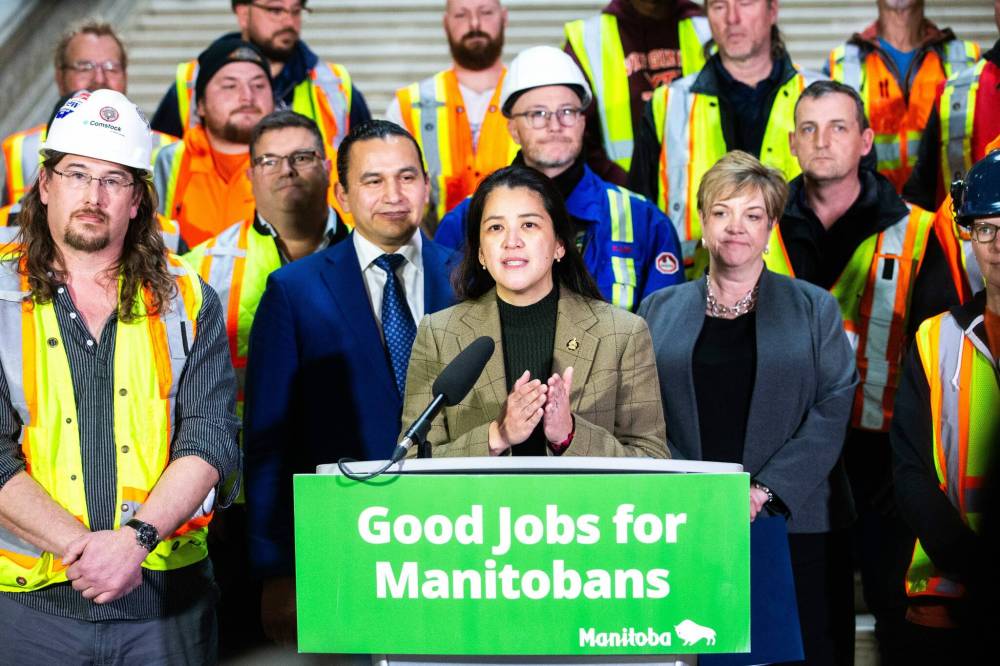
MIKAELA MACKENZIE / FREE PRESS FILES
Manitoba Labour Minister Malaya Marcelino introduced a bill Wednesday to repeal the ban on terms and conditions for labour on large-scale projects enacted by the previous PC government.
Those contrasts come into sharper focus each time there is a change in government. But they are shaped more by the style and philosophies of the leader of the day than by party constitution. Both the NDP and Tories have balanced the books, cut taxes and contracted out services to the private sector. Each has run deficits, raised taxes and protected public-sector services.
Contrary to conventional wisdom, ideology doesn’t drive every decision on Broadway. Political observers were surprised, for example, when former Tory premier Gary Filmon nationalized Centra Gas in the 1990s. They were equally shocked when former NDP premier Greg Selinger privatized the province’s property registry in 2012. Perception and reality don’t always align in Manitoba politics.
Part of the reason for that is the moderate brand of politics in Manitoba. Neither party can afford to venture too far down their respective ideological rabbit holes. They do so at their peril. Consequently, there is more that binds them than sets them apart.
Except when it comes to labour laws. There is no contrast more pronounced between the two parties than how each views — and treats — unionism, collective bargaining and employment standards. On that front, it is all-out political warfare.
One of the reason for that is unions form part of the NDP’s constitution. They have an official seat at the table, including voting rights. That’s not lost on the Tories who, for the most part, see organized labour as the enemy.
It’s against that backdrop that labour laws in Manitoba are made and, unfortunately, frequently altered.
One of the first things the Tories and NDP do when they get back into power is reverse the labour law changes made by the previous government. When the NDP made it easier in the early 2000s to form unions by eliminating mandatory secret-ballot certification votes, the Tories reversed it after they won government in 2016. It appears the NDP plans to change it back again.
When the NDP brought in project labour agreements in the early 2000s, where terms and conditions on large-scale projects are set for all workers (unionized and non-unionized), the Tories subsequently banned them.
Now the NDP is bringing them back again. Labour Minister Malaya Marcelino introduced a bill Wednesday that would repeal the ban.
And so goes the revolving door of labour laws in Manitoba.
The problem: it causes uncertainty and instability in the marketplace. Businesses want to know what the rules of the game are before they make major investments in a province (Premier Wab Kinew’s proverbial “economic horse that pulls the social cart”).
When those rules change as frequently as labour laws do in Manitoba, some investments go elsewhere. It’s impossible to gauge the opportunity cost of that because CEOs don’t make announcements about why they didn’t pick Manitoba to invest their capital. They just quietly move their assets elsewhere.

So what’s the solution? There isn’t one really, other than to ponder the far-fetched idea of convening a labour-relations summit made up of representatives of labour, business and political parties to try to come up with a labour manifesto both parties could live with.
Naturally it wouldn’t, and couldn’t, be binding on future governments. But it could serve as a guiding document to which future governments would have to be answerable.
It would have to be a compromise, just like collective bargaining: project labour agreements in exchange for secret-ballot certification votes; anti-scab legislation in exchange for less-onerous decertification rules. Whatever. It would have to be a give-and-take, check-your-ideology-at-the-door summit chaired by a neutral party.
If successful, it would be a signal to the marketplace that Manitoba has stable labour laws and that it’s open for business. A pipe dream? Probably. But if not that, then what? The status quo is untenable.
tom.brodbeck@freepress.mb.ca
Tom Brodbeck is an award-winning author and columnist with over 30 years experience in print media. He joined the Free Press in 2019. Born and raised in Montreal, Tom graduated from the University of Manitoba in 1993 with a Bachelor of Arts degree in economics and commerce. Read more about Tom.
Tom provides commentary and analysis on political and related issues at the municipal, provincial and federal level. His columns are built on research and coverage of local events. The Free Press’s editing team reviews Tom’s columns before they are posted online or published in print – part of the Free Press’s tradition, since 1872, of producing reliable independent journalism. Read more about Free Press’s history and mandate, and learn how our newsroom operates.
Our newsroom depends on a growing audience of readers to power our journalism. If you are not a paid reader, please consider becoming a subscriber.
Our newsroom depends on its audience of readers to power our journalism. Thank you for your support.
Tom Brodbeck is an award-winning author and columnist with over 30 years experience in print media. He joined the Free Press in 2019. Born and raised in Montreal, Tom graduated from the University of Manitoba in 1993 with a Bachelor of Arts degree in economics and commerce. Read more about Tom.
Tom provides commentary and analysis on political and related issues at the municipal, provincial and federal level. His columns are built on research and coverage of local events. The Free Press’s editing team reviews Tom’s columns before they are posted online or published in print – part of the Free Press’s tradition, since 1872, of producing reliable independent journalism. Read more about Free Press’s history and mandate, and learn how our newsroom operates.
Our newsroom depends on a growing audience of readers to power our journalism. If you are not a paid reader, please consider becoming a subscriber.
Our newsroom depends on its audience of readers to power our journalism. Thank you for your support.
Advertisement Advertise With Us
Advertisement Advertise With Us