Reconciliation about moving forward by looking back, not about guilt or shame
Read this article for free:
or
Already have an account? Log in here »
To continue reading, please subscribe:

Digital Subscription
One year of digital access for only $205*
- Enjoy unlimited reading on winnipegfreepress.com
- Read the E-Edition, our digital replica newspaper
- Access News Break, our award-winning app
- Play interactive puzzles
*First annual payment billed as $205.00 + GST for one year. This annual subscription will automatically renew at $233.00 + GST every 52 weeks (10% off the regular annual price of $259.35). Offer available to new and qualified returning subscribers only. Cancel any time.
To continue reading, please subscribe:
Add Free Press access to your Brandon Sun subscription for only an additional
$1 for the first 4 weeks*
- Enjoy unlimited reading on winnipegfreepress.com
- Read the E-Edition, our digital replica newspaper
- Access News Break, our award-winning app
- Play interactive puzzles
*Your next Brandon Sun subscription payment will increase by $1.00 and you will be charged $17.95 plus GST for four weeks. After four weeks, your payment will increase to $24.95 plus GST every four weeks.
Read unlimited articles for free today:
or
Already have an account? Log in here »
Hey there, time traveller!
This article was published 26/09/2024 (720 days ago), so information in it may no longer be current.
One of the most frequent questions I get when writing about Indigenous issues is: why do we have to keep talking about the harm inflicted on First Nations, Métis and Inuit people? Does it solve anything? Is it merely an exercise in collective guilt?
Those questions are usually based on a misunderstanding of what reconciliation means. Many Canadians often don’t understand why a specific day, week or month is set aside to acknowledge and reflect on Canada’s mistreatment of Indigenous people, such as Orange Shirt Day (also known as the National Day for Truth and Reconciliation), which takes place Monday. They often think those commemorative dates, or reconciliation generally, is about shaming non-Indigenous people.
It isn’t.
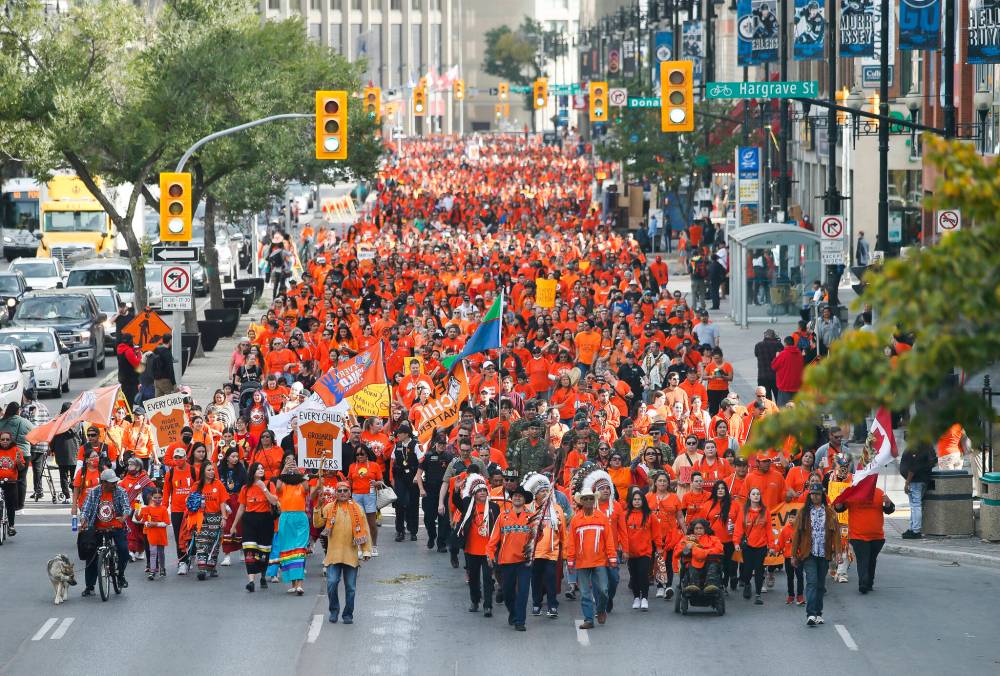
JOHN WOODS / THE CANADIAN PRESS FILES
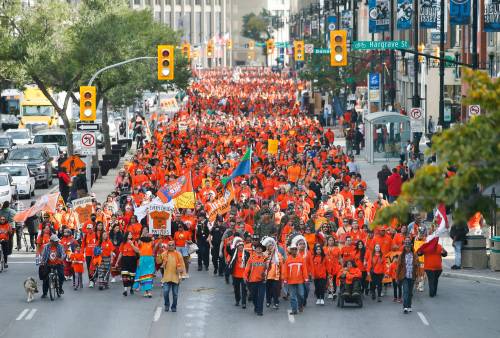
September 30 marks the National Day for Truth and Reconciliation.
Reconciliation is not about guilt. It’s about trying to find a more positive path forward, one that allows Indigenous and non-Indigenous people to live together in a spirit of mutual respect. It’s about having a better understanding of how past and current harms inflicted on Indigenous people have shaped the social and economic inequities that exist today. That is not always well understood in Canada. As a country, we need to do a better job of explaining it.
Perhaps the Truth and Reconciliation Commission said it best in its 2015 report:
“Reconciliation is about establishing and maintaining a mutually respectful relationship between Aboriginal and non-Aboriginal peoples in this country. In order for that to happen, there has to be awareness of the past, acknowledgement of the harm that has been inflicted, atonement for the causes, and action to change behaviour.”
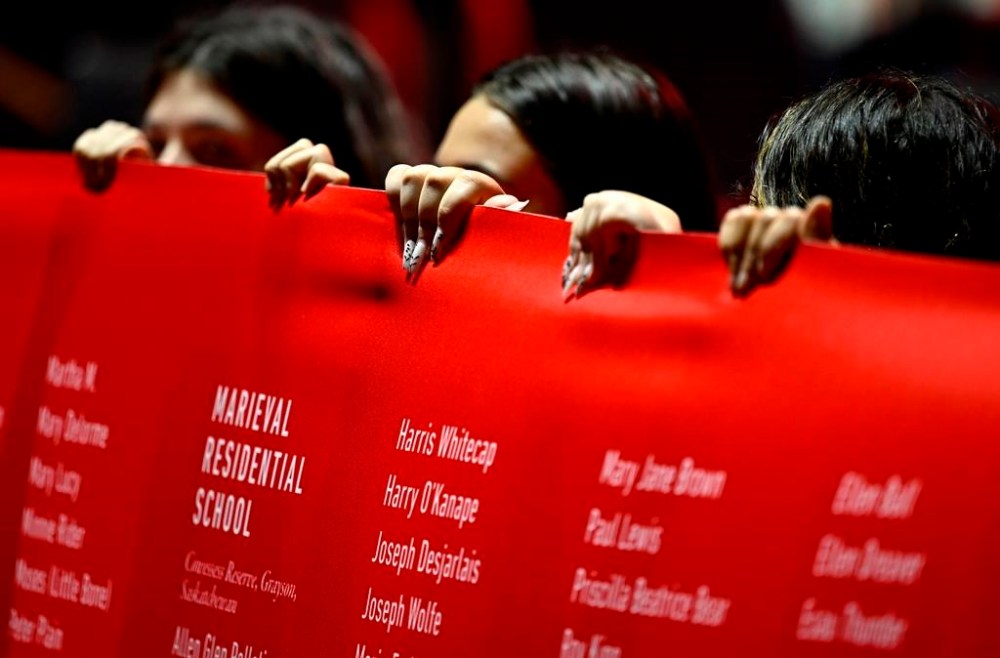
That’s not a shaming exercise. It’s a positive one that ultimately seeks solutions to improve the lives of Indigenous people who have been marginalized and mistreated for decades, including through residential schools, which attempted to assimilate Indigenous people into white society against their will.
“Too many Canadians know little or nothing about the deep historical roots of these conflicts,” the commission wrote. “This lack of historical knowledge has serious consequences for First Nations, Inuit, and Métis peoples, and for Canada as a whole. In government circles, it makes for poor public policy decisions. In the public realm, it reinforces racist attitudes and fuels civic distrust between Aboriginal peoples and other Canadians.”
So we need to learn, reflect and learn some more, not just on Monday but every day. That’s why we keep writing and talking about it.
We also need to become more aware of the positive impacts Indigenous people have had on Canada and how they, as distinct groups of people, have shaped the country we now live in. That includes the negotiation of historic and modern-day treaties and the role the Red River Métis played in Manitoba’s entry into Canada.
“We need to learn, reflect and learn some more, not just on Monday but every day.”
“Too many Canadians still do not know the history of Aboriginal peoples’ contributions to Canada, or understand that by virtue of the historical and modern treaties negotiated by our government, we are all treaty people,” the commission wrote. “History plays an important role in reconciliation; to build for the future, Canadians must look to and learn from the past.”
We are all treaty people because all Canadians, Indigenous and non-Indigenous, are party to those constitutionally protected agreements, which have the force of law today.
Most Canadians are just beginning to learn about those issues and how the historical and present-day harms inflicted on Indigenous people have shaped, and continue to influence, the society we live in today.
It’s a learning process and its purpose is to effect positive change and to generate concrete solutions (such as returning sovereignty and economic control to Indigenous communities, which they never agreed to relinquish in the first place). That will take time, indeed generations.
“Reconciliation must support Aboriginal peoples as they heal from the destructive legacies of colonization that have wreaked such havoc in their lives,” the commission wrote. “But it must do even more. Reconciliation must inspire Aboriginal and non-Aboriginal peoples to transform Canadian society so that our children and grandchildren can live together in dignity, peace, and prosperity on these lands we now share.”

That was supposed to be the objective a century-and-a-half ago when the first numbered treaties were negotiated between First Nations and the Crown in the late 1800s, and when the Red River Métis negotiated the terms of the Manitoba Act with the federal government in 1870.
Instead, colonial governments largely reneged on the terms and spirit of those agreements and attempted to eliminate Indigenous people as a distinct group within Canada. Today we are dealing with the fallout from that.
As the Truth and Reconciliation Commission has said, though, that can change and must change. Canadians — Indigenous and non-Indigenous — have the power, the compassion and the willingness to do the heavy lifting required to transform the society we live in.
That’s why we keep writing and talking about it. And it’s why a day like Monday is set aside to reflect on all of those issues and to remind ourselves of the momentous tasks ahead.
tom.brodbeck@freepress.mb.ca

Tom Brodbeck is an award-winning author and columnist with over 30 years experience in print media. He joined the Free Press in 2019. Born and raised in Montreal, Tom graduated from the University of Manitoba in 1993 with a Bachelor of Arts degree in economics and commerce. Read more about Tom.
Tom provides commentary and analysis on political and related issues at the municipal, provincial and federal level. His columns are built on research and coverage of local events. The Free Press’s editing team reviews Tom’s columns before they are posted online or published in print – part of the Free Press’s tradition, since 1872, of producing reliable independent journalism. Read more about Free Press’s history and mandate, and learn how our newsroom operates.
Our newsroom depends on a growing audience of readers to power our journalism. If you are not a paid reader, please consider becoming a subscriber.
Our newsroom depends on its audience of readers to power our journalism. Thank you for your support.