

Riel was concerned about the rights of all people on the land that became Manitoba

Advertisement
Read this article for free:
or
Already have an account? Log in here »
To continue reading, please subscribe:

Digital Subscription
One year of digital access for only $205*
- Enjoy unlimited reading on winnipegfreepress.com
- Read the E-Edition, our digital replica newspaper
- Access News Break, our award-winning app
- Play interactive puzzles
*First annual payment billed as $205.00 + GST for one year. This annual subscription will automatically renew at $233.00 + GST every 52 weeks (10% off the regular annual price of $259.35). Offer available to new and qualified returning subscribers only. Cancel any time.
To continue reading, please subscribe:
Add Free Press access to your Brandon Sun subscription for only an additional
$1 for the first 4 weeks*
- Enjoy unlimited reading on winnipegfreepress.com
- Read the E-Edition, our digital replica newspaper
- Access News Break, our award-winning app
- Play interactive puzzles
*Your next Brandon Sun subscription payment will increase by $1.00 and you will be charged $17.95 plus GST for four weeks. After four weeks, your payment will increase to $24.95 plus GST every four weeks.
Read unlimited articles for free today:
or
Already have an account? Log in here »
Hey there, time traveller!
This article was published 14/02/2025 (593 days ago), so information in it may no longer be current.
Louis Riel is well-known for his role in protecting the rights of Métis people when he led a resistance against the Canadian government in 1869-70.
But what a lot of people may not know about the fiery Métis leader is that he was instrumental in gaining rights for everyone living in the Red River Settlement and surrounding area, including non-Métis citizens, when Canada sought to unilaterally expand its jurisdiction westward.
History has been slow to recognize that about Riel. But it is one of the many reasons Manitoba now celebrates Louis Riel Day on the third Monday of February.
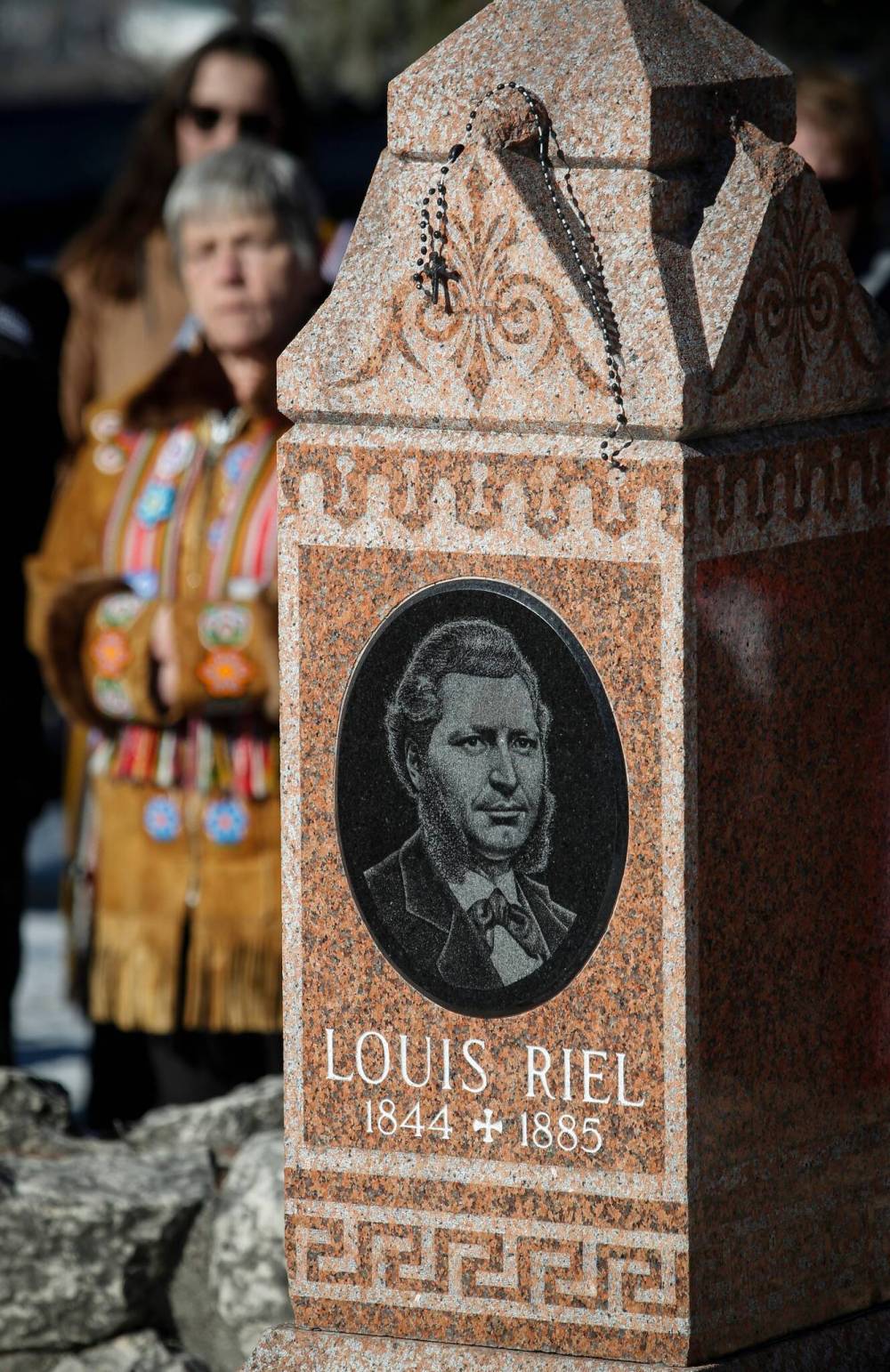
JOHN WOODS / FREE PRESS FILES
Louis Riel’s gravesite at the St. Boniface Cathedral.
There’s little doubt Riel’s main focus during the Red River Resistance was to preserve the language and religious rights of French-speaking Métis. But he was equally passionate about protecting the land, economic, political and language rights of everyone, including First Nations people, in what was then Rupert’s Land.
That’s why almost immediately after blocking lieutenant-governor designate William McDougall at the U.S. border in late October 1869 and seizing Upper Fort Garry (in what is now downtown Winnipeg at the corner of Broadway and Main Street), Riel invited representatives from all parishes in the area — including First Nations Chief Henry Prince of the St. Peter’s band — to attend “national committee” meetings. It was the precursor of the first provisional government established in Red River.
Riel’s objective was to find consensus among all citizens of Red River, Métis and non-Métis, on how to negotiate with Canada to ensure everyone’s rights were protected before joining Confederation.
The vast majority of the approximately 12,000 people living in the Red River Settlement at the time were either French-speaking or English-speaking Métis. But there were others, including Scottish settlers, English-speaking people from Ontario and elsewhere, non-Métis French settlers and First Nations people (living primarily in the surrounding area).
Riel sought to ensure that Canada, which had just purchased Rupert’s Land from the Hudson’s Bay Company without consulting the people who lived there, didn’t just waltz in and take over.
It was the driving force behind the armed resistance, which included taking political prisoners and later resulted in the execution of Thomas Scott, one of a small group of anti-French, anti-Catholic Loyalist Canadians from Ontario who opposed Riel and the resistance.
Not everyone in the settlement agreed with Riel’s methods at first. But the initial meetings were well-attended by representatives from most parishes.
“My dear fellow citizens, because of our attachment to British institutions which we respect as you do, let us not wait together until our liberties pass to alien power,” Riel said during his opening remarks at the first meeting. “Let us not wait to claim them, until they may be in other hands.”
There was vigorous debate at the meetings. Riel did not get the support of English-speaking delegates, including the Anglophone Métis, during the early stages of the resistance. Some English delegates characterized the resistance an act of disloyalty to the British Crown and accused the French-Métis of sedition for seizing Upper Fort Garry.
Riel disagreed. The resistance was not against the British Crown, he argued, it was against Canada and the HBC, which sought to unilaterally annex Rupert’s Land.
“If we rebel against the company which sold us and against Canada which wishes to buy us, we do not rebel against the English government,” Riel told the delegates. “We wish that the people of Red River be a free people. Let us help one another.”
Undaunted, Riel and his supporters (without the support of the English delegates) penned the first of what would be a series of “list of rights,” the conditions under which they would agree to join Canada. That included a demand that the federal government negotiate treaties with First Nations – a condition that was part of every version of the list of rights (including the final one delegates brought to Ottawa to negotiate what would become the Manitoba Act).
Riel eventually gained the support of his English-speaking counterparts about two months later, in January 1870. He was instrumental in creating the “Convention of 40” following two days of mass meetings outdoors. They were the largest meetings ever held in the settlement, attended by about 1,000 people each day in bone-chilling temperatures inside the walls of Upper Fort Garry. The proceedings were translated into French, English and Cree.
Throughout, Riel always spoke of preserving the rights of all people in the settlement.

“As soon as we understood each other, we joined in demanding what our English fellow subjects in common with us believe to be our just rights,” Riel, only 25 years old at the time, said in an impassioned speech. “I am not afraid to say our rights, for we all have rights.”
It was Riel who insisted Manitoba join Canada as a province with an elected legislative assembly, not a territory as the federal government proposed, to ensure local residents had a say in governing their own affairs.
And the rest is history. You can read about that and so much more in my new book Treaties, Lies & Promises: How the Métis & First Nations Shaped Canada.
In the meantime, have a Happy Louis Riel Day Monday.
tom.brodbeck@freepress.mb.ca
Tom Brodbeck is an award-winning author and columnist with over 30 years experience in print media. He joined the Free Press in 2019. Born and raised in Montreal, Tom graduated from the University of Manitoba in 1993 with a Bachelor of Arts degree in economics and commerce. Read more about Tom.
Tom provides commentary and analysis on political and related issues at the municipal, provincial and federal level. His columns are built on research and coverage of local events. The Free Press’s editing team reviews Tom’s columns before they are posted online or published in print – part of the Free Press’s tradition, since 1872, of producing reliable independent journalism. Read more about Free Press’s history and mandate, and learn how our newsroom operates.
Our newsroom depends on a growing audience of readers to power our journalism. If you are not a paid reader, please consider becoming a subscriber.
Our newsroom depends on its audience of readers to power our journalism. Thank you for your support.
Tom Brodbeck is an award-winning author and columnist with over 30 years experience in print media. He joined the Free Press in 2019. Born and raised in Montreal, Tom graduated from the University of Manitoba in 1993 with a Bachelor of Arts degree in economics and commerce. Read more about Tom.
Tom provides commentary and analysis on political and related issues at the municipal, provincial and federal level. His columns are built on research and coverage of local events. The Free Press’s editing team reviews Tom’s columns before they are posted online or published in print – part of the Free Press’s tradition, since 1872, of producing reliable independent journalism. Read more about Free Press’s history and mandate, and learn how our newsroom operates.
Our newsroom depends on a growing audience of readers to power our journalism. If you are not a paid reader, please consider becoming a subscriber.
Our newsroom depends on its audience of readers to power our journalism. Thank you for your support.

Advertisement Advertise With Us
Advertisement Advertise With Us