

Quest for viral soundbites drags question period into gutter

Advertisement
Read this article for free:
or
Already have an account? Log in here »
To continue reading, please subscribe:

Digital Subscription
One year of digital access for only $205*
- Enjoy unlimited reading on winnipegfreepress.com
- Read the E-Edition, our digital replica newspaper
- Access News Break, our award-winning app
- Play interactive puzzles
*First annual payment billed as $205.00 + GST for one year. This annual subscription will automatically renew at $233.00 + GST every 52 weeks (10% off the regular annual price of $259.35). Offer available to new and qualified returning subscribers only. Cancel any time.
To continue reading, please subscribe:
Add Free Press access to your Brandon Sun subscription for only an additional
$1 for the first 4 weeks*
- Enjoy unlimited reading on winnipegfreepress.com
- Read the E-Edition, our digital replica newspaper
- Access News Break, our award-winning app
- Play interactive puzzles
*Your next Brandon Sun subscription payment will increase by $1.00 and you will be charged $17.95 plus GST for four weeks. After four weeks, your payment will increase to $24.95 plus GST every four weeks.
Read unlimited articles for free today:
or
Already have an account? Log in here »
Hey there, time traveller!
This article was published 12/12/2025 (297 days ago), so information in it may no longer be current.
If you’re looking for evidence that the Manitoba legislature has become a more toxic place, you don’t have to take Tory MLA Kelvin Goertzen’s word for it.
Just watch question period for five minutes. The insults, the personal attacks, the performative outrage — it’s all there, and it appears to be getting worse.
Goertzen announced this week he won’t seek re-election. He cited many reasons for his departure. But he did say the legislature is a far more poisonous place than when he first arrived.
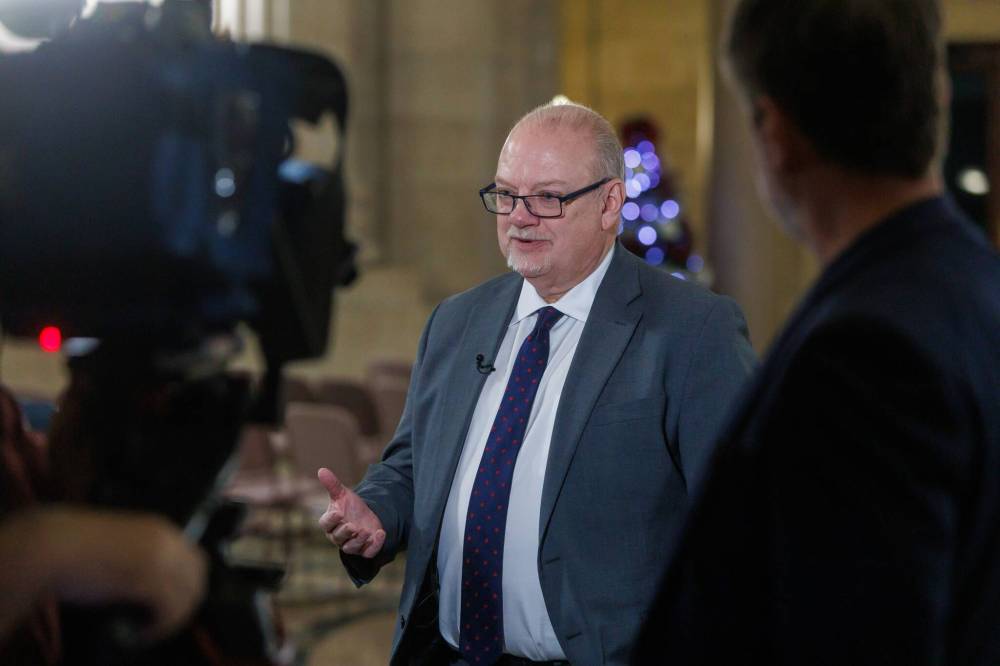
MIKE DEAL / FREE PRESS
Longtime Tory MLA Kelvin Goertzen, who announced this week he won’t be seeking re-election, says the legislature is a far more poisonous place than when he first arrived in provincial politics.
He’s not the only one. Former MLAs, current MLAs, staffers and observers of all stripes have made the same claim. Frankly, it’s getting hard to disagree.
The temperature was particularly high over the past few weeks with accusations of misogyny and bigotry flying back and forth in the chamber.
Quips about “Tofu-eaters,” “fake hunters,” and “latte-sippers,” dominated the proceedings. It was a greatest hits collection of juvenile politics — the kind of thing you’d expect in a bar room, not inside the province’s most important democratic institution.
On the final day of sitting last week before the Christmas break, Premier Wab Kinew accused Opposition Tory Leader Obby Khan of “attacking trans kids.” Khan countered with this:
“When it comes to crime and criminals in this province, you don’t need to look any further than this premier. He has a DUI charge, he has two assaults for assaulting his partner, assaulting his partner and dragging her across the floor. This premier has two charges. He has a charge for failing to attend court. He has a charge for aggravated assault. A charge for failing to comply with a court order… the list goes on and on and on. No wonder crime is worse in this province under this criminal premier. He doesn’t want to make it better because he’s a criminal himself.”
Wow.
I’ve sat through hundreds of question periods over the past 31 years and have witnessed some pretty unsavoury behaviour. But I don’t recall this kind of persistent vitriol in the legislative assembly.
Whether it’s the NDP calling the Tories misogynists or the PCs dredging up Kinew’s 20-year-old convictions — for which he was formally pardoned — the effect is the same: a chamber that looks and sounds more like a partisan cage match than a legislature.
This is not a blip. It seems to be a trend. And it’s getting worse.
The question is: why?
Modern politics rewards outrage. It rewards conflict. It rewards the viral clip, not thoughtful debate.
The legislature didn’t suddenly become toxic. It drifted there, step by step, over years — and both sides helped push it along.
But here’s the part that should alarm Manitobans: the toxicity doesn’t just poison debate. It poisons the institution.
When MLAs lose the ability — or the willingness — to disagree without demeaning each other, democracy becomes weaker. When the speaker loses authority, the chamber becomes ungovernable. When politics becomes a performance instead of a public responsibility, serious people stop wanting to run for office.
That’s the road Manitoba is heading down.
And the danger is not just political. It’s cultural. The legislature sets an example for the province — for students, for civil servants, for the broader public. If the message from MLAs is that shouting, mocking and personal attacks are acceptable tools of persuasion, that trickles down.
If the legislature can’t debate issues without devolving into a circus, how can Manitobans trust it to solve actual problems?
Some in politics shrug all this off as harmless theatre. Voters, they say, don’t care about decorum. They care about outcomes.
Maybe so. But if the process becomes too poisonous, the outcomes inevitably suffer.
It’s difficult to pinpoint exactly when the legislature slipped from adversarial — which is healthy — into toxic, which isn’t. Manitoba politics has always had its share of sharp elbows. Heckling has always existed in the chamber. But the degree of hostility, the personal attacks, the eagerness to hit below the belt, seems to have escalated.
Part of it is the national and global political climate. Politics everywhere has become more polarized, more personal, more performative. Social media has trained politicians to think every zinger is a potential viral clip.
The danger in all this isn’t just that the legislature looks foolish. It’s that it stops doing its job.
When MLAs no longer trust or respect one another, meaningful debate becomes impossible. When question period devolves into daily mudslinging, issues that actually matter — health care, affordability, education — get buried beneath theatrics. And when public confidence erodes, Manitobans tune out. They stop expecting better. Eventually, they stop caring.
That’s when democracy really suffers.

The legislature doesn’t have to be a polite tea party. It’s a place for tough questions, sharp criticism, and passionate argument. But there’s a difference between hard politics and toxic politics. Lately, Manitoba’s MLAs seem intent on proving they don’t know the difference.
The fact both parties now acknowledge the chamber’s declining decorum — while simultaneously contributing to it — shows how entrenched the problem is. Trouble is, everyone sees the fire, but no one is trying to put it out. They’re pouring gasoline on it instead.
The question now is whether anyone inside the building has the will to fix it.
If MLAs don’t start drawing lines about what’s acceptable in debate and what crosses the line into character assassination, the decline will continue. And Manitoba will be worse off for it.
tom.brodbeck@freepress.mb.ca
Tom Brodbeck is an award-winning author and columnist with over 30 years experience in print media. He joined the Free Press in 2019. Born and raised in Montreal, Tom graduated from the University of Manitoba in 1993 with a Bachelor of Arts degree in economics and commerce. Read more about Tom.
Tom provides commentary and analysis on political and related issues at the municipal, provincial and federal level. His columns are built on research and coverage of local events. The Free Press’s editing team reviews Tom’s columns before they are posted online or published in print – part of the Free Press’s tradition, since 1872, of producing reliable independent journalism. Read more about Free Press’s history and mandate, and learn how our newsroom operates.
Our newsroom depends on a growing audience of readers to power our journalism. If you are not a paid reader, please consider becoming a subscriber.
Our newsroom depends on its audience of readers to power our journalism. Thank you for your support.
Tom Brodbeck is an award-winning author and columnist with over 30 years experience in print media. He joined the Free Press in 2019. Born and raised in Montreal, Tom graduated from the University of Manitoba in 1993 with a Bachelor of Arts degree in economics and commerce. Read more about Tom.
Tom provides commentary and analysis on political and related issues at the municipal, provincial and federal level. His columns are built on research and coverage of local events. The Free Press’s editing team reviews Tom’s columns before they are posted online or published in print – part of the Free Press’s tradition, since 1872, of producing reliable independent journalism. Read more about Free Press’s history and mandate, and learn how our newsroom operates.
Our newsroom depends on a growing audience of readers to power our journalism. If you are not a paid reader, please consider becoming a subscriber.
Our newsroom depends on its audience of readers to power our journalism. Thank you for your support.
Advertisement Advertise With Us
Advertisement Advertise With Us