

City, province moving at different speeds; homeless people, camp strategy at risk in dangerously cold middle

Advertisement
Read this article for free:
or
Already have an account? Log in here »
To continue reading, please subscribe:

Digital Subscription
One year of digital access for only $205*
- Enjoy unlimited reading on winnipegfreepress.com
- Read the E-Edition, our digital replica newspaper
- Access News Break, our award-winning app
- Play interactive puzzles
*First annual payment billed as $205.00 + GST for one year. This annual subscription will automatically renew at $233.00 + GST every 52 weeks (10% off the regular annual price of $259.35). Offer available to new and qualified returning subscribers only. Cancel any time.
To continue reading, please subscribe:
Add Free Press access to your Brandon Sun subscription for only an additional
$1 for the first 4 weeks*
- Enjoy unlimited reading on winnipegfreepress.com
- Read the E-Edition, our digital replica newspaper
- Access News Break, our award-winning app
- Play interactive puzzles
*Your next Brandon Sun subscription payment will increase by $1.00 and you will be charged $17.95 plus GST for four weeks. After four weeks, your payment will increase to $24.95 plus GST every four weeks.
Read unlimited articles for free today:
or
Already have an account? Log in here »
Hey there, time traveller!
This article was published 15/12/2025 (274 days ago), so information in it may no longer be current.
Where did the former residents of Mostyn Park go?
Last week, armed with a new city ordinance, city staff evicted about 15 people from the camp, located on the north bank of the Assiniboine River, west of Osborne Street and directly behind the Granite Curling Club.
The Winnipeg’s newly minted ban, passed by council in November, allows the city to clear camps within 50 metres of schools, daycares and municipal recreational facilities such as rinks and playgrounds.
It was touted as a firm but methodical approach, with lots of pre-planning to ensure those being evicted had somewhere safe and warm to go to.
That’s not exactly how the Mostyn Park cleanup unfolded.
As encampment occupants were being evicted, social service agencies — including Main Street Project, the West Central Women’s Resource Centre and the Salvation Army — reportedly scrambled to find them shelter.
It seems as if the Mostyn residents were offered only emergency shelter, not the more stable, longer-term housing the provincial NDP government is attempting to create as part of its housing the homeless strategy.
The agencies said that in general, they were having trouble figuring out when and where the city was enacting the encampment ban. They also complained about a lack of advance warning to find shelter for the suddenly displaced occupants. This was of particular concern now with frigid temperatures creating dangerous conditions.
Did the city act prematurely to clear Mostyn Park without arranging alternate shelter? Or perhaps the city is using abrupt evictions to protest the lack of more permanent housing solutions promised by the provincial government?
Five days later, it’s not entirely clear what happened. But regardless of the eventual outcome, the Mostyn Park evictions seem to have revealed a disconnect between municipal and provincial strategies for the homeless.
In the absence of other, more humane housing, these camps do provide shelter for the homeless at a time when it is essential.
It’s no secret why certain encampments, such as Mostyn Park, are targeted for evictions.
The camp had been the scene of several dangerous fires. Ongoing addictions and mental-health concerns among occupants present a chronic drain on emergency services. And yet, in the absence of other, more humane housing, these camps do provide shelter for the homeless at a time when it is essential.
Again, the city promised it would to pull together a broad array of civic services to ensure residents were moved to a specific somewhere, as opposed to nowhere in particular.
Was Mostyn Park an outlier, and has the city produced better results with other encampments?
If previous evictions were more organized, the city isn’t saying; 10 encampments have been cleared since the ban took effect in mid-November, but municipal officials have, so far, refused to say how many people were evicted and whether any of them had been provided with stable, long-term shelter.
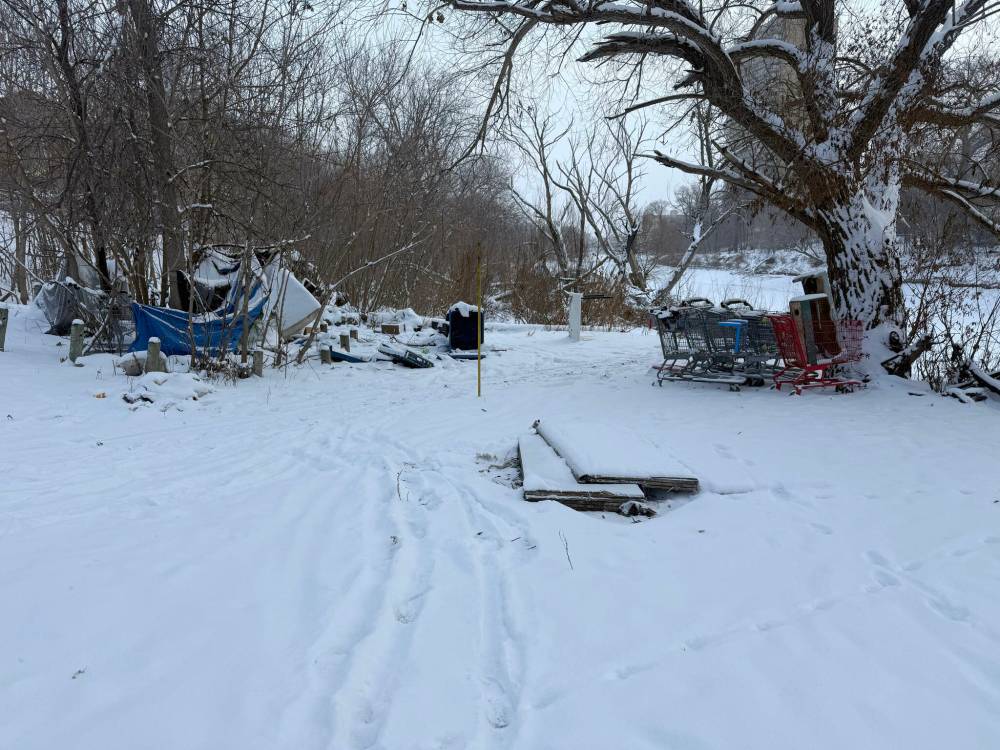
The refusal to release data about the evictions is just one of several signs the city knows that its eviction policy could be moving more quickly than efforts to establish housing options.
For example, the city’s executive policy committee has asked the public service to provide a report within 120 days on the feasibility of establishing a city-managed encampment pilot project. Permanent, municipally managed homeless communities are becoming increasingly popular in cities across Canada.
The interest in considering a more organized, more permanent encampment could be evidence the city has realized it won’t be able to remove more encampments without doing its part to provide an alternative.
Even if the city is moving too fast, it would be unfair to accuse council of not caring about the homeless.
The city has been on the front line of efforts to solve a stubborn challenge aggravated by chronic addictions and mental-health challenges. And, as part of the new policy to ban encampments, heroic work has been done to clean needles and debris from city parks.
Even if the city is moving too fast, it would be unfair to accuse council of not caring about the homeless.
However, the only unambiguous truth in this story is that there are not enough beds — emergency shelter or longer-term — to house the people evicted from encampments.
If the city is frustrated with the current situation, it’s not hard to see why.
Although the province is responsible for long-term re-housing strategies, it is the city that has to endure the front-line costs of dealing with the crime, medical emergencies and property damage that often accompanies encampments. And 2026 is a municipal election year, so the pressure is on to show a reduction in the number of encampments.
Adding to the city’s burden are the shrill demands of those living or working most closely to the encampments to remove them as quickly as possible without regard to where the homeless are relocated. You can see this in the opposition to the NDP government’s efforts to establish detox and supervised drug consumption facilities in the core of the city.
These facilities are designed to not only save lives, but to make the areas in which they are located safer and cleaner. That point is lost on some of those who work and live in the affected neighborhoods, who simply want the problem of homelessness and addiction gone by any means necessary.
The city and province need to co-ordinate better on the removal of encampments to ensure that every person who is evicted has somewhere safe to go.
What the city cannot do is to put the eviction cart before the re-housing horse.
dan.lett@icloud.com
Dan Lett is a columnist for the Free Press, providing opinion and commentary on politics in Winnipeg and beyond. Born and raised in Toronto, Dan joined the Free Press in 1986. Read more about Dan.
Dan’s columns are built on facts and reactions, but offer his personal views through arguments and analysis. The Free Press’ editing team reviews Dan’s columns before they are posted online or published in print — part of the our tradition, since 1872, of producing reliable independent journalism. Read more about Free Press’s history and mandate, and learn how our newsroom operates.
Our newsroom depends on a growing audience of readers to power our journalism. If you are not a paid reader, please consider becoming a subscriber.
Our newsroom depends on its audience of readers to power our journalism. Thank you for your support.
Dan Lett is a columnist for the Free Press, providing opinion and commentary on politics in Winnipeg and beyond. Born and raised in Toronto, Dan joined the Free Press in 1986. Read more about Dan.
Dan’s columns are built on facts and reactions, but offer his personal views through arguments and analysis. The Free Press’ editing team reviews Dan’s columns before they are posted online or published in print — part of the our tradition, since 1872, of producing reliable independent journalism. Read more about Free Press’s history and mandate, and learn how our newsroom operates.
Our newsroom depends on a growing audience of readers to power our journalism. If you are not a paid reader, please consider becoming a subscriber.
Our newsroom depends on its audience of readers to power our journalism. Thank you for your support.
Related Articles
From encampment to housing: A look at addressing Winnipeg's homelessness crisis


Advertisement Advertise With Us
Advertisement Advertise With Us
History
Updated on Tuesday, December 16, 2025 11:03 AM CST: Updates photo caption