

Union decries Crown prosecutors’ crushing workload

Advertisement
Read this article for free:
or
Already have an account? Log in here »
To continue reading, please subscribe:
Monthly Digital Subscription
$1 per week for 24 weeks*
- Enjoy unlimited reading on winnipegfreepress.com
- Read the E-Edition, our digital replica newspaper
- Access News Break, our award-winning app
- Play interactive puzzles
*Billed as $4.00 plus GST every four weeks. After 24 weeks, price increases to the regular rate of $19.95 plus GST every four weeks. Offer available to new and qualified returning subscribers only. Cancel any time.
Monthly Digital Subscription
$4.99/week*
- Enjoy unlimited reading on winnipegfreepress.com
- Read the E-Edition, our digital replica newspaper
- Access News Break, our award-winning app
- Play interactive puzzles
*Billed as $19.95 plus GST every four weeks. Cancel any time.
To continue reading, please subscribe:
Add Free Press access to your Brandon Sun subscription for only an additional
$1 for the first 4 weeks*
*Your next subscription payment will increase by $1.00 and you will be charged $16.99 plus GST for four weeks. After four weeks, your payment will increase to $23.99 plus GST every four weeks.
Read unlimited articles for free today:
or
Already have an account? Log in here »
Manitoba judges have thrown out only a handful of cases that did not meet strict timelines for the completion of criminal trials that came out of a landmark Supreme Court ruling nearly 10 years ago.
Jordan limits, meant to protect the Charter of Rights and Freedoms right to a trial within a reasonable time and to tackle systemic delays in the country’s courts, are set at 18 months for cases to move from laying charges to the end of trial in provincial courts and 30 months for superior courts such as the Manitoba Court of King’s Bench.
If those limits are surpassed, the high court ruled in its R v. Jordan decision in 2016, it creates the presumption of an unreasonable delay, barring exceptional circumstances. Defence lawyers can then file a motion asking for the judge assigned to the case to enter a stay of proceedings.
Figures provided by the provincial government indicate that a total 19 cases have been stayed as a result of those considerations in Manitoba courts since 2016.
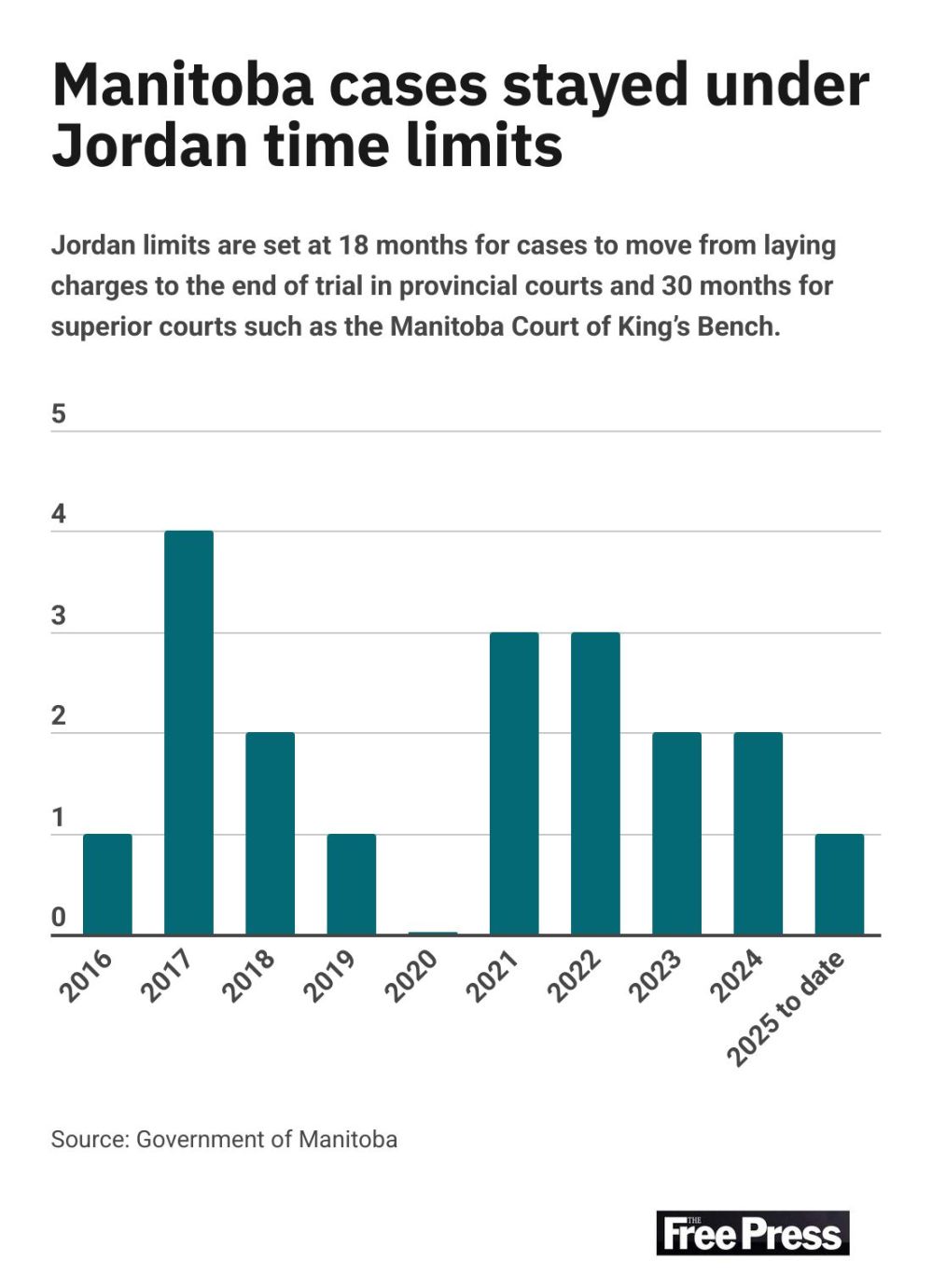
No cases were stayed in 2020. One case was stayed each year in 2016 and 2019 and in 2025 to date. Four cases were stayed in 2017. There were two each year in 2018, 2023 and 2024, and three each year in 2021 and 2022.
Manitoba’s justice system, including the Crown attorneys office, has worked to mitigate delays and bring matters to trial expeditiously following the 2016 ruling, a provincial spokesman said Thursday.
But Michael Desautels, the president of the Manitoba Association of Crown Attorneys, argues the relatively small number of stayed cases doesn’t reflect the amount of work put in to prevent others being thrown out.
“Crowns are basically bending over backwards to prevent this stuff. It’s embarrassing and it’s unjust to victims (to have cases stayed out of Jordan considerations),” said Desautels, who’s a senior prosecutor.
He said Crown prosecutors are double-booking themselves, working weekends, evenings and cancelling holidays to ensure cases can be scheduled within the Jordan timeline.
The provincial spokesman said the Crown’s office has implemented initiatives to minimize delays and prosecute efficiently, including an early assessment process to look at whether a case can be diverted or addressed with restorative justice or other forms of resolution, and to prepare files for trial sooner.
The office also tracks the age of files and conducts reviews to look for cases in which delays have become a concern. The office has implemented a digital management system to more efficiently process evidence.
MIKAELA MACKENZIE / FREE PRESS FILES Manitoba Association of Crown Attorneys president and senior Crown prosecutor Michael Desautels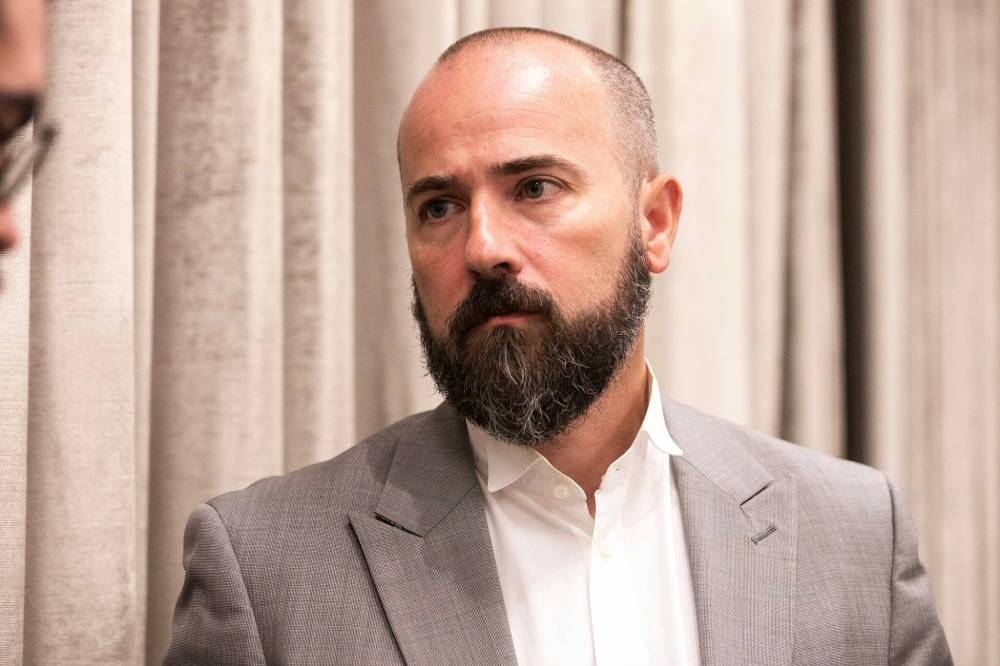
Desautels argued triage decisions are resulting in prosecutors entering more plea bargains with defence lawyers in which offenders are given lower sentences for lesser charges — rather than the outcome that would be best for public safety — to avoid Jordan motions being filed.
The union is currently embroiled in contract negotiations with the provincial government and has repeatedly raised alarm about the number of lawyers in the prosecutions service, arguing it has not kept up with the volume and complexity of cases.
“I’d be very concerned if I was a victim of crime. Is my case getting the attention it deserves? Is my daughter’s sexual assault case going to have the Crown who has the time and ability and the tools they need to analyze this evidence and put the case in, before a judge says it has to get stayed, or before they have to make some plea bargain?” asked Desautels.
“That’s not an answer, that’s not justice.”
He said as cases become more and more complex, with more evidence to sift through from police body cameras, the staffing issue will only increase.
“Crowns are nervous about not being able to do what needs to get done,” said Desautels, adding the courts and the administrative justice system needs more staff and resources.
Chris Gamby, a spokesman for the Criminal Defence Lawyers Association of Manitoba, said the Jordan limits resulted in “pretty significant changes” in how defence lawyers and prosecutors have practised since the 2016 ruling.
“All of a sudden, you’ve got what are, essentially, hard time limits that you’re bumping up against,” said Gamby, a practising lawyer. “It meant that the Crown would be breathing down your neck to set things, to do this, to do that, to make decisions.”
He said the system is moving faster than it did in the past, though he began his law career shortly before the ruling, and has adapted with a changing approach.
“I think that at this point, we’re all sort of used to it,” said Gamby.
The provincial government spokesman refused requests to interview officials at the Manitoba Prosecutions Service about Jordan limits and what they’ve meant for Crown attorneys, and also about the union’s concerns.
Justice Minister Matt Wiebe, responded to a request for comment on Desautels’ remarks in an email, pointing to hires made in the Crown’s office and pay increases.
erik.pindera@freepress.mb.ca
Erik Pindera is a reporter for the Free Press, mostly focusing on crime and justice. The born-and-bred Winnipegger attended Red River College Polytechnic, wrote for the community newspaper in Kenora, Ont. and reported on television and radio in Winnipeg before joining the Free Press in 2020. Read more about Erik.
Every piece of reporting Erik produces is reviewed by an editing team before it is posted online or published in print — part of the Free Press‘s tradition, since 1872, of producing reliable independent journalism. Read more about Free Press’s history and mandate, and learn how our newsroom operates.
Our newsroom depends on a growing audience of readers to power our journalism. If you are not a paid reader, please consider becoming a subscriber.
Our newsroom depends on its audience of readers to power our journalism. Thank you for your support.
Erik Pindera is a reporter for the Free Press, mostly focusing on crime and justice. The born-and-bred Winnipegger attended Red River College Polytechnic, wrote for the community newspaper in Kenora, Ont. and reported on television and radio in Winnipeg before joining the Free Press in 2020. Read more about Erik.
Every piece of reporting Erik produces is reviewed by an editing team before it is posted online or published in print — part of the Free Press‘s tradition, since 1872, of producing reliable independent journalism. Read more about Free Press’s history and mandate, and learn how our newsroom operates.
Our newsroom depends on a growing audience of readers to power our journalism. If you are not a paid reader, please consider becoming a subscriber.
Our newsroom depends on its audience of readers to power our journalism. Thank you for your support.
Related Articles
Burnout among Crown attorneys so bad, it’s akin to PTSD: survey


Advertisement Advertise With Us
Advertisement Advertise With Us
History
Updated on Monday, December 15, 2025 7:50 AM CST: Adds photo
Updated on Friday, December 19, 2025 4:49 PM CST: A previous version of this story said 13 cases had been stayed, a figure the province reported in error. The story has been updated to reflect the correct number provided today and the years those cases were stayed.