

Zero tolerance during parking bans would deliver the message

Advertisement
Read this article for free:
or
Already have an account? Log in here »
To continue reading, please subscribe:

Digital Subscription
One year of digital access for only $205*
- Enjoy unlimited reading on winnipegfreepress.com
- Read the E-Edition, our digital replica newspaper
- Access News Break, our award-winning app
- Play interactive puzzles
*First annual payment billed as $205.00 + GST for one year. This annual subscription will automatically renew at $233.00 + GST every 52 weeks (10% off the regular annual price of $259.35). Offer available to new and qualified returning subscribers only. Cancel any time.
To continue reading, please subscribe:
Add Free Press access to your Brandon Sun subscription for only an additional
$1 for the first 4 weeks*
- Enjoy unlimited reading on winnipegfreepress.com
- Read the E-Edition, our digital replica newspaper
- Access News Break, our award-winning app
- Play interactive puzzles
*Your next Brandon Sun subscription payment will increase by $1.00 and you will be charged $17.95 plus GST for four weeks. After four weeks, your payment will increase to $24.95 plus GST every four weeks.
Read unlimited articles for free today:
or
Already have an account? Log in here »
Hey there, time traveller!
This article was published 08/01/2026 (276 days ago), so information in it may no longer be current.
Every winter the city pleads, it advertises, it tweets. It posts billboards. It runs television and radio ads.
And every winter, a stubborn minority of motorists shrugs and leaves vehicles parked on streets during residential parking bans after major snowfalls.
For reasons that defy common sense, Winnipeg has decided that during snow-clearing operations, scofflaw motorists shouldn’t — in most cases — be towed during residential parking bans. City officials have concluded, wrongly, that ticketing them instead is usually enough.
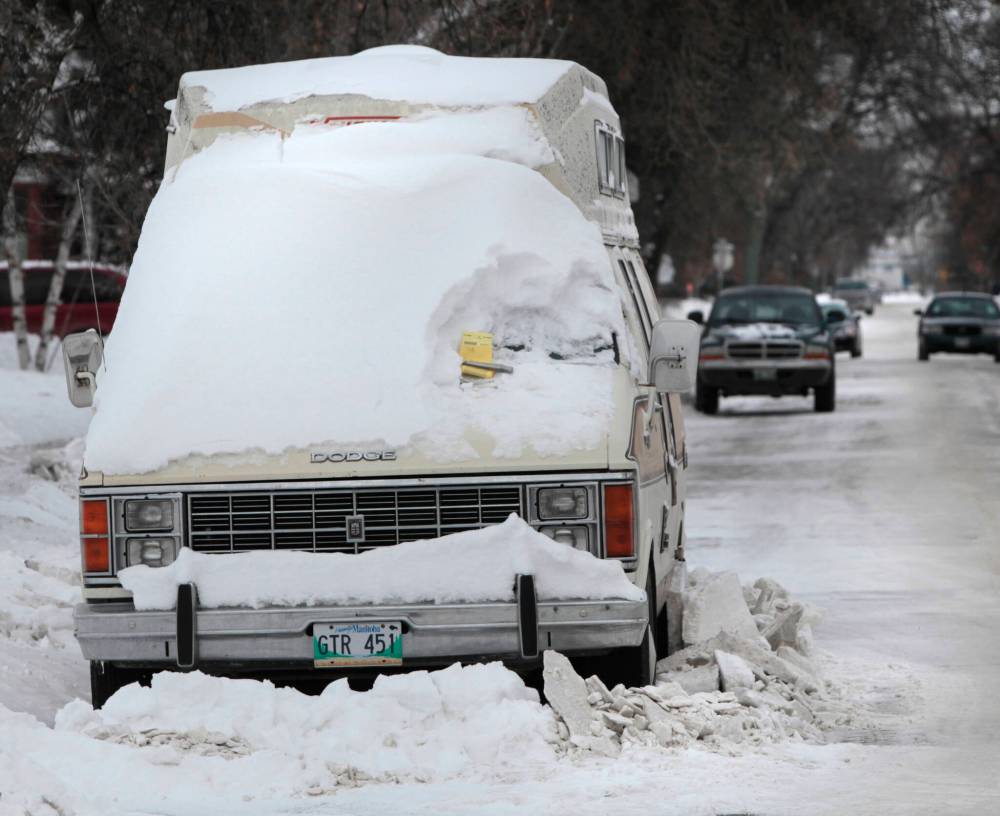
This problem is entirely avoidable if the city would only get serious about properly enforcing parking bans. (Wayne Glowacki / Free Press files)
Anyone who has walked or driven down a residential street after a major snowfall cleanup, where motorists have refused to comply with the parking ban, knows that doesn’t work.
The snow left behind where cars remain parked gets driven over and often turns to ruts, which eventually freeze. Mounds of snow and ice are left behind, causing hazardous driving conditions. It makes parking difficult and causes unsafe conditions for some pedestrians.
Some residents have recently complained about the ongoing problem, and they’re right to do so. Especially since it’s so easy to solve.
This problem is entirely avoidable if the city would only get serious about properly enforcing parking bans.
The city stopped offering “courtesy tows” during snow-clearing operations in 2022. Under that program, vehicles parked in violation of a ban could be towed out of the way — while still ticketed — but owners wouldn’t have to pay for the tow, taxpayers would. City officials said the program was expensive and that there was no evidence it improved compliance.
In December 2022 alone, there were 2,498 courtesy tows, costing close to $1 million.
Clearly, courtesy towing is not the answer. But the no-tow policy isn’t, either.
Thousands of tickets were issued last month to motorists who ignored the ban. Some were towed, but only if they posed a “hazard” to snow cleaning operators, whatever that’s supposed to mean. Don’t they all pose a hazard?
When they are towed, motorists must pay the cost. But it applies only to a minority of offenders. Most are just ticketed. The fine is $200, which is clearly not enough to deter some drivers.
For some, it’s treated as a convenience fee — cheaper than finding off-street parking or rearranging plans. Others just don’t seem to care.
Meanwhile, the rest of the neighbourhood has to endure rut-filled streets, unsafe conditions and weeks of frustration.
This isn’t complicated. The city already tows vehicles in a minority of cases during residential parking bans. It also tows vehicles on major routes during rush hour. If you park where you’re not supposed to between 3:30 and 5:30 p.m., your car is gone. No debate. No hand-wringing. No tolerance.
Residential parking bans should be treated the same way.
A ticket doesn’t move a vehicle. A tow truck does.
Public works chair Coun. Janice Lukes has suggested increasing fines for repeat offenders, arguing that messaging alone won’t reach everyone. She’s probably right. But even higher fines won’t fix the immediate problem: the car is still there, blocking the plows.
A ticket doesn’t move a vehicle. A tow truck does.
The city has budgeted about $50 million for snow clearing this year. That money is supposed to buy clear streets, safe sidewalks and accessible neighbourhoods — not half-plowed roads because a handful of drivers couldn’t be bothered to move their vehicles.
Unlike courtesy towing, the zero-tolerance variety – where motorists pick up the tab – during parking bans wouldn’t cost the city a dime. The person who caused the problem would be the one paying to fix it, as it should be.
Towing companies would no doubt welcome the extra business.
Once motorists see that the city is serious about enforcing residential parking bans, compliance would almost certainly improve. When drivers know their car will be towed and that they’ll have to pay for it (and still get ticketed), their behaviour would change. For most motorists, anyway.
For those who still refuse? Their vehicle will be towed at their expense, period. It’s pretty simple.
Winter in Winnipeg is hard enough. We don’t need to make it even more difficult by tolerating behaviour that leaves our streets unsafe.

Winter in Winnipeg is hard enough. We don’t need to make it even more difficult by tolerating behaviour that leaves our streets unsafe and difficult to navigate. Zero tolerance isn’t punitive — it’s practical.
The city faces many challenges, many of which don’t have simple solutions (such as what to do with encampments, how to curb violence on Winnipeg Transit buses or how to manage vacant, derelict buildings). But this is not one of them.
And it’s baffling why city hall can’t seem to wrap its head around what should be a very straightforward enforcement policy — especially when it would cost taxpayers nothing.
Tow the vehicles. Clear the streets. And stop pretending this is more complicated than it is.
tom.brodbeck@freepress.mb.ca
Tom Brodbeck is an award-winning author and columnist with over 30 years experience in print media. He joined the Free Press in 2019. Born and raised in Montreal, Tom graduated from the University of Manitoba in 1993 with a Bachelor of Arts degree in economics and commerce. Read more about Tom.
Tom provides commentary and analysis on political and related issues at the municipal, provincial and federal level. His columns are built on research and coverage of local events. The Free Press’s editing team reviews Tom’s columns before they are posted online or published in print – part of the Free Press’s tradition, since 1872, of producing reliable independent journalism. Read more about Free Press’s history and mandate, and learn how our newsroom operates.
Our newsroom depends on a growing audience of readers to power our journalism. If you are not a paid reader, please consider becoming a subscriber.
Our newsroom depends on its audience of readers to power our journalism. Thank you for your support.
Tom Brodbeck is an award-winning author and columnist with over 30 years experience in print media. He joined the Free Press in 2019. Born and raised in Montreal, Tom graduated from the University of Manitoba in 1993 with a Bachelor of Arts degree in economics and commerce. Read more about Tom.
Tom provides commentary and analysis on political and related issues at the municipal, provincial and federal level. His columns are built on research and coverage of local events. The Free Press’s editing team reviews Tom’s columns before they are posted online or published in print – part of the Free Press’s tradition, since 1872, of producing reliable independent journalism. Read more about Free Press’s history and mandate, and learn how our newsroom operates.
Our newsroom depends on a growing audience of readers to power our journalism. If you are not a paid reader, please consider becoming a subscriber.
Our newsroom depends on its audience of readers to power our journalism. Thank you for your support.
Advertisement Advertise With Us
Advertisement Advertise With Us