

Staying silent about hate is really choosing a side

Advertisement
Read this article for free:
or
Already have an account? Log in here »
To continue reading, please subscribe:
Digital Subscription
One year of digital access for only $1.44 a week*
- Enjoy unlimited reading on winnipegfreepress.com
- Read the E-Edition, our digital replica newspaper
- Access News Break, our award-winning app
- Play interactive puzzles
*Billed as $5.77 plus GST every four weeks. After 52 weeks, price increases to the regular rate of $19.95 plus GST every four weeks. Offer available to new and qualified returning subscribers only. Cancel any time.
To continue reading, please subscribe:
Add Free Press access to your Brandon Sun subscription for only an additional
$1 for the first 4 weeks*
- Enjoy unlimited reading on winnipegfreepress.com
- Read the E-Edition, our digital replica newspaper
- Access News Break, our award-winning app
- Play interactive puzzles
*Your next Brandon Sun subscription payment will increase by $1.00 and you will be charged $17.95 plus GST for four weeks. After four weeks, your payment will increase to $24.95 plus GST every four weeks.
Read unlimited articles for free today:
or
Already have an account? Log in here »
Hey there, time traveller!
This article was published 09/01/2026 (283 days ago), so information in it may no longer be current.
There was a time when a swastika spray-painted on a building in Winnipeg would have been shocking in its rarity.
Now it’s shocking in its familiarity.
In the span of less than a week, hate has left its mark across the city — on a mosque in the West End, on a synagogue, on a high school, near an elementary school community and on a Palestinian-owned restaurant.
Different targets, same intent. To intimidate. To dehumanize. To remind certain people that, in the minds of others, they don’t belong.
That’s not just a crime spree. It’s a snapshot of where we are as a society.
One of the recent incidents involved the Abu Bakr Al-Siddique mosque and community centre at Ellice Avenue and Home Street, where a swastika was painted on the building. Mosque director Adnan Siddiqui learned about it not from a passerby, but from calls by police and the media. Officers moved quickly to have the symbol removed before daily prayers.
“It’s upsetting,” said Siddiqui, noting the mosque has spent four years serving the community without discrimination and maintaining good relations with neighbours. “But some people are targeting us.”
Those words land heavier when you remember the community is still reeling from a violent attack in November, when a 26-year-old volunteer was assaulted with a hatchet while walking to Tim Hortons in broad daylight.
MIKE DEAL / FREE PRESS The Habibiz Café, at 1373 Portage Ave., was vandalized early Sunday morning. 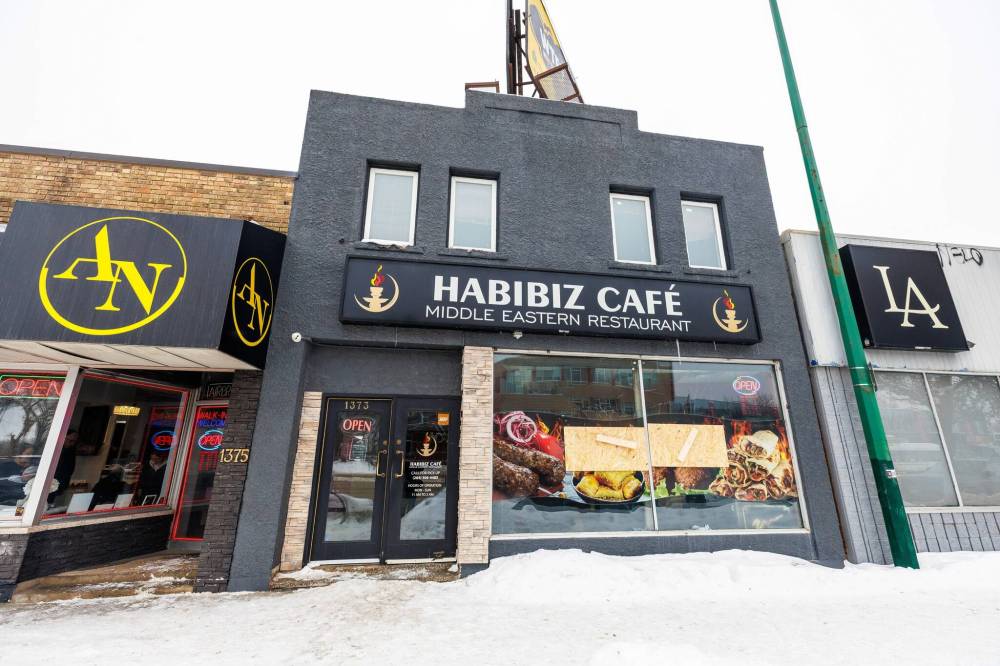
Graffiti might be dismissed by some as “just vandalism.” It doesn’t feel that way when it follows real bloodshed.
Jewish families are dealing with their own version of the same anxiety. Parents at Brock Corydon School, which offers Manitoba’s only Hebrew immersion program, received an email not about curriculum or concerts, but about security protocols, locked doors and close contact with police.
The message came after antisemitic graffiti appeared at Kelvin High School and nearby Shaarey Zedek synagogue.
At Shaarey Zedek, the graffiti included swastikas and the word “hate” — as if clarity were needed. Maintenance staff removed it quickly, but the damage isn’t measured by how long the paint stays on the wall. It’s measured by how long people look over their shoulders afterward.
Meanwhile, early Sunday morning, someone smashed the front windows of Habibiz Café, a Palestinian-owned hookah lounge and restaurant, and left behind a note telling the owners to “Leave our country terrorist. F—k off.” Police are treating that, too, as a hate crime.
The Winnipeg Police Service said Friday that someone spray-painted hate-related graffiti on garages, homes and vehicles in the Crescentwood area on Jan. 2. Police also announced Friday that a 34-year-old man faces dozens of mischief charges tied to some of the recent crimes.
These are not isolated incidents. This is hate moving laterally — Muslims, Jews, Palestinians — fed by the same distorted world view.
This is hate moving laterally – Muslims, Jews, Palestinians – fed by the same distorted world view.
Lori Binder, head of school and CEO of Gray Academy of Jewish Education, said her school has long had strong security infrastructure in place. Guards are on site. Protocols are established. Readiness is constant. That reality alone should make us uncomfortable. Schools shouldn’t need to operate in a perpetual state of alert because of who their students are.
Binder also pointed to something newer and harder to contain: the online world. Antisemitism and other forms of hate have exploded digitally. It is faster, louder and more aggressive than ever before. Kids are seeing things online that previous generations didn’t encounter until much later, if at all.
That matters because hate doesn’t begin with spray paint. It begins with language. With jokes that go unchallenged. With memes that normalize cruelty. With comment sections that reward outrage and dehumanization.
Mayor Scott Gillingham touched on this when he spoke about hateful replies on his own Facebook page, including messages telling a non-white supporter to “go home.” That phrase is ugly in its simplicity and disturbingly common.
What’s changed in recent years is not that prejudice exists — it always has — but that it seems increasingly unrestrained. Less coded. Less ashamed. More confident it will find allies rather than consequences.
If these incidents tell us anything, it’s that racism and hatred are not receding.
Social media plays a role, no question. Platforms amplify the most extreme voices and flatten complex global conflicts into local resentments. But online spaces don’t invent hate. They magnify what already exists, and they reward people for pushing it further.
We also need to be honest about fatigue. Many people hear about yet another hate crime and feel overwhelmed or numb. There’s a temptation to sigh, shake your head and move on. That reaction is understandable — and dangerous. Apathy is oxygen for intolerance.
Silence is not neutral. It tilts the field toward the loudest, ugliest voices.
Education, as several leaders have emphasized, is essential. Not just formal lessons in history or diversity, but teaching critical thinking, media literacy and moral courage. Teaching young people — and adults — how to recognize when anger is being manipulated and when fear is being weaponized.
If these incidents tell us anything, it’s that racism and hatred are not receding. They’re adapting, spreading and growing bolder. The question now is whether the rest of us are willing to meet that reality with more than statements and cleanups.
Because if the last week has shown us anything, it’s this: when hate feels free to roam, it doesn’t stop at one door.
tom.brodbeck@freepress.mb.ca
Tom Brodbeck is an award-winning author and columnist with over 30 years experience in print media. He joined the Free Press in 2019. Born and raised in Montreal, Tom graduated from the University of Manitoba in 1993 with a Bachelor of Arts degree in economics and commerce. Read more about Tom.
Tom provides commentary and analysis on political and related issues at the municipal, provincial and federal level. His columns are built on research and coverage of local events. The Free Press’s editing team reviews Tom’s columns before they are posted online or published in print – part of the Free Press’s tradition, since 1872, of producing reliable independent journalism. Read more about Free Press’s history and mandate, and learn how our newsroom operates.
Our newsroom depends on a growing audience of readers to power our journalism. If you are not a paid reader, please consider becoming a subscriber.
Our newsroom depends on its audience of readers to power our journalism. Thank you for your support.
Tom Brodbeck is an award-winning author and columnist with over 30 years experience in print media. He joined the Free Press in 2019. Born and raised in Montreal, Tom graduated from the University of Manitoba in 1993 with a Bachelor of Arts degree in economics and commerce. Read more about Tom.
Tom provides commentary and analysis on political and related issues at the municipal, provincial and federal level. His columns are built on research and coverage of local events. The Free Press’s editing team reviews Tom’s columns before they are posted online or published in print – part of the Free Press’s tradition, since 1872, of producing reliable independent journalism. Read more about Free Press’s history and mandate, and learn how our newsroom operates.
Our newsroom depends on a growing audience of readers to power our journalism. If you are not a paid reader, please consider becoming a subscriber.
Our newsroom depends on its audience of readers to power our journalism. Thank you for your support.
Related Articles
Police arrest 34-year-old man in hate graffiti spree; prosecutors could add to mischief charges


Advertisement Advertise With Us
Advertisement Advertise With Us