

Pothole problem will only get worse unless province steps up

Advertisement
Read this article for free:
or
Already have an account? Log in here »
To continue reading, please subscribe:

Digital Subscription
One year of digital access for only $205*
- Enjoy unlimited reading on winnipegfreepress.com
- Read the E-Edition, our digital replica newspaper
- Access News Break, our award-winning app
- Play interactive puzzles
*First annual payment billed as $205.00 + GST for one year. This annual subscription will automatically renew at $233.00 + GST every 52 weeks (10% off the regular annual price of $259.35). Offer available to new and qualified returning subscribers only. Cancel any time.
To continue reading, please subscribe:
Add Free Press access to your Brandon Sun subscription for only an additional
$1 for the first 4 weeks*
- Enjoy unlimited reading on winnipegfreepress.com
- Read the E-Edition, our digital replica newspaper
- Access News Break, our award-winning app
- Play interactive puzzles
*Your next Brandon Sun subscription payment will increase by $1.00 and you will be charged $17.95 plus GST for four weeks. After four weeks, your payment will increase to $24.95 plus GST every four weeks.
Read unlimited articles for free today:
or
Already have an account? Log in here »
Winnipeg’s surest sign of spring isn’t melting snow or longer days. It’s pothole season — that annual stretch when driving across the city turns into a test of reflexes, patience and how much punishment your vehicle can take.
Once again, the streets have become a bone-rattling obstacle course. Drivers swerve to avoid craters beneath murky puddles. It can mean a blown tire, a bent rim or a suspension bill that arrives like an unwelcome tax notice.
And that’s essentially what it is: a hidden tax on anyone who drives in this city.
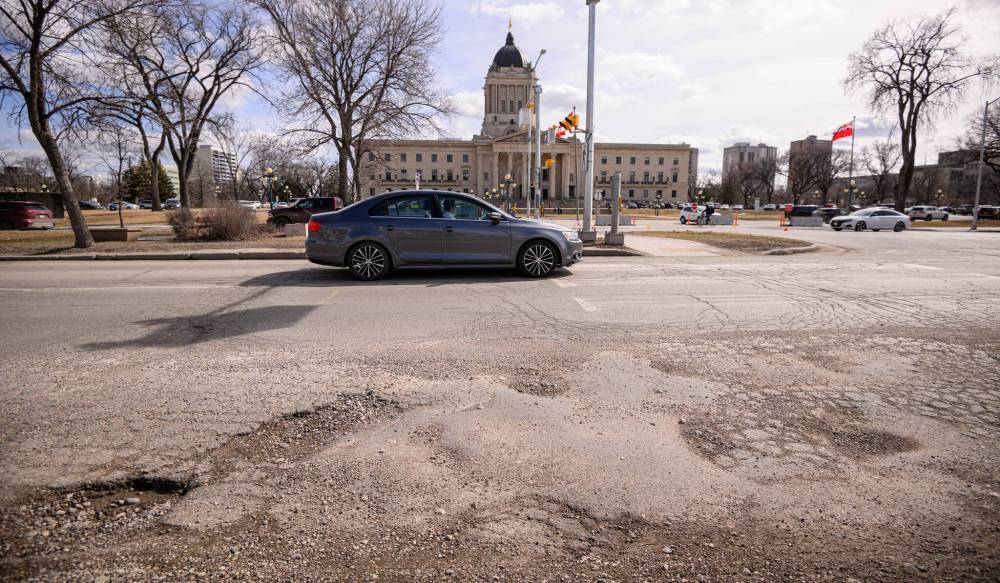
MIKE SUDOMA / FREE PRESS FILES
Drivers avoid the long line of potholes at the corner of Broadway and Memorial Boulevard.
Every year, the same cycle plays out. Crews scramble to fill holes. City officials assure residents they’re doing their best. And Winnipeggers vent their frustration while bracing for the next jolt.
Then, as temperatures stabilize, the problem fades just enough to slip off the public radar — until the following spring, when it all starts over again and seems to get worse.
So it’s worth asking: when will Winnipeg ever catch up?
Because this is structural, predictable and decades in the making.
The freeze-thaw cycle is always the go-to explanation. Water seeps into cracks, freezes, expands and breaks the pavement apart. That’s all true.
But it’s also not unique. Plenty of cities endure harsh winters without their road networks collapsing into something that feels like a minefield every March and April.
The real problem is what happens — or doesn’t happen — the rest of the year.
For years, Winnipeg has relied heavily on patchwork repairs instead of long-term solutions. Potholes get filled, but the underlying roads continue to deteriorate.
Temporary fixes last weeks, sometimes days, before crews are sent back to the exact same spots. It’s a cycle of repetition that keeps roads barely driveable but never truly fixed.
Meanwhile, the backlog of streets needing full reconstruction — not surface patching, but complete rebuilds — continues to grow.
City hall knows this. The reports are there. The plans exist. And so does the price tag.
Fixing roads properly is expensive. Tearing them down to the base and rebuilding them costs far more upfront than filling potholes.
Every year a road isn’t properly rebuilt, it deteriorates further. What could have been a relatively straightforward rehabilitation becomes a far more costly reconstruction. Multiply that across a city the size of Winnipeg, and the financial hole becomes just as daunting as the physical ones drivers are dodging.
And then there’s the cost outside city hall’s books.
Pothole season hits drivers directly. Tires blow. Rims bend. Suspensions take a beating. Insurance claims spike, repair shops fill up and households absorb costs they shouldn’t have to bear. For many, it’s not just an annoyance. It’s a real financial burden.
So why does this keep happening?
Winnipeg is trying to maintain a road infrastructure it can’t afford, at least not under current fiscal realities. Years of urban expansion have stretched the network, leaving the city responsible for vast kilometres of roadway.
At the same time, it remains heavily dependent on property taxes to fund that infrastructure — a model that simply doesn’t generate enough revenue to keep up.
Property taxes are stable, but they don’t grow in step with construction costs, inflation or the mounting backlog of deferred maintenance. The result is a system that is permanently playing catch-up.
That’s where the province has to come into the picture.
Winnipeg is Manitoba’s economic engine. It generates a significant share of the province’s economic activity and, by extension, provincial tax revenue. But the city doesn’t see a proportional share of that growth revenue when it comes to funding the infrastructure that supports it.
That imbalance is a big part of the problem.
If the province is serious about economic growth, it should also be serious about ensuring the infrastructure that underpins that growth is properly funded. That means giving Winnipeg access to growth revenues or creating a more sustainable revenue-sharing model.
That wouldn’t be a bailout. It would be an overdue adjustment to a system that no longer reflects reality. Like all cities in Canada, Winnipeg is not a stand-alone order of government. It exists and operates under provincial legislation. The province has a responsibility to ensure it operates efficiently and effectively.
Winnipeggers aren’t expecting perfection. They understand winter takes a toll. But expecting roads that are safe, reasonably driveable and not in a constant state of disrepair isn’t asking too much.
Right now, even that modest standard feels out of reach.

Pothole season will pass, as it always does. The worst holes will be filled, the complaints will subside and driving will become a little less punishing.
But without a fundamental shift in both how Winnipeg funds its infrastructure and how it prioritizes long-term investment, the cycle is locked in.
Next spring, we’ll be right back here again — dodging holes, paying repair bills and asking the same question: When will the city ever catch up?
At this rate, not anytime soon.
tom.brodbeck@freepress.mb.ca
Tom Brodbeck is an award-winning author and columnist with over 30 years experience in print media. He joined the Free Press in 2019. Born and raised in Montreal, Tom graduated from the University of Manitoba in 1993 with a Bachelor of Arts degree in economics and commerce. Read more about Tom.
Tom provides commentary and analysis on political and related issues at the municipal, provincial and federal level. His columns are built on research and coverage of local events. The Free Press’s editing team reviews Tom’s columns before they are posted online or published in print – part of the Free Press’s tradition, since 1872, of producing reliable independent journalism. Read more about Free Press’s history and mandate, and learn how our newsroom operates.
Our newsroom depends on a growing audience of readers to power our journalism. If you are not a paid reader, please consider becoming a subscriber.
Our newsroom depends on its audience of readers to power our journalism. Thank you for your support.
Tom Brodbeck is an award-winning author and columnist with over 30 years experience in print media. He joined the Free Press in 2019. Born and raised in Montreal, Tom graduated from the University of Manitoba in 1993 with a Bachelor of Arts degree in economics and commerce. Read more about Tom.
Tom provides commentary and analysis on political and related issues at the municipal, provincial and federal level. His columns are built on research and coverage of local events. The Free Press’s editing team reviews Tom’s columns before they are posted online or published in print – part of the Free Press’s tradition, since 1872, of producing reliable independent journalism. Read more about Free Press’s history and mandate, and learn how our newsroom operates.
Our newsroom depends on a growing audience of readers to power our journalism. If you are not a paid reader, please consider becoming a subscriber.
Our newsroom depends on its audience of readers to power our journalism. Thank you for your support.
Related Articles
Spring sprung, grass not riz; frozen drains flood, hide where potholes is
Advertisement Advertise With Us
Advertisement Advertise With Us