

Supervised consumption site can be delayed no longer

Advertisement
Read this article for free:
or
Already have an account? Log in here »
To continue reading, please subscribe:

Digital Subscription
One year of digital access for only $205*
- Enjoy unlimited reading on winnipegfreepress.com
- Read the E-Edition, our digital replica newspaper
- Access News Break, our award-winning app
- Play interactive puzzles
*First annual payment billed as $205.00 + GST for one year. This annual subscription will automatically renew at $233.00 + GST every 52 weeks (10% off the regular annual price of $259.35). Offer available to new and qualified returning subscribers only. Cancel any time.
To continue reading, please subscribe:
Add Free Press access to your Brandon Sun subscription for only an additional
$1 for the first 4 weeks*
- Enjoy unlimited reading on winnipegfreepress.com
- Read the E-Edition, our digital replica newspaper
- Access News Break, our award-winning app
- Play interactive puzzles
*Your next Brandon Sun subscription payment will increase by $1.00 and you will be charged $17.95 plus GST for four weeks. After four weeks, your payment will increase to $24.95 plus GST every four weeks.
Read unlimited articles for free today:
or
Already have an account? Log in here »
If not now, then when?
That question hangs over Manitoba’s long-delayed supervised drug consumption site as the province weathers yet another surge in overdoses — one that front-line workers say is among the worst they’ve ever seen.
In just two weeks, organizations on the ground report as many as 15 deaths tied to drug toxicity.
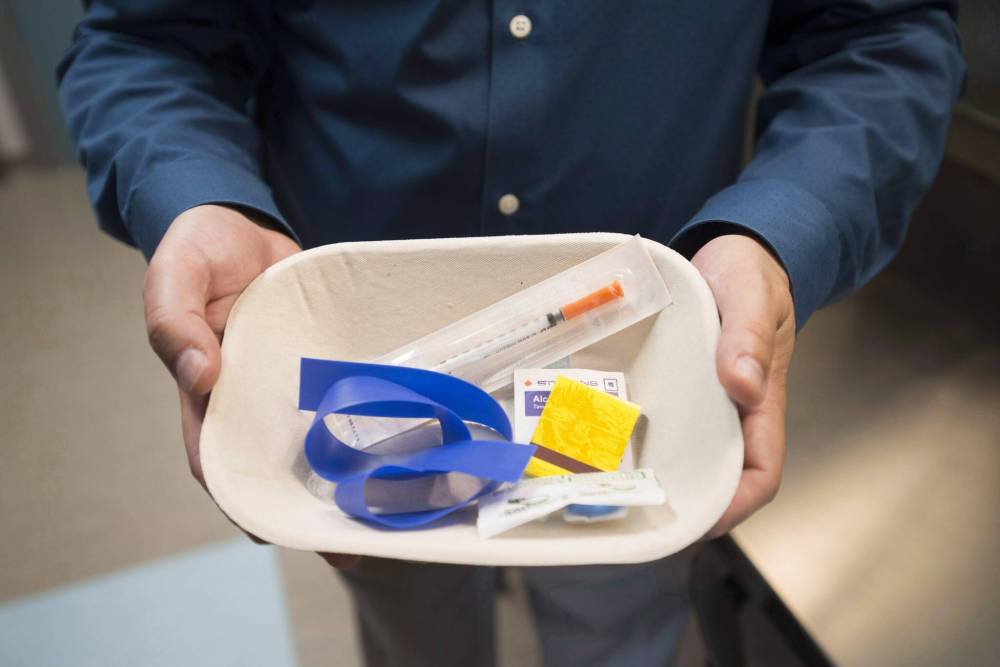
Supervised drug consumption sites offer, among other things, drug-checking services and harm-reduction tools like clean needles. (Jonathan Hayward / The Canadian Press files)
Main Street Project executive director Jamil Mahmood calls it “the worst spring I’ve ever seen.” That’s a warning from someone watching the crisis unfold in real time.
And yet, the site at 366 Henry Ave. — announced, debated, relocated and promised — still isn’t open.
At this point, the case for a supervised consumption site isn’t theoretical. It’s backed by a substantial and growing body of evidence. Study after study has shown these facilities reduce fatal overdoses by ensuring people aren’t using alone and that trained staff are there to intervene when something goes wrong.
They also do something just as important, and often overlooked: they connect people to the health-care system.
Supervised consumption sites aren’t just about preventing death in the moment. They’re about creating a consistent point of contact for people who may otherwise be disconnected from care.
That includes access to addiction treatment, primary health services and supports for mental health — all delivered without judgment and on the individual’s timeline.
Add in drug-checking services and harm-reduction tools like clean needles, and the public health benefits become even clearer. These measures reduce the spread of infectious diseases such as HIV and hepatitis C, while giving people better information about what they’re putting into their bodies — an increasingly critical issue as the drug supply becomes more toxic and unpredictable.
The latest threat, medetomidine, underscores that reality. This veterinary tranquilizer, now showing up in street drugs, can leave people deeply sedated for hours. Naloxone doesn’t counteract its effects.
Outreach workers are being forced to adapt on the fly, administering multiple doses of naloxone to address accompanying opioids while providing oxygen and monitoring people far longer than before.
A supervised consumption site doesn’t create drug use. It makes an already dangerous reality less deadly.
Critics, however, continue to raise familiar objections. They claim supervised consumption sites drive up crime rates in local neighbourhoods. That’s contradicted by a McGill University study released in January that found no indication that supervised consumption sites in Toronto led to increased crime in surrounding areas.
Opponents have also seized on a recent Alberta study examining what happened after a supervised consumption site closed in Red Deer. It found no significant change in emergency room visits or overdose deaths.
At first glance, that sounds damning. It isn’t.
The study was limited in scope and based on a small sample size. Even its own authors cautioned against drawing sweeping conclusions.
That nuance tends to get lost in political talking points. One narrow study — with acknowledged limitations — doesn’t outweigh the extensive body of research showing these sites save lives.
And those who will run the one planned for Winnipeg are making a direct appeal to a skeptical public.
Monica Cyr, head of the Aboriginal Health and Wellness Centre, which will operate the Indigenous-led facility, has been explicit about what the site will and won’t be.
It will allow people to use their own drugs under medical supervision. It will offer testing, treatment referrals and social supports. It will not supply drugs, and it will not tolerate trafficking.
There will be round-the-clock security. There will be a direct line for businesses and residents to report concerns, with guaranteed followup.
There will be regular public reporting and an eight-page “good neighbour commitment” outlining how the facility will operate and respond to issues.
This isn’t being thrown together haphazardly. It’s structured, accountable and backed by a coalition of community partners, including Main Street Project, Sunshine House and the Manitoba Harm Reduction Network, along with support from police, paramedics and multiple levels of government.
Still, some remain unconvinced. That’s their right. But skepticism should at least be informed by evidence and by the reality unfolding just outside their doors.
Because while the debate continues, people are dying.

Even the province’s own data showing a drop in substance-related deaths last year comes with an asterisk. More people are carrying naloxone. As a result, more overdoses are being reversed.
The system is working harder to keep the numbers down. It’s not because the crisis is easing.
No one is suggesting a supervised consumption site is a silver bullet. Addiction is far too complex for that. It requires housing, treatment, mental health care and long-term support.
One supervised consumption site in a province the size of Manitoba is not going to make a huge dent in overdose deaths. But it will help. And if it proves effective, it’s a made-in-Manitoba model that could be expanded elsewhere.
tom.brodbeck@freepress.mb.ca
Tom Brodbeck is an award-winning author and columnist with over 30 years experience in print media. He joined the Free Press in 2019. Born and raised in Montreal, Tom graduated from the University of Manitoba in 1993 with a Bachelor of Arts degree in economics and commerce. Read more about Tom.
Tom provides commentary and analysis on political and related issues at the municipal, provincial and federal level. His columns are built on research and coverage of local events. The Free Press’s editing team reviews Tom’s columns before they are posted online or published in print – part of the Free Press’s tradition, since 1872, of producing reliable independent journalism. Read more about Free Press’s history and mandate, and learn how our newsroom operates.
Our newsroom depends on a growing audience of readers to power our journalism. If you are not a paid reader, please consider becoming a subscriber.
Our newsroom depends on its audience of readers to power our journalism. Thank you for your support.
Tom Brodbeck is an award-winning author and columnist with over 30 years experience in print media. He joined the Free Press in 2019. Born and raised in Montreal, Tom graduated from the University of Manitoba in 1993 with a Bachelor of Arts degree in economics and commerce. Read more about Tom.
Tom provides commentary and analysis on political and related issues at the municipal, provincial and federal level. His columns are built on research and coverage of local events. The Free Press’s editing team reviews Tom’s columns before they are posted online or published in print – part of the Free Press’s tradition, since 1872, of producing reliable independent journalism. Read more about Free Press’s history and mandate, and learn how our newsroom operates.
Our newsroom depends on a growing audience of readers to power our journalism. If you are not a paid reader, please consider becoming a subscriber.
Our newsroom depends on its audience of readers to power our journalism. Thank you for your support.
Related Articles
City MP urges federal health minister to declare national emergency over toxic drug crisis



Advertisement Advertise With Us
Advertisement Advertise With Us