

It’s becoming frustratingly clear the NDP made a health-care promise it didn’t know how to keep

Advertisement
Read this article for free:
or
Already have an account? Log in here »
To continue reading, please subscribe:

Digital Subscription
One year of digital access for only $205*
- Enjoy unlimited reading on winnipegfreepress.com
- Read the E-Edition, our digital replica newspaper
- Access News Break, our award-winning app
- Play interactive puzzles
*First annual payment billed as $205.00 + GST for one year. This annual subscription will automatically renew at $233.00 + GST every 52 weeks (10% off the regular annual price of $259.35). Offer available to new and qualified returning subscribers only. Cancel any time.
To continue reading, please subscribe:
Add Free Press access to your Brandon Sun subscription for only an additional
$1 for the first 4 weeks*
- Enjoy unlimited reading on winnipegfreepress.com
- Read the E-Edition, our digital replica newspaper
- Access News Break, our award-winning app
- Play interactive puzzles
*Your next Brandon Sun subscription payment will increase by $1.00 and you will be charged $17.95 plus GST for four weeks. After four weeks, your payment will increase to $24.95 plus GST every four weeks.
Read unlimited articles for free today:
or
Already have an account? Log in here »
Another month, another ER wait-time record. And at this point, that’s not a headline, it’s a pattern.
Wait times in Winnipeg’s emergency rooms and urgent-care centres hit their highest level in at least nine years in March, according to the latest data from the Winnipeg Regional Health Authority.
The median wait time climbed to 4.28 hours. That means half of patients waited longer than that to see a doctor or nurse practitioner, and half waited less.
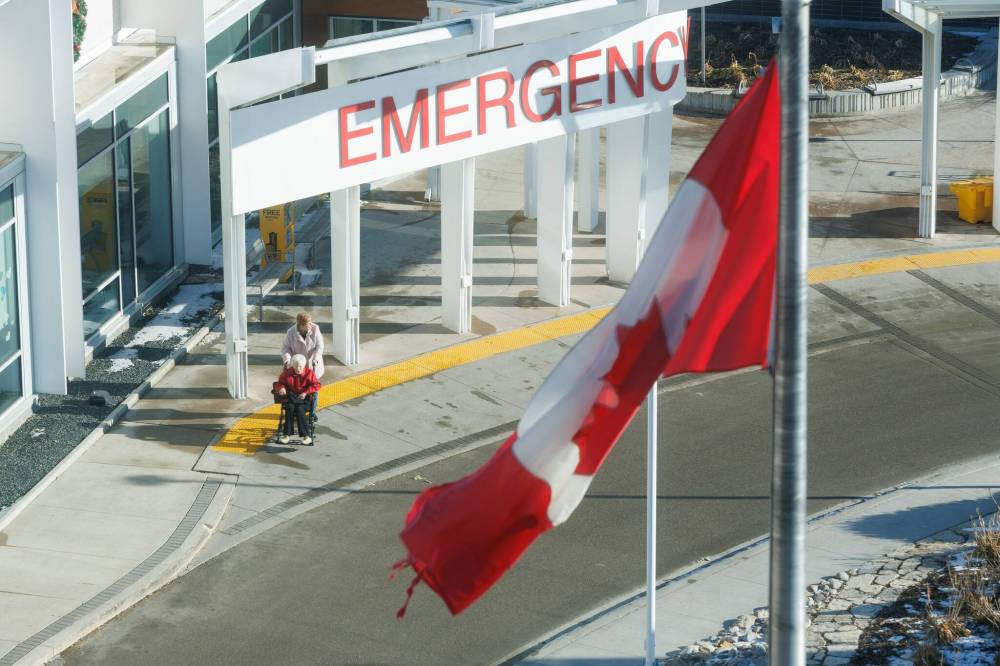
The main emergency entrance at the Grace Hospital (Mike Deal / Free Press files)
If that sounds bad, it should. But it also understates the problem.
The more revealing number is the 90th percentile — the point at which one in 10 patients waits even longer. In March, that figure reached 11.28 hours. At Grace Hospital, it was a staggering 14.53 hours. That’s not a long wait, that’s a disaster.
And yet, the numbers keep creeping up.
Before the COVID-19 pandemic, the median ER wait time in Winnipeg hovered just above two hours. It has since doubled. Not spiked temporarily, not fluctuated wildly. Doubled — and stayed there, with a steady upward trajectory.
This isn’t a system under stress, it’s a system that has fundamentally lost its ability to keep up.
The NDP government made reducing wait times a central promise in the 2023 provincial election. Voters were told help was on the way — more front-line staff, more beds, better patient flow, expanded capacity for seniors waiting for long-term care placements.
On paper, it all sounds reasonable. In practice, none of it appears to be moving the needle.
In fact, by the government’s own data, things are getting worse.
That raises an uncomfortable but unavoidable question: do the people in charge of Manitoba’s health-care system actually know how to fix it?
Because whatever strategy is being deployed now isn’t working.
And this isn’t just about inconvenience. It’s not about people grumbling in waiting rooms or scrolling their phones for hours on end. These are patients, many of them seriously ill or in severe pain, waiting in overcrowded ERs where delays can — and do — lead to worse outcomes.
We’ve already seen cases where patients have died after long waits for care. Those aren’t isolated tragedies, they’re warning signs.
There’s also a growing body of evidence showing that patients stuck on stretchers in emergency rooms — sometimes for days — receive a lower standard of care than those admitted to proper hospital beds.
This is not how a modern health-care system is supposed to function.
So why does it keep happening?
Part of the problem is capacity. There simply isn’t enough of it.
But capacity alone doesn’t explain the steady deterioration over the past decade.
The deeper issue is planning — or, more accurately, the lack of it.
Manitoba’s population is aging. That’s not a surprise. It’s been known for years, even decades. Older populations use more health-care services, they stay in hospital longer and they require more complex care. And many are living longer.
Yet, there has been little evidence of a coherent, long-term strategy to deal with that reality.
Instead, governments of all stripes have opted for short-term fixes — adding a few beds here, hiring a few staff there, shuffling resources around the system in response to the latest pressure point.
It’s reactive, not proactive. And it shows.
Perhaps the most telling detail to emerge this year was the admission that Shared Health doesn’t even know how many front-line staff are needed to meet current and future demand.
We’re dealing with record wait times, overcrowded emergency rooms and a growing population with increasing health-care needs and the agency responsible for co-ordinating the system can’t say how many doctors, nurses and support staff are required.
That’s not a gap, that’s a blind spot.
When you’re operating a system this complex without a clear understanding of its basic requirements, you’re not really managing it, you’re improvising.
There’s also a broader cultural issue at play — one that may be even harder to fix.
Have we simply become used to this?
Long ER wait times barely register anymore. A decade ago, a 4.28-hour median wait time would have sparked outrage. Today, it barely raises eyebrows. Even a 10- or 12-hour wait is often met with resignation rather than anger.
That’s a problem.
Because public systems don’t improve when expectations fall. They improve when people demand better and when governments feel pressure to deliver it.
Manitobans pay a lot in taxes for health care. They should expect timely access to it. Not perfection, but competence. Not miracles, but a system that functions.

Right now, that’s not what we have.
We have a system that is consistently failing to meet demand, a government that insists it’s making progress despite evidence to the contrary, and a planning framework that appears, at best, incomplete.
None of this is unsolvable. But it requires a clear, data-driven plan for staffing, capacity and patient flow — one that looks not just at today’s pressures, but at where demand will be five, 10 and 20 years from now.
Until that happens, don’t expect the records to stop.
tom.brodbeck@freepress.mb.ca
Tom Brodbeck is an award-winning author and columnist with over 30 years experience in print media. He joined the Free Press in 2019. Born and raised in Montreal, Tom graduated from the University of Manitoba in 1993 with a Bachelor of Arts degree in economics and commerce. Read more about Tom.
Tom provides commentary and analysis on political and related issues at the municipal, provincial and federal level. His columns are built on research and coverage of local events. The Free Press’s editing team reviews Tom’s columns before they are posted online or published in print – part of the Free Press’s tradition, since 1872, of producing reliable independent journalism. Read more about Free Press’s history and mandate, and learn how our newsroom operates.
Our newsroom depends on a growing audience of readers to power our journalism. If you are not a paid reader, please consider becoming a subscriber.
Our newsroom depends on its audience of readers to power our journalism. Thank you for your support.
Tom Brodbeck is an award-winning author and columnist with over 30 years experience in print media. He joined the Free Press in 2019. Born and raised in Montreal, Tom graduated from the University of Manitoba in 1993 with a Bachelor of Arts degree in economics and commerce. Read more about Tom.
Tom provides commentary and analysis on political and related issues at the municipal, provincial and federal level. His columns are built on research and coverage of local events. The Free Press’s editing team reviews Tom’s columns before they are posted online or published in print – part of the Free Press’s tradition, since 1872, of producing reliable independent journalism. Read more about Free Press’s history and mandate, and learn how our newsroom operates.
Our newsroom depends on a growing audience of readers to power our journalism. If you are not a paid reader, please consider becoming a subscriber.
Our newsroom depends on its audience of readers to power our journalism. Thank you for your support.
Related Articles
Defective dashboard erred on ER wait times



Advertisement Advertise With Us
Advertisement Advertise With Us