

Before punishment, guilt must be established
Advertisement
Read this article for free:
or
Already have an account? Log in here »
To continue reading, please subscribe:
Digital Subscription
One year of digital access for only $1.44 a week*
- Enjoy unlimited reading on winnipegfreepress.com
- Read the E-Edition, our digital replica newspaper
- Access News Break, our award-winning app
- Play interactive puzzles
*Billed as $5.77 plus GST every four weeks. After 52 weeks, price increases to the regular rate of $19.95 plus GST every four weeks. Offer available to new and qualified returning subscribers only. Cancel any time.
To continue reading, please subscribe:
Add Free Press access to your Brandon Sun subscription for only an additional
$1 for the first 4 weeks*
- Enjoy unlimited reading on winnipegfreepress.com
- Read the E-Edition, our digital replica newspaper
- Access News Break, our award-winning app
- Play interactive puzzles
*Your next Brandon Sun subscription payment will increase by $1.00 and you will be charged $17.95 plus GST for four weeks. After four weeks, your payment will increase to $24.95 plus GST every four weeks.
Read unlimited articles for free today:
or
Already have an account? Log in here »
Winnipeg’s city council has removed Coun. Russ Wyatt from civic committees because he was charged with criminal code offences.
Were councillors entitled to take this step before Wyatt faces those charges in court?
No.
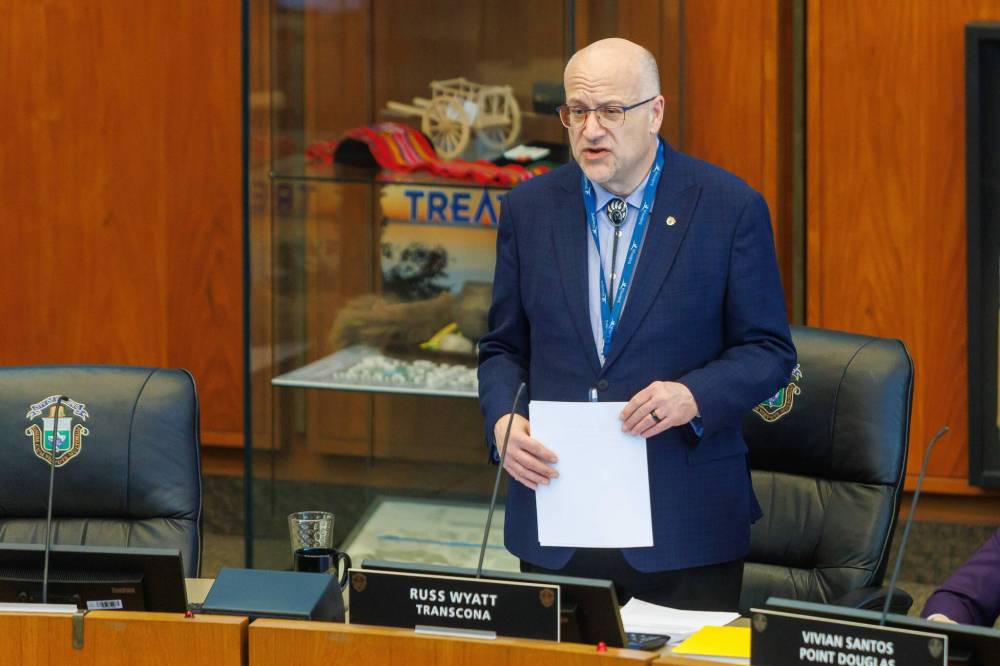
MIKE DEAL / FREE PRESS
City Coun. Russ Wyatt
Wyatt has been charged with sexual assault and administering a noxious substance, and has publicly proclaimed his innocence. Almost immediately, a debate ensued about whether Wyatt should be forced off council.
In Canada, all accused persons are presumed to be innocent until proven guilty. Removing an elected official from their job, either temporarily or permanently, would seem at first blush to be a violation of that fundamental right that all Canadians enjoy.
So, taking a different tack, councillors voted this week to remove Wyatt from seven committees and boards.
Mayor Scott Gillingham said it was nuanced compromise that maintains Wyatt’s presumption of innocence while also ensuring that his personal travails do not detrimentally affect his ability to fulfil his duties at city hall.
“So, this is a way for council to take this matter seriously, while still the presumption of innocence remains,” said Gillingham said after the vote.
Is this a fair compromise?
No, it is not.
The best thing that can be said about it is that, theatrically, it shows well in an election year.
You can understand that the mayor and councillors found themselves in an uncomfortable position.
The problem is that they don’t currently have the tools in place to use established procedure to sideline Wyatt — there aren’t existing rules that apply to any councillor who might face criminal charges.
That means that any action the council takes now is specifically punishing Wyatt for being charged.
Punishment is the court’s prerogative, but only if Wyatt is convicted.
The mayor has already said that he thinks there should be an amendment to the City of Winnipeg charter, the provincial law that dictates many of the operational and legal processes of running the city. An amendment that focuses on what should be done when an elected member of council is charged or convicted of a criminal offence would be a welcome step — but a slapdash approach now isn’t the solution.
Regrettably — and improperly — it intimates that council believes Wyatt has done something wrong.
There are policies at other levels of government that have had some impact on local government.
At the federal level, a member of parliament cannot be removed from office if they are charged with an offence. However, MPs who are convicted and sentenced to more than two years in prison automatically lose their seats.
The key word there is “convicted.” Not charged — convicted.
At the provincial level, different provinces have different protocols. In British Columbia, legislation was amended to require that provincial and municipal elected officials charged with a criminal offence be put on leave until their cases are resolved.

That may be the best solution here, one that everyone can understand from the start as a condition of their employment. All cards fully on the table, well before anyone is charged.
In voting to remove Wyatt from committees and boards, councillors seem to think they have found a workaround that lets them be seen to be taking action, but to also to somehow claim that their actions do not affect Wyatt’s rights.
It’s perfectly reasonable to tell people going into a job that there are circumstances where they would be expected to step away from their duties.
It’s different if you remove them from duties when such a policy doesn’t yet formally exist. Then, you’re sending a message.
It’s not a concept that’s all that difficult to grasp.
Related Articles
Councillors vote to remove Wyatt from civic committees



Advertisement Advertise With Us
Advertisement Advertise With Us