

Offended U.S. ambassador’s cries of bullied anguish on trade ring hypocritically hollow

Advertisement
Read this article for free:
or
Already have an account? Log in here »
To continue reading, please subscribe:

Digital Subscription
One year of digital access for only $205*
- Enjoy unlimited reading on winnipegfreepress.com
- Read the E-Edition, our digital replica newspaper
- Access News Break, our award-winning app
- Play interactive puzzles
*First annual payment billed as $205.00 + GST for one year. This annual subscription will automatically renew at $233.00 + GST every 52 weeks (10% off the regular annual price of $259.35). Offer available to new and qualified returning subscribers only. Cancel any time.
To continue reading, please subscribe:
Add Free Press access to your Brandon Sun subscription for only an additional
$1 for the first 4 weeks*
- Enjoy unlimited reading on winnipegfreepress.com
- Read the E-Edition, our digital replica newspaper
- Access News Break, our award-winning app
- Play interactive puzzles
*Your next Brandon Sun subscription payment will increase by $1.00 and you will be charged $17.95 plus GST for four weeks. After four weeks, your payment will increase to $24.95 plus GST every four weeks.
Read unlimited articles for free today:
or
Already have an account? Log in here »
You really have to feel for Pete Hoekstra.
U.S. President Donald Trump’s hand-picked ambassador to Canada has suffered innumerable indignities in the months since he officially began the job. So rough, in fact, that Hoekstra is taking his suffering public.
In an interview last week with Radio-Canada, Hoekstra defended Trump’s punishing tariffs by asserting the right of the U.S. to “do certain things that protect America.” At the same time, he assailed Canada for having the temerity to ban American alcohol.
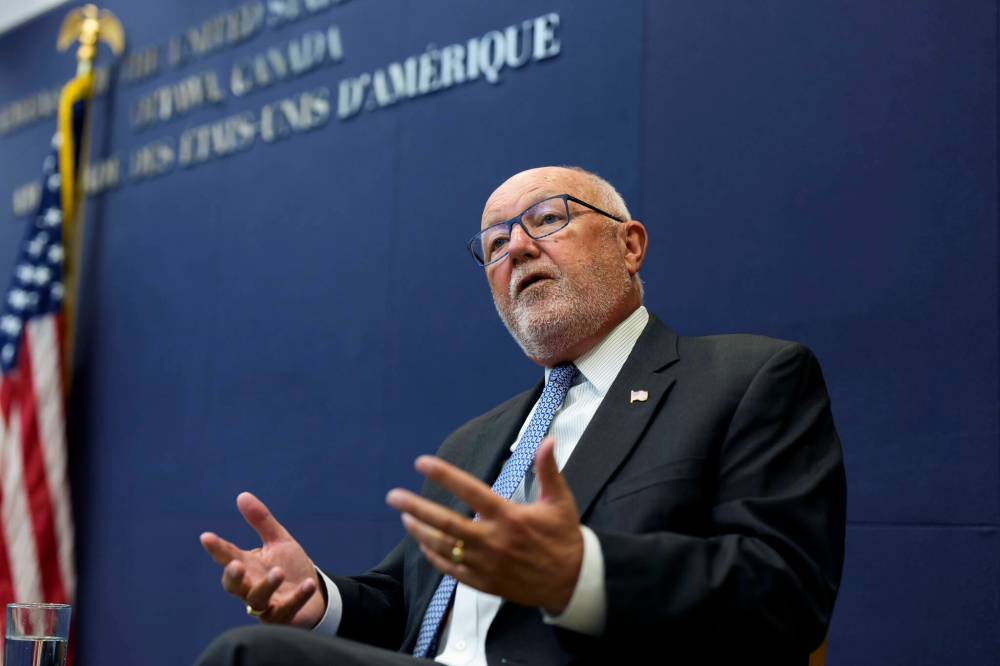
U.S. Ambassador to Canada Pete Hoekstra has been defending the U.S.’s crippling tariffs. (The Canadian Press files)
“It creates some questions about whether Canada really wants to do business with the United States,” Hoekstra told Radio-Canada.
And how did Hoekstra defend the Trump administration’s crippling tariffs, many of which were illegally levied? The ambassador expressed astonishment that Canadians would take particular umbrage to the tariffs because “it’s a policy that is uniformly administered” with all U.S. trading partners.
It has been the distinguishing characteristic of the Trump 2.0 administration to indiscriminately harm as many countries as possible in pursuit of American priorities, and then to cry red-hot tears of outrage whenever one of those countries pushes back.
The most recent outrage was triggered by the Canadian Radio-television and Telecommunications Commission, which announced last week it was increasing the levy it charges on revenues generated by foreign streaming companies to 15 per cent, up from five per cent. The levies are to be re-invested in Canadian TV and movie production.
The Trump administration and the Motion Picture Association, the lobby group that represents companies such as Netflix, Disney+, Apple TV and Prime Video, cried foul.
Hoekstra was just as hyperbolic about the CRTC levies as he is about the booze ban. “CRTC is targeting and taxing U.S. companies, putting up new, discriminatory trade barriers, and worsening the investment climate for American businesses,” Hoekstra posted on social media.
Hoekstra is trying to make this an issue about Canada, even though he is, no doubt, aware that Canada is doing only what most countries outside the U.S. do to ensure that their domestic TV and film industries are not erased from existence by the massive U.S. content machines.
The European Union requires that least 30 per cent of online streaming content is produced by member countries. Most European countries also charge levies to streamers to re-invest in domestic production; France, for example, requires streamers to allocate between 20 and 25 per cent of their net local revenue to French or European content.
Is Canada’s levy at the high-end of the spectrum? Yes, but we also face greater threat.
We are closer to the U.S. geographically and as a result, have much more integrated film and television industries. And Canada is second only to the U.S. itself in the number of hours of streaming per person. So, we’re really the best market for streamers — both in production and in consumption — outside the U.S.
Still it’s fair to ask: when Canada is trying to renegotiate a broader continental trade pact with the U.S., is bloodying the nose of streamers a good strategy?
On the one hand, it could be argued that it’s needlessly provocative. It should be noted that the previous levy of five per cent, set in 2024, is already being challenged in court by streaming companies.
On the other hand, the suggestion that Canada is going to get what it wants on trade simply through negotiation is becoming more and more absurd. Hoekstra provides excellent insight into a Trump administration that feels entitled to take what it wants from other countries without any hint of giving anything back in return.
In that context, the CRTC’s decision to triple its levy while the streamers are still involved in an initial court challenge is employing a rather Trumpian strategy. It wasn’t just provocative, it was deliberately provocative and as such, a valuable statement that on certain important issues, Canada will do what it has to do to protect Canadian interests.
In the final analysis, what else can Canada do but initiate protective measures it believes are morally legitimate and legally permissible? Waiting for a kinder, gentler Trump isn’t going to get us anywhere.
Just 16 months into his second and — one can only hope — last term as president, Trump has demonstrated quite clearly he cannot be dissuaded from doing what he wants, when he wants, with no regard to the consequences.

Republicans facing midterm challenges in the fall are begging the president to end the war in Iran, take immediate measures to stabilize inflation and abandon boondoggles such as the White House east wing ballroom expansion, the 76 metre (250 foot) victory arch in D.C. and the creation of a US $1.8-billion fund to pay compensation to victims of “government weaponization” that may include insurrectionists who stormed the U.S. Capitol on Jan. 6, 2021.
Trump’s response has been to tune out the begging and forge ahead with their plans. That makes it essential that we do what we can to protect Canadian interests.
In fact, there’s an argument to ramp up the provocation by restricting Americans’ access to Heated Rivalry, the wildly popular Canadian-made TV series.
You want to poke the Canucks? You could have to live without the heat.
dan.lett@freepress.mb.ca
Dan Lett is a columnist for the Free Press, providing opinion and commentary on politics in Winnipeg and beyond. Born and raised in Toronto, Dan joined the Free Press in 1986. Read more about Dan.
Dan’s columns are built on facts and reactions, but offer his personal views through arguments and analysis. The Free Press’ editing team reviews Dan’s columns before they are posted online or published in print — part of the our tradition, since 1872, of producing reliable independent journalism. Read more about Free Press’s history and mandate, and learn how our newsroom operates.
Our newsroom depends on a growing audience of readers to power our journalism. If you are not a paid reader, please consider becoming a subscriber.
Our newsroom depends on its audience of readers to power our journalism. Thank you for your support.
Dan Lett is a columnist for the Free Press, providing opinion and commentary on politics in Winnipeg and beyond. Born and raised in Toronto, Dan joined the Free Press in 1986. Read more about Dan.
Dan’s columns are built on facts and reactions, but offer his personal views through arguments and analysis. The Free Press’ editing team reviews Dan’s columns before they are posted online or published in print — part of the our tradition, since 1872, of producing reliable independent journalism. Read more about Free Press’s history and mandate, and learn how our newsroom operates.
Our newsroom depends on a growing audience of readers to power our journalism. If you are not a paid reader, please consider becoming a subscriber.
Our newsroom depends on its audience of readers to power our journalism. Thank you for your support.
Related Articles
Motion Picture Association slams CRTC rules on Canadian content investment



Advertisement Advertise With Us
Advertisement Advertise With Us
History
Updated on Monday, May 25, 2026 3:56 PM CDT: Removes incorrect date reference