

Teaching, learning are unrealistic expectations in intolerably hot classrooms

Advertisement
Read this article for free:
or
Already have an account? Log in here »
To continue reading, please subscribe:
Digital Subscription
One year of digital access for only $1.44 a week*
- Enjoy unlimited reading on winnipegfreepress.com
- Read the E-Edition, our digital replica newspaper
- Access News Break, our award-winning app
- Play interactive puzzles
*Billed as $5.77 plus GST every four weeks. After 52 weeks, price increases to the regular rate of $19.95 plus GST every four weeks. Offer available to new and qualified returning subscribers only. Cancel any time.
To continue reading, please subscribe:
Add Free Press access to your Brandon Sun subscription for only an additional
$1 for the first 4 weeks*
- Enjoy unlimited reading on winnipegfreepress.com
- Read the E-Edition, our digital replica newspaper
- Access News Break, our award-winning app
- Play interactive puzzles
*Your next Brandon Sun subscription payment will increase by $1.00 and you will be charged $17.95 plus GST for four weeks. After four weeks, your payment will increase to $24.95 plus GST every four weeks.
Read unlimited articles for free today:
or
Already have an account? Log in here »
There is something fundamentally wrong with a province that can find room for tax cuts yet still sends thousands of children and teachers into classrooms that feel more like saunas than places of learning.
As another spring heat wave grips Manitoba, schools are once again scrambling to deal with soaring indoor temperatures. Classes are being shortened or cancelled.
Students are struggling to focus. Teachers are filing health and safety reports. In one reported case, a classroom temperature reached an astonishing 42 C.
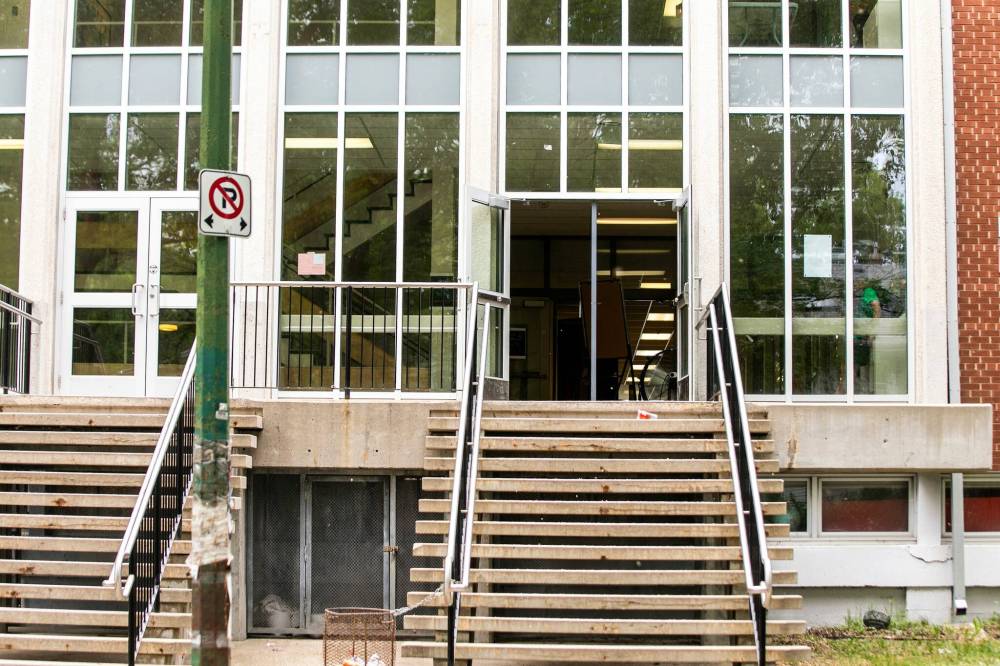
MIKAELA MACKENZIE / FREE PRESS FILES
Kelvin High School propped one of the front doors open in an attempt to cool the building earlier this week, one of many Manitoba schools struggling with the heat.
And still, dozens of Winnipeg schools remain without proper air conditioning.
That should be unacceptable to every Manitoban.
The debate over school funding often revolves around teacher staffing, curriculum, literacy scores and nutrition programs. Those are all are important. But none of them matter much if students are sitting in classrooms so hot they can barely concentrate.
This is not a minor comfort issue. It is a health and safety issue and an educational issue.
Anyone who has spent time indoors at those temperatures knows exactly what happens. Concentration fades. Fatigue sets in. Productivity collapses.
The Manitoba Teachers’ Society says students become lethargic once classrooms hit 30 C. Teachers face the same conditions. Reports have already been filed about extreme heat at Kelvin High School and at Helen Betty Osborne Ininiw Education Resource Centre in Norway House, where students were dismissed early.
The Winnipeg School Division’s own capital plan paints a troubling picture. Twenty-one buildings have no air conditioning system at all. Another 27 have schools or wings without cooling technology. Fourteen more require replacement systems because their equipment is outdated or failing.
This is not an isolated maintenance problem. It’s a widespread infrastructure failure.
To his credit, superintendent Matt Henderson has been candid about the challenge. Winnipeg has many old buildings never designed for prolonged 30-degree weather in May and June. Facilities staff are hauling industrial fans into schools and installing portable air conditioners where electrical capacity allows.
That may provide temporary relief, but nobody should confuse emergency measures with a long-term solution.
Fans do not solve structural heat problems. Portable units are stopgaps. They are evidence of a system trying to patch over deficiencies that should have been addressed years ago.
The estimated cost to equip all Winnipeg schools with air conditioning is roughly $200 million.
That’s not pocket change. But neither is it some impossible fantasy beyond the reach of government.
Manitoba governments of all political stripes routinely make choices involving hundreds of millions of dollars. They announce tax reductions, infrastructure projects and spending priorities based on what they consider important.
That is exactly what this comes down to: priorities.
The province argues air conditioning competes with other pressing needs, including staffing and nutrition programs. Education Minister Tracy Schmidt says difficult decisions are required and that government is doing its best.
No one doubts schools face competing demands. But framing this as a choice between student comfort and educational programming misses the point entirely.
Students cannot properly benefit from staffing, curriculum or nutrition initiatives when learning environments are physically intolerable.
Air conditioning is no longer a luxury upgrade reserved for newer buildings.
Climate realities have changed.
Manitoba is experiencing hotter weather earlier in the year. Heat waves arriving in May and lingering through June are increasingly common. Schools built decades ago were never designed for these conditions, but that only strengthens the case for modernization.
Governments routinely adapt infrastructure to changing realities. Roads are rebuilt. Flood protections are strengthened. Water systems are upgraded.
Schools should not be treated differently.
The situation in northern communities makes the issue even more urgent. Schools in Norway House have already experienced disruptions because of heat concerns. Helen Betty Osborne and Jack River School have faced shortened days as administrators try to protect students.
Children in northern and Indigenous communities should not be expected to endure unsafe classroom conditions because infrastructure renewal moves too slowly.
The Manitoba Teachers’ Society is right to call for mandatory indoor temperature standards. Clear rules would establish expectations and eliminate ambiguity about when conditions become unsafe.
But standards alone will not cool classrooms.
Money and political will are required.
The good news is this problem is solvable.
New schools, such as the planned K-8 building in Devonshire Park, are being constructed with modern HVAC systems. That proves governments already recognize climate-controlled learning environments are essential.
The question is why students in older schools should be expected to settle for less.
There is no educational virtue in sweating through algebra or trying to write exams while heat radiates off classroom walls.

Safe and comfortable schools are not extravagant demands. They are basic public responsibilities.
Governments that can debate tax relief and find resources for other priorities can find the money to modernize schools, as well.
Children should not have to leave school early or search for air conditioning during lunch hour simply to make it through the day.
A classroom should be a place for learning — not endurance.
tom.brodbeck@freepress.mb.ca
Tom Brodbeck is an award-winning author and columnist with over 30 years experience in print media. He joined the Free Press in 2019. Born and raised in Montreal, Tom graduated from the University of Manitoba in 1993 with a Bachelor of Arts degree in economics and commerce. Read more about Tom.
Tom provides commentary and analysis on political and related issues at the municipal, provincial and federal level. His columns are built on research and coverage of local events. The Free Press’s editing team reviews Tom’s columns before they are posted online or published in print – part of the Free Press’s tradition, since 1872, of producing reliable independent journalism. Read more about Free Press’s history and mandate, and learn how our newsroom operates.
Our newsroom depends on a growing audience of readers to power our journalism. If you are not a paid reader, please consider becoming a subscriber.
Our newsroom depends on its audience of readers to power our journalism. Thank you for your support.
Tom Brodbeck is an award-winning author and columnist with over 30 years experience in print media. He joined the Free Press in 2019. Born and raised in Montreal, Tom graduated from the University of Manitoba in 1993 with a Bachelor of Arts degree in economics and commerce. Read more about Tom.
Tom provides commentary and analysis on political and related issues at the municipal, provincial and federal level. His columns are built on research and coverage of local events. The Free Press’s editing team reviews Tom’s columns before they are posted online or published in print – part of the Free Press’s tradition, since 1872, of producing reliable independent journalism. Read more about Free Press’s history and mandate, and learn how our newsroom operates.
Our newsroom depends on a growing audience of readers to power our journalism. If you are not a paid reader, please consider becoming a subscriber.
Our newsroom depends on its audience of readers to power our journalism. Thank you for your support.
Related Articles
Heat wave leaves schools sweltering
Advertisement Advertise With Us
Advertisement Advertise With Us