

Brandon not immune to drug crisis
Advertisement
Read this article for free:
or
Already have an account? Log in here »
To continue reading, please subscribe:

Digital Subscription
One year of digital access for only $205*
- Enjoy unlimited reading on winnipegfreepress.com
- Read the E-Edition, our digital replica newspaper
- Access News Break, our award-winning app
- Play interactive puzzles
*First annual payment billed as $205.00 + GST for one year. This annual subscription will automatically renew at $233.00 + GST every 52 weeks (10% off the regular annual price of $259.35). Offer available to new and qualified returning subscribers only. Cancel any time.
To continue reading, please subscribe:
Add Free Press access to your Brandon Sun subscription for only an additional
$1 for the first 4 weeks*
- Enjoy unlimited reading on winnipegfreepress.com
- Read the E-Edition, our digital replica newspaper
- Access News Break, our award-winning app
- Play interactive puzzles
*Your next Brandon Sun subscription payment will increase by $1.00 and you will be charged $17.95 plus GST for four weeks. After four weeks, your payment will increase to $24.95 plus GST every four weeks.
Read unlimited articles for free today:
or
Already have an account? Log in here »
BRANDON — When Gage Wood started working as a firefighter-paramedic in Brandon a decade ago, it was “very rare” to respond to an opioid overdose.
But now, emergency services are called to more than 100 overdoses per year.
“I think that the whole community of Brandon is feeling the effects of the drug crisis … These are people that need help,” said Wood, the union president for Brandon Firefighter Paramedics Local 803.
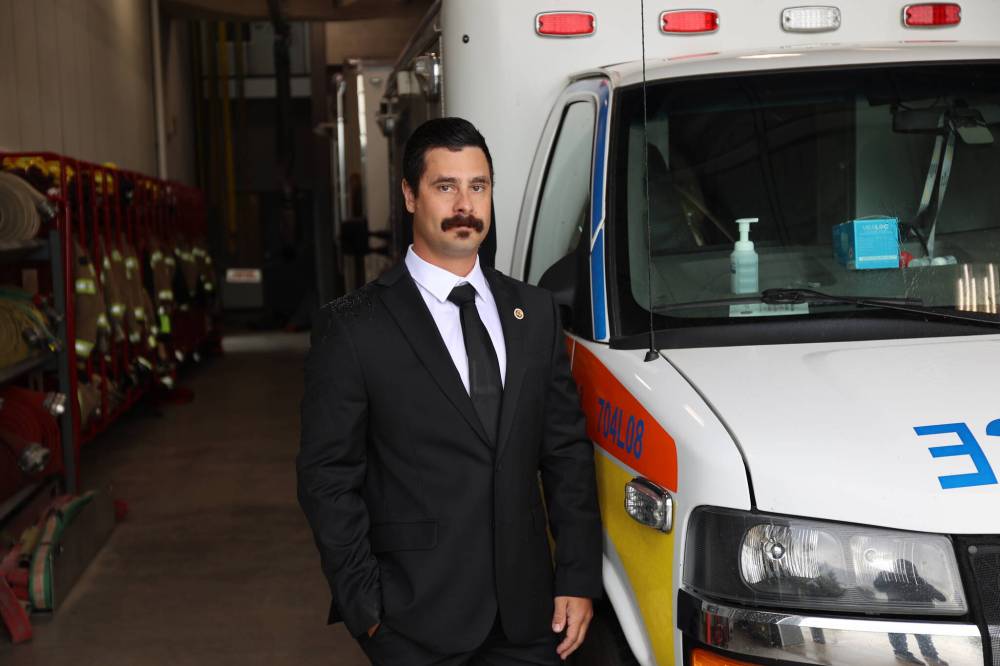
Abiola Odutola/The Brandon Sun files
Brandon Firefighter Paramedics union president, Gage Wood.
“We might not have the same, you know, 66 kind of overdoses in one weekend, like Winnipeg, but we’re definitely dealing with this issue at scale in Brandon.”
Wood said street drugs have become more potent.
“We’re not just dealing with fentanyl anymore,” he said. “We’re dealing with carfentanil … There’s even things like tranquilizers being put into the drug supply now, and unfortunately, Narcan doesn’t work on everything.”
Carfentanil is a synthetic opioid about 10,000 times more potent than morphine and 100 times more potent than fentanyl. Narcan is the brand name for naloxone, a fast-acting medication used to reverse the effects of opioid overdoses.
People are also overdosing on methamphetamine and down or purple down, which comes in waves, Wood said.
Brandon Fire Emergency Services has responded to nearly 50 overdoses so far this year, Wood said. Narcan was administered more than 30 times.
In 2025, firefighter-paramedics responded to around 135 overdoses and Narcan was needed to revive someone in 60 of those cases, he said. In 2024, crews responded to more than 140 overdoses.
The data include emergency medical responses to all overdoses — from illicit drugs to Tylenol — and overlap with data from Brandon police because both emergency services may get dispatched to the same call for safety reasons, Wood said.
Brandon Police Service Sgt. Kirby Sararas said local firefighter-paramedics are the primary responders to overdoses in the city.
“We go in an assisting role just in case the person who is experiencing the overdose kind of becomes violent with paramedics or if they need assistance in any other manner,” she said.
Brandon police officers have responded to 13 overdoses this year as of May, one of those instances was fatal, data show.
Last year, police responded to 51 overdoses, and five of those resulted in death. In 2024, police were called to 52 overdoses, and 11 people could not be revived.
The numbers can change as autopsy and toxicology reports are completed, a BPS spokesperson said.
In 2025, there were 388 substance-related deaths across Manitoba, a decrease from 570 in 2024, preliminary data from the chief medical examiner’s office show.
The overdose crisis is a result of a toxic supply, with people ingesting substances they weren’t aware were cut with a combination of dangerous drugs, said Solange Machado, Brandon’s co-ordinator for the Manitoba Harm Reduction Network.
Communities typically see a spike in overdoses following a major drug bust because the supply becomes more potent and life-threatening, she said.
She estimates the number of overdoses occurring in the city is drastically higher than the official tally because the majority of cases are successfully reversed by a friend, family or community member who may not call 911.
“We always recommend that people call emergency services, but we just know that some people don’t have the means to, or there’s fear or other things preventing them,” she said.
Firefighter-paramedics are using higher dosages of Narcan because some substances, such as animal tranquilizers, don’t respond to the medication, Wood said.
Years ago, emergency crews used around 0.4 milligrams of Narcan to reverse a fentanyl overdose, he said. Since then, the highest dosage he’s seen administered was 14 milligrams.
“The other scary thing is that Narcan doesn’t last as long as some of the substances that people are taking,” he said.
Sometimes when an overdose has been reversed, people think they are fine and don’t need additional care at a hospital, but there’s a chance they could start overdosing again, Wood said.
Medical responses to overdoses don’t make up a huge portion of calls in the EMS system, but the city continues to be “taxed to the limit” with five ambulances — two of which are dedicated to inter-facility transfers, he said.

Jade Gamblin, a patrol supervisor with Brandon Bear Clan, said community members frequently ask them for Narcan during their patrols, but the group doesn’t have enough supply to hand it out.
Hearing about how many people are overdosing in the community is “heartbreaking … because addiction is real in Brandon. Instability, poverty, the mental health crisis — a lot of people are struggling,” she said.
Data from the Indigenous-led group show volunteers picked up more than 1,400 needles last year.
This year, volunteers have safely disposed of 30 to 150 needles, stems or bubble pipes per patrol.
— Brandon Sun
Related Articles
Fathers united by loss share warning about dangers of fentanyl
Advertisement Advertise With Us
Advertisement Advertise With Us