

PMO issued communique on proposed Manitoba project without doing its homework

Advertisement
Read this article for free:
or
Already have an account? Log in here »
To continue reading, please subscribe:
Digital Subscription
One year of digital access for only $1.44 a week*
- Enjoy unlimited reading on winnipegfreepress.com
- Read the E-Edition, our digital replica newspaper
- Access News Break, our award-winning app
- Play interactive puzzles
*Billed as $5.77 plus GST every four weeks. After 52 weeks, price increases to the regular rate of $19.95 plus GST every four weeks. Offer available to new and qualified returning subscribers only. Cancel any time.
To continue reading, please subscribe:
Add Free Press access to your Brandon Sun subscription for only an additional
$1 for the first 4 weeks*
- Enjoy unlimited reading on winnipegfreepress.com
- Read the E-Edition, our digital replica newspaper
- Access News Break, our award-winning app
- Play interactive puzzles
*Your next Brandon Sun subscription payment will increase by $1.00 and you will be charged $17.95 plus GST for four weeks. After four weeks, your payment will increase to $24.95 plus GST every four weeks.
Read unlimited articles for free today:
or
Already have an account? Log in here »
Premier Wab Kinew was so upset, he got his European cities mixed up.
Kinew was asked last week on a Winnipeg radio show about Prime Minister Mark Carney’s decision to include Sio Silica — an Alberta company with German and American partners proposing an as-yet unlicensed sand mining project in Manitoba — on a list of promising Canadian critical mineral projects issued during last week’s G7 summit.
Kinew said Manitoba would not be swayed by the prime minister’s hyperbole into approving Sio Silica’s Vivian Sand Extraction Project, which is believed to pose a threat to drinking water used by more than 100,000 people in southeastern Manitoba.
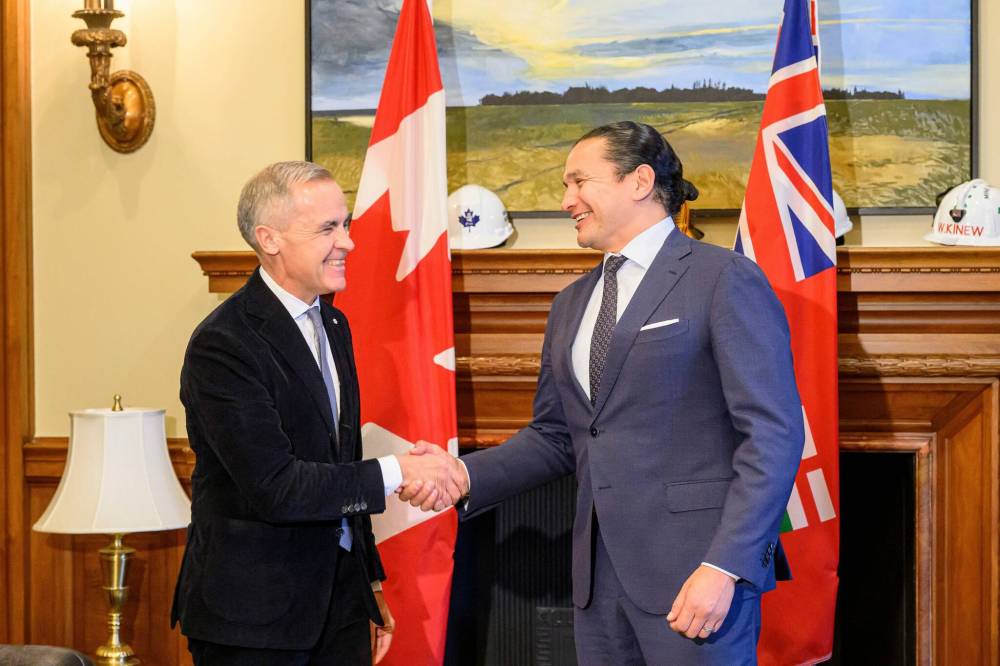
Mike Sudoma/Free Press Files
Prime Minister Mark Carney and Manitoba Premier Wab Kinew during a visit to the Manitoba Legislature, last November.
“I work for the people of eastern Manitoba, not for the Davos crowd,” Kinew said. “We’re going to continue to put the drinking water and the priorities of the people who live in this province first.”
An unapologetic quibbler might note the G7 took place in Evian, France, and not Davos, Switzerland, home to the often-assailed World Economic Forum. But given that Kinew was clearly blindsided by Carney’s communique, he can be forgiven for mistaking one European playground for the rich and famous for another.
The main issue for quibbling is why Carney used the G7 to highlight a project in Manitoba that not only failed to obtain an environmental licence, but was the focus of one of the province’s biggest political scandals.
It is a safe assumption that Sio Silica somehow managed to convince the Prime Minister’s Office to include the Manitoba project despite its shortcomings. It’s also safe to assume Sio Silica was thrilled and buoyed by Carney’s endorsement. (The company issued a same-day news release out-trumpeting the communique and thanking the PMO for “the support and engagement of the Government of Canada.”
It’s hard to believe the PMO fully understood what it was getting with the Sio Silica reference. At the same time, it’s not hard to see why Carney’s people would love the idea of the Sio Silica project.
It involves a source of high-grade silica sand located close to major transportation infrastructure that carries the promise of value-added investments in the form of glass or solar-panel manufacturing. That is exactly the kind of project the Carney government needs to establish Canada’s reputation as a critical mineral powerhouse.
And yet, those details don’t tell the whole story.

Sio Silica arrived in Manitoba in 2019 with a controversial plan to sink more than 7,000 wells and pump out ground water containing high-quality silica sand.
There were two major problems with the proposal: Sio Silica’s technology had never been used for that kind of application; and the aquifer they wanted to invade is a crucial source of drinking water for more than 100,000 people.
In 2024, the NDP government rejected Sio Silica’s licence application, deciding the risks of the proposal far outweighed the potential rewards. The company has made a second application, with a scaled-back proposal that involves fewer wells and lower volumes of water.
The unresolved environmental concerns surrounding that proposal might be reason enough for the PMO to leave the company out of its G7 communique. But there is also the fact Sio Silica was directly involved in one of Manitoba’s biggest political scandals.
After losing the 2023 election, former premier Heather Stefanson, along with cabinet ministers Jeff Wharton and Cliff Cullen, attempted to force bureaucrats to issue a licence to Sio Silica. The former premier and her ministers violated the so-called “caretaker convention,” a principle of parliamentary democracy that bars outgoing governments from making major decisions before a new government takes control.
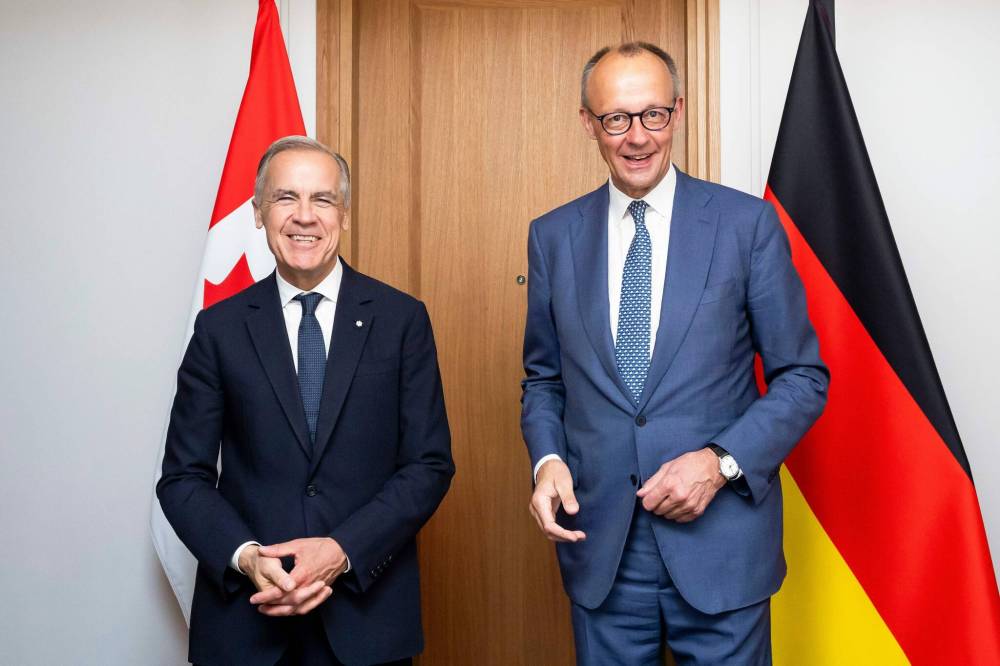
CHRISTOPHER KATSAROV / THE CANADIAN PRESS
Prime Minister Mark Carney (left) with German Chancellor Friedrich Merz during the G7 summit in Evian-les-Bains, France, on Wednesday.
The province’s ethics commissioner found Stefanson, Wharton and Cullen had violated the province’s conflict-of-interest legislation and — in a historic first — recommended fines ($18,000 for Stefanson, $12,000 for Cullen and $10,000 for Wharton) approved by members of the legislature.
Sio Silica was not punished in the conflict-of-interest investigation, but it’s hard to believe the company was not aware, and tacitly supportive, of what the outgoing premier and two of her ministers were doing.
If there are misgivings in Ottawa about the decision to include Sio Silica in the communique, they are being carefully concealed.
Northern and Arctic Affairs Minister Rebecca Chartrand, Manitoba’s senior representative in the federal Liberal government, said in an emailed statement the G7 communique was not intended to sway the province on environmental approval.
“This is a project involving two private-sector companies and the federal government played no role in that,” Chartrand said. “We would expect that before anything happens, the project would receive provincial environmental approval.”
Ah, but there’s the rub.
Even as the company takes another run at environmental licensing, Kinew is readying a public inquiry into the actions of Stefanson and her ministers. That makes approval of the project highly unlikely.
Would the PMO have included Sio Silica in its communique if it had known any of this? It seems possible, even probable, that the authors of the communique saw that Sio Silica has a live licensing application, and decided that was proof enough of its viability.
Sio Silica celebrated the “engagement and support” of the federal government in pursuit of its project. In the end, all that Ottawa has done is harden the Kinew government’s apparent resolve to keep the project on the drawing board.
dan.lett@freepress.mb.ca
Dan Lett is a columnist for the Free Press, providing opinion and commentary on politics in Winnipeg and beyond. Born and raised in Toronto, Dan joined the Free Press in 1986. Read more about Dan.
Dan’s columns are built on facts and reactions, but offer his personal views through arguments and analysis. The Free Press’ editing team reviews Dan’s columns before they are posted online or published in print — part of the our tradition, since 1872, of producing reliable independent journalism. Read more about Free Press’s history and mandate, and learn how our newsroom operates.
Our newsroom depends on a growing audience of readers to power our journalism. If you are not a paid reader, please consider becoming a subscriber.
Our newsroom depends on its audience of readers to power our journalism. Thank you for your support.
Dan Lett is a columnist for the Free Press, providing opinion and commentary on politics in Winnipeg and beyond. Born and raised in Toronto, Dan joined the Free Press in 1986. Read more about Dan.
Dan’s columns are built on facts and reactions, but offer his personal views through arguments and analysis. The Free Press’ editing team reviews Dan’s columns before they are posted online or published in print — part of the our tradition, since 1872, of producing reliable independent journalism. Read more about Free Press’s history and mandate, and learn how our newsroom operates.
Our newsroom depends on a growing audience of readers to power our journalism. If you are not a paid reader, please consider becoming a subscriber.
Our newsroom depends on its audience of readers to power our journalism. Thank you for your support.
Related Articles
Kinew not swayed by PM’s support for silica sand mining project

Advertisement Advertise With Us
Advertisement Advertise With Us