

Two-track Trump’s bluster best taken with grain of salt

Advertisement
Read this article for free:
or
Already have an account? Log in here »
To continue reading, please subscribe:

Digital Subscription
One year of digital access for only $205*
- Enjoy unlimited reading on winnipegfreepress.com
- Read the E-Edition, our digital replica newspaper
- Access News Break, our award-winning app
- Play interactive puzzles
*First annual payment billed as $205.00 + GST for one year. This annual subscription will automatically renew at $233.00 + GST every 52 weeks (10% off the regular annual price of $259.35). Offer available to new and qualified returning subscribers only. Cancel any time.
To continue reading, please subscribe:
Add Free Press access to your Brandon Sun subscription for only an additional
$1 for the first 4 weeks*
- Enjoy unlimited reading on winnipegfreepress.com
- Read the E-Edition, our digital replica newspaper
- Access News Break, our award-winning app
- Play interactive puzzles
*Your next Brandon Sun subscription payment will increase by $1.00 and you will be charged $17.95 plus GST for four weeks. After four weeks, your payment will increase to $24.95 plus GST every four weeks.
Read unlimited articles for free today:
or
Already have an account? Log in here »
By now, everyone knows Donald Trump has made it nearly impossible to know what to believe from one day to the next when it comes to tariffs, trade deals or other thorny global issues.
One day the U.S. president threatens massive tariffs, the next, he hints at exemptions. One morning he declares a trade deal is dead or that “we don’t need anything that Canada has.” And by afternoon, officials are quietly arranging another round of negotiations.
Trump’s often incoherent or inaccurate social media posts can send markets tumbling (or soaring), only to be contradicted hours later by members of his own administration.
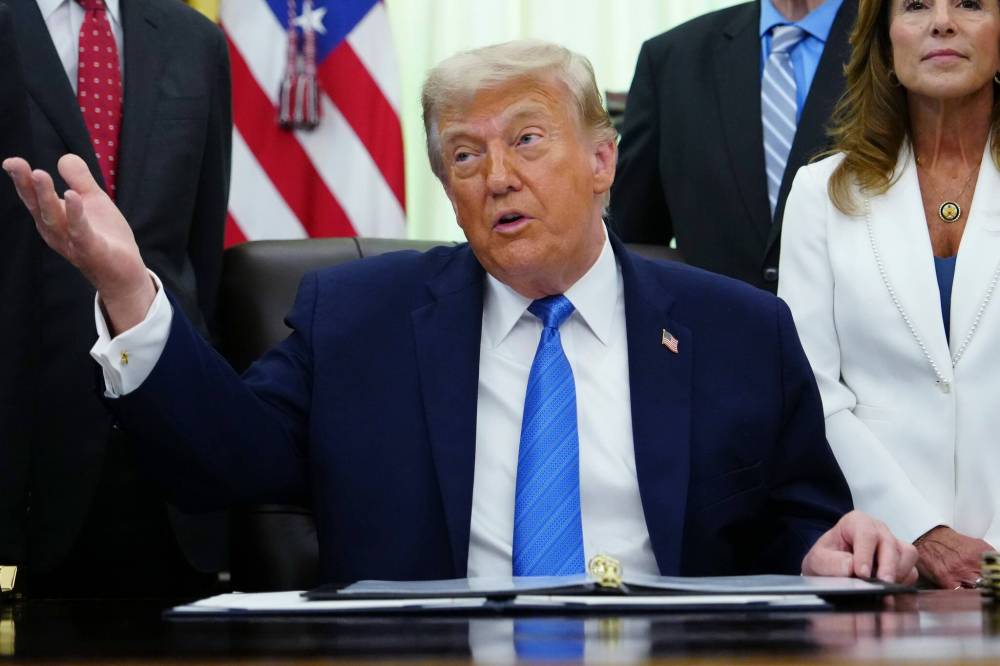
JULIA DEMAREE NIKHINSON / THE ASSOCIATED PRESS FILES
President Donald Trump
For governments dealing with the United States, that has become the new normal.
But what people should remember is that Trump’s public comments don’t necessarily represent official U.S. policy and rarely represent the final outcome of anything.
That’s because there are effectively two tracks operating simultaneously.
The first is the highly visible Trump track — public statements, social media posts and impromptu comments to reporters that are often wrong or misleading. Those seem designed more for political theatre than policy, if they’re designed for anything at all.
The second is the quieter diplomatic track, where experienced civil servants, trade negotiators and senior officials continue doing the painstaking work of finding agreements that actually function.
Those two tracks frequently appear to be heading in opposite directions. Canada’s ongoing trade negotiations illustrate the point perfectly.
Last week, the Trump administration confirmed it will require annual reviews of the Canada-U.S.-Mexico Agreement rather than allowing the current agreement to remain in place until 2042, as Canada and Mexico had hoped.
On the surface, that sounds like another example of Trump injecting uncertainty into North American trade. And it certainly does create uncertainty.
Even Canada’s Trade Minister Dominic LeBlanc admitted Ottawa doesn’t yet know how the annual review process will work because nothing like it has existed before.
There is no road map and no established process.
U.S. Trade Representative Jamieson Greer also couldn’t explain how the reviews will be structured when Canada and Mexico asked.
Yet while all that uncertainty dominates headlines, something else is happening behind the scenes.
Canadian and American officials continue scheduling bilateral meetings. Chief negotiators remain in regular contact. Discussions continue on reducing tariffs on steel, aluminum and softwood lumber and both sides continue searching for common ground.
None of that generates dramatic headlines. But it’s probably more important than whatever Trump posts on his Truth Social platform on any given day.
LeBlanc’s comments were revealing. Despite acknowledging the uncertainty created by the White House, he also said he remains confident Canada will eventually reach a bilateral agreement with the United States and establish more predictability around the CUSMA review process.
That confidence isn’t based on wishful thinking. It’s based on what’s happening on the diplomatic track. The same pattern has emerged repeatedly throughout Trump’s presidency.
His public rhetoric often establishes negotiating positions that are far more aggressive than the eventual outcome. Markets sometimes panic and media outlets report every new Trump declaration as though it represents settled policy.
Then days, weeks or months later, officials quietly negotiate something considerably less dramatic.
Despite Trump’s tariff threats, CUSMA continues protecting most Canadian exports that comply with the agreement.
The same two-track reality exists well beyond trade. Take peace talks around the U.S.-Iran conflict. Trump’s often inflammatory public comments usually suggest confrontation, even when American diplomats and intermediaries continue exploring diplomatic openings through indirect channels.
Publicly, it can appear diplomacy is dead. Privately, discussions continue.
That doesn’t guarantee success. Sometimes negotiations fail. Sometimes Trump’s public position ultimately prevails.
But understanding how this administration operates means recognizing that public statements and private negotiations are often entirely different conversations.
That presents an enormous challenge for countries like Canada. Ottawa can’t afford to overreact every time Trump makes an inflammatory comment, nor can it ignore those comments altogether.
Instead, Canadian officials must simultaneously respond politically to Trump’s public messaging while continuing to negotiate with the American officials responsible for turning presidential objectives, if you can call them that, into actual policy.
It’s a frustrating way to conduct international relations. Traditional diplomacy relies heavily on predictability, consistency and carefully crafted public messaging. But Trump thrives on unpredictability.
He frequently changes positions, contradicts advisers and leaves allies wondering whether yesterday’s announcement still applies today.
That uncertainty carries real economic consequences. Businesses delay investments. Markets become volatile. Governments struggle to plan for the future.
Yet beneath all the political noise, institutions continue functioning. Trade officials still meet and civil servants still draft agreements.
The machinery of government keeps moving even when the political messaging appears chaotic.

That doesn’t eliminate the uncertainty. It simply explains why experienced negotiators often remain calmer than television commentators. They understand that with Trump, the loudest voice isn’t always the decisive one.
His comments matter because he is president. But they are often only the opening bid in a much longer negotiation.
For Canada, that means resisting the temptation to treat every presidential outburst as the final chapter.
With Donald Trump, there are almost always two conversations happening at once — the one everyone sees, and the one that actually determines where things eventually end up.
tom.brodbeck@freepress.mb.ca
Tom Brodbeck is an award-winning author and columnist with over 30 years experience in print media. He joined the Free Press in 2019. Born and raised in Montreal, Tom graduated from the University of Manitoba in 1993 with a Bachelor of Arts degree in economics and commerce. Read more about Tom.
Tom provides commentary and analysis on political and related issues at the municipal, provincial and federal level. His columns are built on research and coverage of local events. The Free Press’s editing team reviews Tom’s columns before they are posted online or published in print – part of the Free Press’s tradition, since 1872, of producing reliable independent journalism. Read more about Free Press’s history and mandate, and learn how our newsroom operates.
Our newsroom depends on a growing audience of readers to power our journalism. If you are not a paid reader, please consider becoming a subscriber.
Our newsroom depends on its audience of readers to power our journalism. Thank you for your support.
Tom Brodbeck is an award-winning author and columnist with over 30 years experience in print media. He joined the Free Press in 2019. Born and raised in Montreal, Tom graduated from the University of Manitoba in 1993 with a Bachelor of Arts degree in economics and commerce. Read more about Tom.
Tom provides commentary and analysis on political and related issues at the municipal, provincial and federal level. His columns are built on research and coverage of local events. The Free Press’s editing team reviews Tom’s columns before they are posted online or published in print – part of the Free Press’s tradition, since 1872, of producing reliable independent journalism. Read more about Free Press’s history and mandate, and learn how our newsroom operates.
Our newsroom depends on a growing audience of readers to power our journalism. If you are not a paid reader, please consider becoming a subscriber.
Our newsroom depends on its audience of readers to power our journalism. Thank you for your support.
Advertisement Advertise With Us
Advertisement Advertise With Us