

Keystone Party, like other right-wing factions, remains irrelevant in Manitoba

Advertisement
Read this article for free:
or
Already have an account? Log in here »
To continue reading, please subscribe:

Digital Subscription
One year of digital access for only $205*
- Enjoy unlimited reading on winnipegfreepress.com
- Read the E-Edition, our digital replica newspaper
- Access News Break, our award-winning app
- Play interactive puzzles
*First annual payment billed as $205.00 + GST for one year. This annual subscription will automatically renew at $233.00 + GST every 52 weeks (10% off the regular annual price of $259.35). Offer available to new and qualified returning subscribers only. Cancel any time.
To continue reading, please subscribe:
Add Free Press access to your Brandon Sun subscription for only an additional
$1 for the first 4 weeks*
- Enjoy unlimited reading on winnipegfreepress.com
- Read the E-Edition, our digital replica newspaper
- Access News Break, our award-winning app
- Play interactive puzzles
*Your next Brandon Sun subscription payment will increase by $1.00 and you will be charged $17.95 plus GST for four weeks. After four weeks, your payment will increase to $24.95 plus GST every four weeks.
Read unlimited articles for free today:
or
Already have an account? Log in here »
Every few provincial elections, Manitoba politics produces the same ghost story.
A new right-wing political party emerges, declares the Progressive Conservatives have abandoned conservative principles and vows to offer voters a “real” conservative alternative. Political observers immediately begin wondering whether this could finally be the election where the conservative vote splits, allowing the NDP to slip up the middle and win seats it otherwise wouldn’t.
Then almost nothing happens.
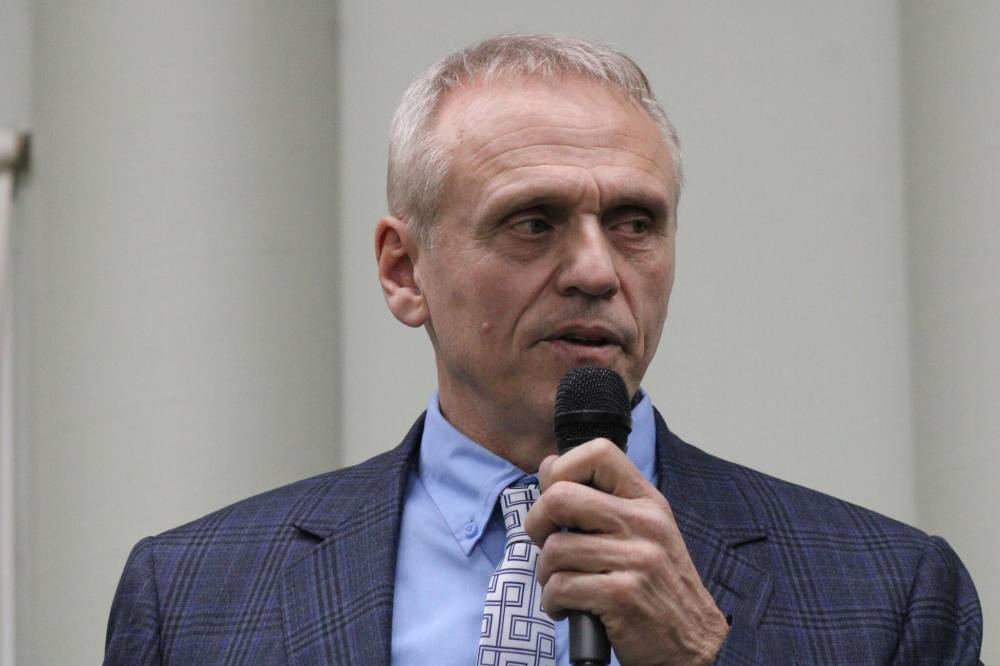
GREG VANDERMEULEN / THE CARILLON FILES
Former Progressive Conservative leadership candidate Wally Daudrich is running under the Keystone Party banner in the July 21 byelection in The Pas-Kameesak.
The new party wins a few hundred votes in ridings scattered around the province, perhaps cracks 1,000 votes where its leader is running, loses every seat and slowly disappears from public view. Eventually it folds, changes its name or is replaced by another protest party making exactly the same argument.
Manitobans have been watching this movie since at least the 1990s.
The latest cast member is the relatively new Keystone Party, which recently grabbed headlines after former PC leadership contender Wally Daudrich announced he would run under its banner in the July 21 byelection in The Pas-Kameesak.
The move may have created some awkward optics for PC Leader Obby Khan. But politically, it’s difficult to see why anyone in Tory headquarters should be concerned.
History says they shouldn’t be.
The Keystone Party, formed in 2022, barely made a ripple in the 2023 provincial election. It fielded just five candidates across the province. Most collected only a few hundred votes.
Party leader Kevin Friesen had the strongest showing, picking up 1,507 votes in the rural constituency of Turtle Mountain. But he still finished nowhere near either the Progressive Conservatives or the NDP.
The closest a fringe right-wing party in Manitoba came to splitting the vote with the Tories was perhaps in 2016 when the now-defunct, far-right Manitoba Party may have had an impact on two Winnipeg ridings.
In Elmwood, Manitoba Party candidate Albert Ratt received 579 votes while NDP incumbent Jim Maloway defeated Progressive Conservative Sarah Langevin by only 107 votes. In Concordia, the Manitoba Party picked up 254 votes while the NDP’s Matt Wiebe beat the PC candidate by a slim margin of 278 votes.
It’s easy to conclude those Manitoba Party votes would have otherwise gone to the Tories and ultimately helped the NDP win those two constituencies. But politics is rarely that tidy.
Some people vote for fringe parties simply to register a protest. Others dislike all the major parties. Some may not have voted at all if their preferred fringe candidate wasn’t on the ballot.
Assuming every Manitoba Party or Keystone Party vote would otherwise go to the Progressive Conservatives oversimplifies how people actually vote.
More importantly, those examples are the exception, not the rule.
Over the past three decades, Manitoba has seen a revolving door of conservative protest parties. They emerge because a segment of the conservative movement inevitably becomes frustrated that the PCs aren’t conservative enough, particularly on fiscal or social issues.
Yet none has ever come close to replacing the Progressive Conservatives as the dominant party on the right.
There’s a reason for that.
When elections become serious, most conservative voters recognize that only one centre-right party has any realistic chance of forming government. Whatever frustrations they may have with the PCs usually take a back seat to defeating the NDP.
That’s why the Keystone Party represents little more than background noise.
The Progressive Conservatives have a much bigger challenge staring them in the face. They need to fix their brand.
The party is still carrying political baggage from the Stefanson government and, to some extent, the Pallister years before that. Whether it’s the lingering perception of cuts to public services, unpopular health-care decisions or a style of toxic politics many Winnipeg voters rejected, the PCs have yet to convince enough moderate voters that they’ve genuinely turned the page.
Changing leaders is one thing, but changing public perceptions is another.
And that’s where elections in Manitoba are won or lost, not in safe rural Conservative seats.
They’re won in Winnipeg, particularly in suburban constituencies where elections are decided by moderate voters who are less interested in political ideology than competent government, affordable living, good health care and functioning public services.
That’s where the Progressive Conservatives have recently struggled.
No political party ever governed Manitoba by appealing only to its ideological base. The most successful Progressive Conservative governments understood that winning required building a coalition that stretched well beyond committed conservatives.
That’s still true today.

The Keystone Party may generate headlines. Daudrich’s candidacy may create a few uncomfortable news cycles. Political insiders may once again speculate about splitting the conservative vote.
We’ve heard it all before, but it never seems to materialize in any meaningful way.
The real threat to the Progressive Conservatives isn’t the party on the far right. It’s the large number of moderate voters in Winnipeg who still aren’t convinced the PCs have become the kind of party they would trust with government again.
Until that changes, the Keystone Party is little more than a familiar sideshow in Manitoba politics.
tom.brodbeck@freepress.mb.ca
Tom Brodbeck is an award-winning author and columnist with over 30 years experience in print media. He joined the Free Press in 2019. Born and raised in Montreal, Tom graduated from the University of Manitoba in 1993 with a Bachelor of Arts degree in economics and commerce. Read more about Tom.
Tom provides commentary and analysis on political and related issues at the municipal, provincial and federal level. His columns are built on research and coverage of local events. The Free Press’s editing team reviews Tom’s columns before they are posted online or published in print – part of the Free Press’s tradition, since 1872, of producing reliable independent journalism. Read more about Free Press’s history and mandate, and learn how our newsroom operates.
Our newsroom depends on a growing audience of readers to power our journalism. If you are not a paid reader, please consider becoming a subscriber.
Our newsroom depends on its audience of readers to power our journalism. Thank you for your support.
Tom Brodbeck is an award-winning author and columnist with over 30 years experience in print media. He joined the Free Press in 2019. Born and raised in Montreal, Tom graduated from the University of Manitoba in 1993 with a Bachelor of Arts degree in economics and commerce. Read more about Tom.
Tom provides commentary and analysis on political and related issues at the municipal, provincial and federal level. His columns are built on research and coverage of local events. The Free Press’s editing team reviews Tom’s columns before they are posted online or published in print – part of the Free Press’s tradition, since 1872, of producing reliable independent journalism. Read more about Free Press’s history and mandate, and learn how our newsroom operates.
Our newsroom depends on a growing audience of readers to power our journalism. If you are not a paid reader, please consider becoming a subscriber.
Our newsroom depends on its audience of readers to power our journalism. Thank you for your support.
Related Articles
NDP handily retains northern seat in byelection
Advertisement Advertise With Us
Advertisement Advertise With Us