

Pipeline could be Kinew’s legacy or a slick disappointment

Advertisement
Read this article for free:
or
Already have an account? Log in here »
To continue reading, please subscribe:
Digital Subscription
One year of digital access for only $1.44 a week*
- Enjoy unlimited reading on winnipegfreepress.com
- Read the E-Edition, our digital replica newspaper
- Access News Break, our award-winning app
- Play interactive puzzles
*Billed as $5.77 plus GST every four weeks. After 52 weeks, price increases to the regular rate of $19.95 plus GST every four weeks. Offer available to new and qualified returning subscribers only. Cancel any time.
To continue reading, please subscribe:
Add Free Press access to your Brandon Sun subscription for only an additional
$1 for the first 4 weeks*
- Enjoy unlimited reading on winnipegfreepress.com
- Read the E-Edition, our digital replica newspaper
- Access News Break, our award-winning app
- Play interactive puzzles
*Your next Brandon Sun subscription payment will increase by $1.00 and you will be charged $17.95 plus GST for four weeks. After four weeks, your payment will increase to $24.95 plus GST every four weeks.
Read unlimited articles for free today:
or
Already have an account? Log in here »
Is Wab Kinew poised to become Manitoba’s Pipeline King?
Developments on several fronts are giving Manitoba’s premier the opportunity to make oil and gas pipelines not only the cornerstone of his current economic policy, but also the lasting legacy from his time governing the province.
On the one hand, Prime Minister Mark Carney has promised significant sums of federal money to develop the Port of Churchill into the major shipping hub it has always aspired to be. The catch is that Manitoba must come up with a firm plan to ship liquefied natural gas (LNG) through the port by 2030, a goal that almost certainly requires a pipeline.
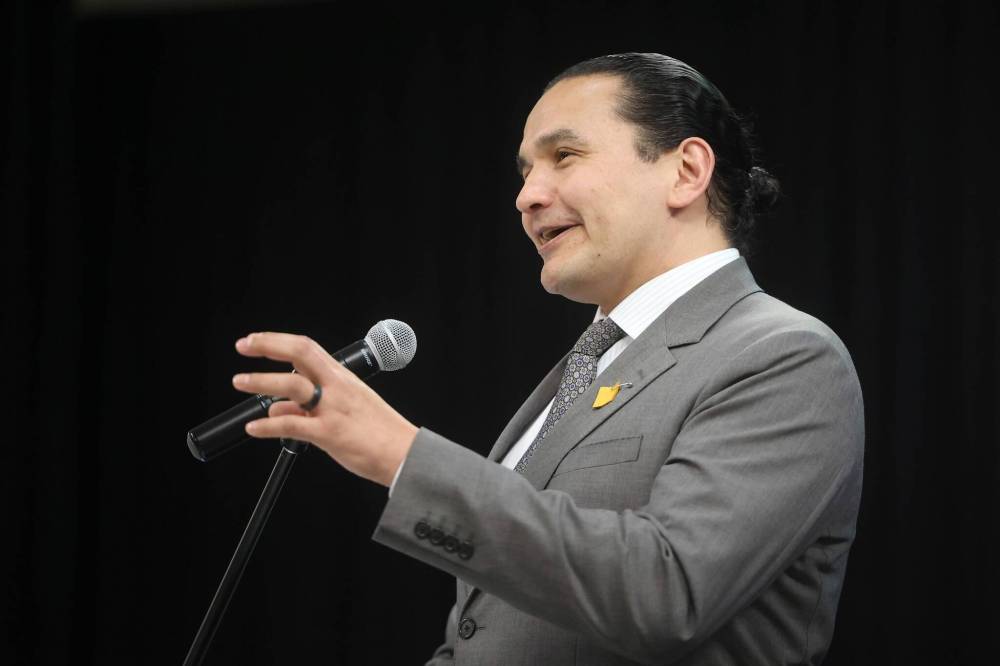
TIM SMITH / THE BRANDON SUN FILES
Manitoba Premier Wab Kinew
At the same time, Alberta Premier Danielle Smith, Saskatchewan Premier Scott Moe and, most recently, Ontario Premier Doug Ford are signing deals to build LNG pipelines that connect western oil fields to major shipping hubs in eastern Canada.
Given that these projects would have to pass through Manitoba, a spur pipeline to Churchill becomes a definite possibility, something Kinew has repeatedly noted.
Still, all this pipeline speculation has prompted Kinew to embrace a dangerous hyperbole about what it could do for Manitoba’s economy.
Kinew has claimed that a redevelopment of Churchill, along with a new gas-fired electrical generating plant near Brandon and a series of wind-generation projects could generate more than $30 billion in economic activity. This, Kinew has repeatedly claimed, could transform Manitoba from a so-called ‘have-not’ province to a ‘have’ province.
The ‘have-not’ designation refers to provinces that receive equalization payments; ‘have’ provinces with larger economies do not. The reality that Kinew does not acknowledge is that most ‘have’ provinces earn that distinction through being producers of oil and gas, something Manitoba is not.
In that context, Kinew is desperately overstating the economic benefits of building a gas pipeline that would allow LNG to flow up to and out of the Port of Churchill.
Yes, a project of this kind would be monumental in upfront investments in both pipeline and port infrastructure. And construction projects of that size and scope do provide significant, but fleeting, boosts to GDP.
In the long-term, however, it’s not clear that either hosting or operating a pipeline is, in and of itself, a major catalyst for economic growth.
The energy companies — the entities that provide the LNG — benefit the most when their products can move more quickly and efficiently to market. Private investment funds, if they become involved, also usually get a healthy return, as do First Nations that sign deals to allow the pipelines to cross their lands. Construction companies that build pipelines also do well from the years-long project.
For a pipeline to benefit all Manitobans, it would have to generate enormous and lasting economic growth and the government revenues that usually follow. It’s unclear that is something Kinew can count on.
Governments typically make money on LNG through resource royalties and corporate income taxes. Those revenues normally accrue to provinces where oil and gas is produced, and oil and gas companies are located. Manitoba does not produce much in the way of fossil fuels, and does not boast the corporate head offices of oil and gas companies.
Manitoba is destined, in any grand plan to expand pipelines, to be the very definition of a middle man.
Of course, Manitoba would earn revenue to ship the LNG through the Port of Churchill. The province could also take a stake in the construction and operation of the pipeline. But any money it earned from tolls, tariffs and other taxes would have to be applied to the massive 10-figure investment required to build the pipeline.
Kinew understands all the tenuous economics at play here. He recently rejected the idea of building a massive AI data processing centre in Île-des-Chênes because the up-front costs of subsidies and incentives to the technology companies, and long-term costs to ramp-up electricity capacity to feed the facility, would offset any revenue Manitoba might earn.
There is a potent argument for building new pipelines, and establishing new markets for Canadian LNG other than the United States. Changing the orientation of LNG transportation from north-south to east west through new pipelines could, in the short term, lead to significant national GDP growth.

But it’s a zero-sum game. Right now, there are no private investors pledging to put up the billions of dollars to build all these new pipelines. That leaves the federal and provincial governments to put up the money. Investments of that size and scope would naturally make it very difficult for Canada to make the necessary investments in clean, sustainable energy.
The Carney government is trying to do both: sponsoring huge pipeline projects while also trying to find money for solar and wind generation, and battery storage. The amounts of money in the latter are dwarfed by the cash that could be needed for the former.
It leaves Kinew in a precarious situation. He can only become the Pipeline King if he gets one built, and it transforms Manitoba’s economy.
Otherwise, he could end up being known as the Pipeline Fool.
dan.lett@freepress.mb.ca
Dan Lett is a columnist for the Free Press, providing opinion and commentary on politics in Winnipeg and beyond. Born and raised in Toronto, Dan joined the Free Press in 1986. Read more about Dan.
Dan’s columns are built on facts and reactions, but offer his personal views through arguments and analysis. The Free Press’ editing team reviews Dan’s columns before they are posted online or published in print — part of the our tradition, since 1872, of producing reliable independent journalism. Read more about Free Press’s history and mandate, and learn how our newsroom operates.
Our newsroom depends on a growing audience of readers to power our journalism. If you are not a paid reader, please consider becoming a subscriber.
Our newsroom depends on its audience of readers to power our journalism. Thank you for your support.
Dan Lett is a columnist for the Free Press, providing opinion and commentary on politics in Winnipeg and beyond. Born and raised in Toronto, Dan joined the Free Press in 1986. Read more about Dan.
Dan’s columns are built on facts and reactions, but offer his personal views through arguments and analysis. The Free Press’ editing team reviews Dan’s columns before they are posted online or published in print — part of the our tradition, since 1872, of producing reliable independent journalism. Read more about Free Press’s history and mandate, and learn how our newsroom operates.
Our newsroom depends on a growing audience of readers to power our journalism. If you are not a paid reader, please consider becoming a subscriber.
Our newsroom depends on its audience of readers to power our journalism. Thank you for your support.
Advertisement Advertise With Us
Advertisement Advertise With Us