

When it comes to our city’s tree canopy, Winnipeggers stand tall

Advertisement
Read this article for free:
or
Already have an account? Log in here »
To continue reading, please subscribe:

Digital Subscription
One year of digital access for only $205*
- Enjoy unlimited reading on winnipegfreepress.com
- Read the E-Edition, our digital replica newspaper
- Access News Break, our award-winning app
- Play interactive puzzles
*First annual payment billed as $205.00 + GST for one year. This annual subscription will automatically renew at $233.00 + GST every 52 weeks (10% off the regular annual price of $259.35). Offer available to new and qualified returning subscribers only. Cancel any time.
To continue reading, please subscribe:
Add Free Press access to your Brandon Sun subscription for only an additional
$1 for the first 4 weeks*
- Enjoy unlimited reading on winnipegfreepress.com
- Read the E-Edition, our digital replica newspaper
- Access News Break, our award-winning app
- Play interactive puzzles
*Your next Brandon Sun subscription payment will increase by $1.00 and you will be charged $17.95 plus GST for four weeks. After four weeks, your payment will increase to $24.95 plus GST every four weeks.
Read unlimited articles for free today:
or
Already have an account? Log in here »
Summer came to Winnipeg a little late, and a whole lot wet, but at least it finally came. It felt as if, in the last week or so, the rain finally took a backseat to the sun and heat, and the brief but blissful days of a Manitoba summer were truly here to stay.
Not a moment too soon, either: just in time for Folk Fest this weekend, and the Fringe Fest after that.
To make the most of the pleasant weather, I spent most recent afternoons and evenings working on my balcony on a quiet street in Osborne Village, watching the red squirrels careening through the trees.
They’ve been busy, rushing to replenish their stashes. The best perk of a treetop-level balcony is watching them at work, flying through the branches.
Every year, there are a little fewer such wonderlands for them to work and play.
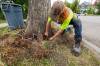
MIKAELA MACKENZIE / FREE PRESS FILES Though Winnipeg still has around 190,000 elm trees, in the last five decades the city has removed 300,000.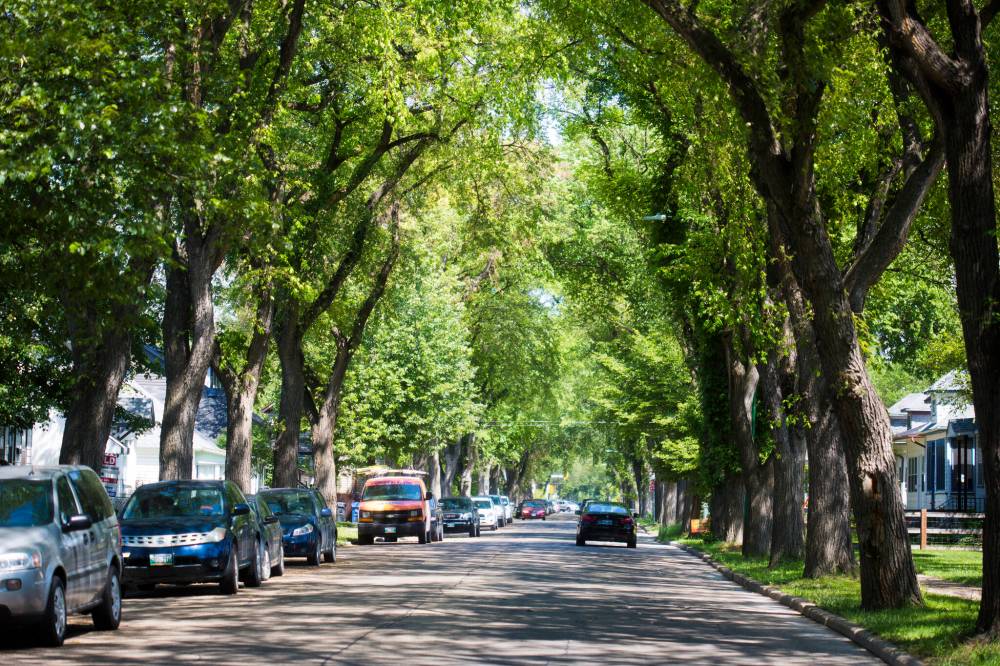
On the corner across from my apartment, the big old elm that used to stand there is gone, cut down four years ago after it was marked with the “red dot of death,” the splash of paint that earmarked it for removal.
I remember watching city crews bring it down. Chainsaws whined, and then the sun suddenly glared more more harshly through my windows.
It’s stayed that way ever since. The corner the elm watched over for at least eight decades now sits naked.
There is hope, though. Because now, a little sapling stands where the grand old tree once stood. It’s still young, and slender, and doesn’t give off much shade.
One day it will, should it have the time and space to grow. And maybe someday, long after I’m gone, someone else will sit writing on the balcony, watching the squirrels dance through the branches.
If human beings still do their own writing by then, anyway. Maybe it will be considered outdated.
After all, how different was the world — and Winnipeg — when most of our urban forest was planted? Our tree canopy is a gift passed to us from those who built the city. They could most likely never have fully imagined how it would change. Nor, back then, could they have foreseen Dutch elm disease and the emerald ash borer, among other things.
Now, we are left to tend their gift against many ills, knowing that is our way of passing it down the line.
For over 50 years, we’ve watched trees slowly vanish from the core neighbourhoods of the city. In 2024 alone, 3.4 per cent of Winnipeg’s elms had to be felled, largely to contain Dutch elm disease. A 2022 Statistics Canada report found Winnipeg was losing green space at the second-highest pace in Canada.
Stretches of old streets that were once dappled with shade now lie bare and baking in the summer heat. That means fewer homes for squirrels and birds. Fewer shields of leaves to protect from the sun, thereby saving energy. We still have around 190,000 elms, though in the last five decades the city has removed 300,000.
BROOK JONES / FREE PRESS FILES A boulevard along Strathcona Stree where a number of elm trees were removed to contain Dutch elm disease in 2025. A Statistics Canada report found Winnipeg was losing green space at the second-highest pace in Canada with 3.4 per cent of Winnipeg’s elms felled in 2024 alone.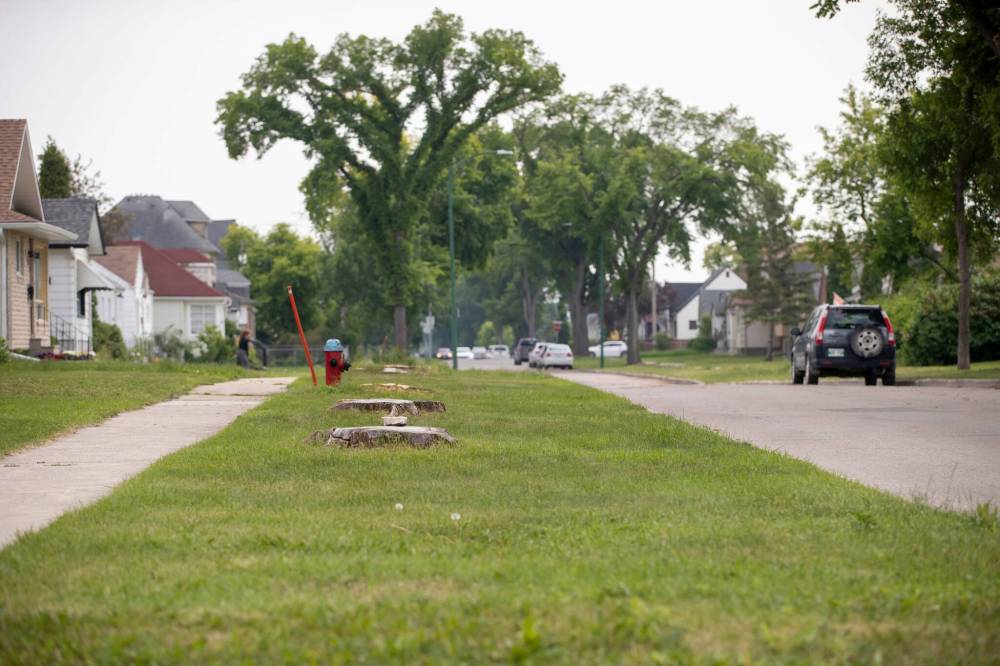
At one point, experts warned that if nothing were done, the city could lose all its elms in just 20 years. That would be about one-quarter of the city’s entire tree canopy — and the largest urban forest of American elms on the continent — totally gone. Other species too have their risks and problems.
There’s no way to put a price tag on that loss, in either beauty or environmental value.
The saving grace is that the trees of Winnipeg have many allies; neighbourhood residents communities, urban forest experts and the advocacy coalitions Trees Winnipeg and Trees Please Winnipeg are among them. And because of their work to raise awareness of the problem, in recent years the push to restore the tree canopy has taken on new momentum.
An example of that effort played out this week.
It started when city council’s executive policy committee approved a proposed $1.2-million cut to Winnipeg’s tree replanting program. The move was not entirely of the city’s making: it came after the province directed the city to spend over $1.2 million of its strategic infrastructure basket funding on the Assiniboine Park Zoo’s Journey to Churchill exhibit. That money had to come from somewhere else, and finance officials suggested the tree-planting budget.
In his first comments, Mayor Scott Gillingham said he wished city council “didn’t have to make this decision.” He would’ve preferred the province kick in an extra $1.2 million. (Relatable; I also wish someone would simply give me more money to pay for things I need.) But the province needed an answer, and the mayor urged city council to move forward.

Just one day later, after a robust public response from local tree advocates, the mayor changed direction.
On Thursday, Gillingham’s office announced that next week, the mayor will bring forward a proposal to city council to maintain full funding for tree planting in the 2026 urban forest renewal program. The initial news release gave no specifics, but did highlight how the public response factored into the decision.
“Winnipeggers care deeply about our urban forest, and I’ve heard that clearly,” Gillingham stated in the release.
We’ll have to wait for the particulars to give a final verdict on the proposal. Still, we should recognize the spirit of the move as the right decision. In a way, I can understand why it’s tempting to cut from a tree-planting budget; a sapling will take decades to show its full value, and many of the city’s other needs may feel more pressing.
Yet every year we delay restoring the tree canopy has a cost, and it will be felt most fully by those who come after us. Each year of growth lost is another year in which the greatest gift of our forebears deteriorates further; and another year where the verdant jewel of Winnipeg summers slowly dies away.
For now, as we walk and bike and work and play under the shade of 120-year-old trees, we should pause to thank those who planted them. It’s easy to forget that the urban forest did not spring up on its own. We revel in its splendour now because once, long ago, someone invested in a dream of what such a forest could be.
And perhaps, a century from now, some Winnipegger looking through the archives will notice this little turn-around in the city’s tree-planting plans, and thank us the same.
melissa.martin@freepress.mb.ca
Melissa Martin
Reporter-at-large
Melissa Martin reports and opines for the Winnipeg Free Press.
Every piece of reporting Melissa produces is reviewed by an editing team before it is posted online or published in print — part of the Free Press‘s tradition, since 1872, of producing reliable independent journalism. Read more about Free Press’s history and mandate, and learn how our newsroom operates.
Our newsroom depends on a growing audience of readers to power our journalism. If you are not a paid reader, please consider becoming a subscriber.
Our newsroom depends on its audience of readers to power our journalism. Thank you for your support.
Melissa Martin
Reporter-at-large
Melissa Martin reports and opines for the Winnipeg Free Press.
Every piece of reporting Melissa produces is reviewed by an editing team before it is posted online or published in print — part of the Free Press‘s tradition, since 1872, of producing reliable independent journalism. Read more about Free Press’s history and mandate, and learn how our newsroom operates.
Our newsroom depends on a growing audience of readers to power our journalism. If you are not a paid reader, please consider becoming a subscriber.
Our newsroom depends on its audience of readers to power our journalism. Thank you for your support.
Related Articles
Mayor flip-flops on cutting tree-planting budget after intense criticism

Advertisement Advertise With Us
Advertisement Advertise With Us