

Mayor’s flip-flop a welcome effect of campaign
Advertisement
Read this article for free:
or
Already have an account? Log in here »
To continue reading, please subscribe:

Digital Subscription
One year of digital access for only $205*
- Enjoy unlimited reading on winnipegfreepress.com
- Read the E-Edition, our digital replica newspaper
- Access News Break, our award-winning app
- Play interactive puzzles
*First annual payment billed as $205.00 + GST for one year. This annual subscription will automatically renew at $233.00 + GST every 52 weeks (10% off the regular annual price of $259.35). Offer available to new and qualified returning subscribers only. Cancel any time.
To continue reading, please subscribe:
Add Free Press access to your Brandon Sun subscription for only an additional
$1 for the first 4 weeks*
- Enjoy unlimited reading on winnipegfreepress.com
- Read the E-Edition, our digital replica newspaper
- Access News Break, our award-winning app
- Play interactive puzzles
*Your next Brandon Sun subscription payment will increase by $1.00 and you will be charged $17.95 plus GST for four weeks. After four weeks, your payment will increase to $24.95 plus GST every four weeks.
Read unlimited articles for free today:
or
Already have an account? Log in here »
Trees may not have a vote, but they are poised to become among the biggest winners from this fall’s municipal elections in Winnipeg.
At the start of the week, things didn’t look good for Winnipeg’s tree population. City staff issued a report recommending city council reduce the 2026 urban forest renewal program and divert the money to improvements to the Assiniboine Park Conservancy’s Journey to Churchill exhibition.
The recommendation was triggered by a directive from the provincial government to take the same sum of money out of a strategic infrastructure fund it provides to the city to support the conservancy exhibit. This left the city with a $1.2-million hole in its infrastructure program. Staff felt the money could come from the tree-planting budget.
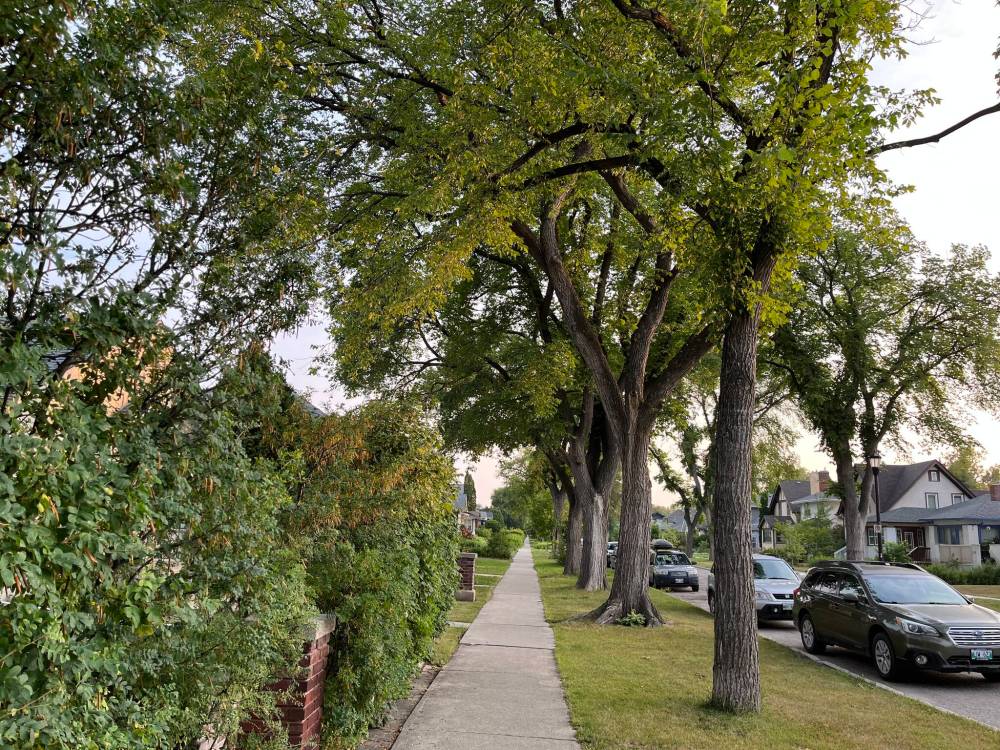
Russell Wangersky / Free Press
Winnipeg’s tree canopy is getting a financial respite.
Mayor Scott Gillingham — who is running for re-election this fall — initially endorsed the recommendation when it was put before the executive policy committee (which he chairs) earlier this week. Seventy-two hours later, however, Gillingham was having second thoughts.
Gillingham said Thursday he had sharpened his pencil and devised a plan to find the money for the Churchill exhibit from other sources. He has yet to identify those sources, but in a statement released to news organizations and via elaborate social media posts, Gillingham announced he was personally riding to the rescue of the tree-planting program he had voted to cut just three days earlier.
“The public wants this tree-planting funding protected. I agree, and I’ll be bringing forward a plan to council next week to do exactly that,” Gillingham said in a news release.
Does this qualify as a flip-flop by the mayor? Absolutely.
Was the flip-flop triggered by Gillingham’s desire to be re-elected this fall? In all likelihood, yes.
Does this diminish the value of his efforts to restore funding to a critically important program that is essential to maintaining quality of life for all Winnipeggers? No, not really.
Election cycles are an essential, active ingredient in the decision-making processes of government. Bad news, tax increases and austerity measures, if required, are often front-end loaded in election cycles so that good news, tax cuts and more robust spending can be done as voters hit the on-ramp for an election. That is not always the case, but it is the case often enough that political observers can recognize it when it happens.
In this instance, Gillingham and council could not necessarily anticipate that the NDP government would order a re-purposing of strategic infrastructure funds to help out the conservancy. The province is allowed to identify how money from strategic infrastructure funding is spent, but even so, this was a bit cynical on the part of Premier Wab Kinew’s government.

It is also worth noting that there was method to the madness of the recommendation from city finance officials.
The urban forest strategy was an initiative adopted shortly after Gillingham was first elected in 2022. Since then, the total amount of money spent on planting new trees and pruning existing ones has gone from $21 million in 2022 to $33.6 million this year. That’s a 60 per cent increase. Given the steady increase in funding to a much-neglected program, it’s not hard to see why bean counters thought there might be a bit of excess to use for the Churchill exhibit.
And yet, as citizens clearly enunciated and Gillingham eventually grew to accept, the idea of taking money out of a program that is waging an annual war to save Winnipeg’s glorious tree canopy is the very definition of penny wise and pound foolish.
Some Winnipeggers may resent the fact that Gillingham reacted as quickly as he did to restore funding primarily because of an impending election.
Other Winnipeggers, and the trees, are just happy he did.