

Presumption of innocence important when politicians criminally charged, but so is public confidence

Advertisement
Read this article for free:
or
Already have an account? Log in here »
To continue reading, please subscribe:

Digital Subscription
One year of digital access for only $205*
- Enjoy unlimited reading on winnipegfreepress.com
- Read the E-Edition, our digital replica newspaper
- Access News Break, our award-winning app
- Play interactive puzzles
*First annual payment billed as $205.00 + GST for one year. This annual subscription will automatically renew at $233.00 + GST every 52 weeks (10% off the regular annual price of $259.35). Offer available to new and qualified returning subscribers only. Cancel any time.
To continue reading, please subscribe:
Add Free Press access to your Brandon Sun subscription for only an additional
$1 for the first 4 weeks*
- Enjoy unlimited reading on winnipegfreepress.com
- Read the E-Edition, our digital replica newspaper
- Access News Break, our award-winning app
- Play interactive puzzles
*Your next Brandon Sun subscription payment will increase by $1.00 and you will be charged $17.95 plus GST for four weeks. After four weeks, your payment will increase to $24.95 plus GST every four weeks.
Read unlimited articles for free today:
or
Already have an account? Log in here »
It’s probably time to stop pretending that elected politicians can simply carry on as usual after being charged with a serious criminal offence.
The case of Transcona Coun. Russ Wyatt has brought an uncomfortable question back to Winnipeg City Hall: what should happen when an elected official is accused of a serious crime but refuses to step away from public office?
Wyatt arrived at city hall Thursday and said he would “absolutely” continue doing his job after being charged this week with sexual assault and administering a noxious substance. Those are serious allegations.
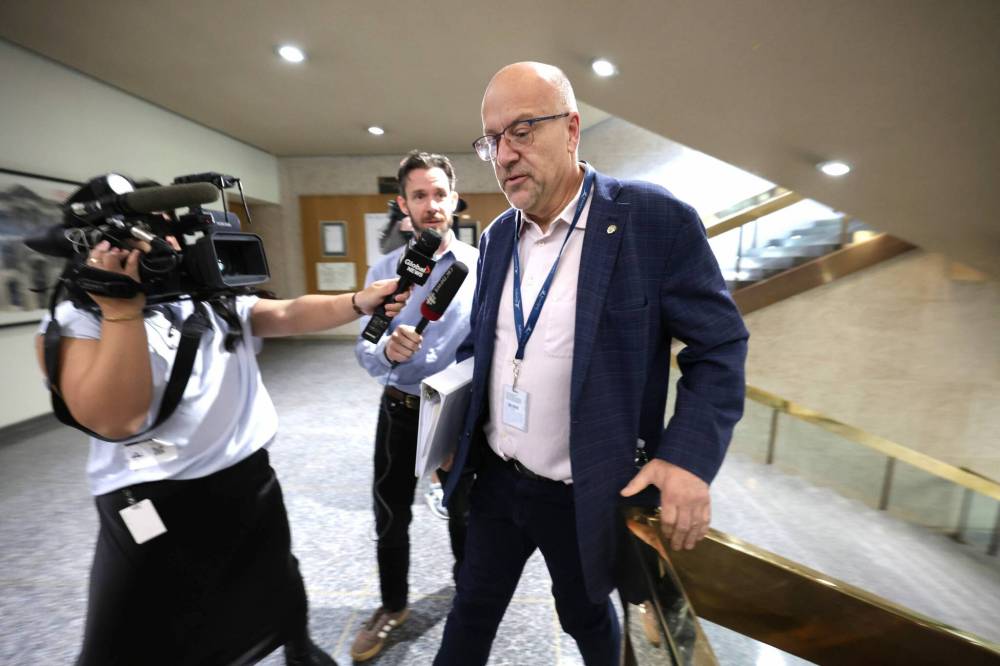
Coun. Russ Wyatt tries to evade reporters as he walks into City Hall on Thursday. (Ruth Bonneville / Free Press)
They are also only allegations, and Wyatt is entitled to the presumption of innocence. His lawyer has said he is innocent.
That distinction matters.
But so does the public’s confidence in its elected institutions.
Mayor Scott Gillingham has urged Wyatt to step aside. Premier Wab Kinew has now done the same, saying the allegations are disturbing and that the province should consider changing the rules governing elected officials facing criminal charges.
Kinew is right about the need to look at the rules. But the answer shouldn’t be to declare an elected official guilty before a court has had its say.
There is a reasonable middle ground.
British Columbia found one in 2022 when it introduced legislation requiring municipal politicians charged with certain serious offences to take a leave of absence.
Importantly, it is a paid leave. The politician doesn’t lose the office or the income attached to it merely because charges have been laid. The person simply steps away from the duties of public office while the criminal matter works its way through the courts.
That is a sensible compromise.
It recognizes the fundamental principle that being charged with a crime is not the same thing as being convicted of one. At the same time, it recognizes that holding elected office carries certain responsibilities and expectations.
A councillor is not an ordinary employee. The public has entrusted that person with representing constituents, participating in public decisions and exercising authority on their behalf.
When someone holding that position is facing allegations of a particularly serious nature, it is not unreasonable to say that the person should temporarily step away while the justice system does its work.
If the alternative is forcing a politician to resign, then the presumption of innocence becomes a much more difficult problem. A resignation can effectively end a political career before a trial has taken place.
A temporary leave is different. It preserves the elected mandate while removing the politician from the day-to-day business of governing. If the charges are withdrawn, stayed or result in an acquittal, the politician can return.
But there is an equally important caveat.
If Manitoba decides municipal politicians should be subject to mandatory leave after being charged with serious offences, the province should apply the same principle to itself.
It would be difficult to defend a system in which a city councillor must step away from elected office after being charged with a serious crime while a provincial MLA facing an equivalent charge can continue sitting in the legislature.
British Columbia has already faced criticism over precisely that kind of double standard. Municipal politicians there can be required to take leave after certain criminal charges, while provincial politicians aren’t subject to the same requirement.
That makes little sense.
Peace River North MLA Jordan Kealy was charged earlier this year with one count of sexual assault. Kealy is a former B.C. Conservative who now sits as an independent. He denied the allegation and said he would continue to advocate for his constituents.
If the principle is that serious criminal charges can undermine public confidence in an elected institution, it shouldn’t suddenly disappear when the politician works at the legislature instead of city hall.
The same should apply federally. Members of Parliament should not be treated as though they occupy some special constitutional category where the ordinary expectations of public accountability don’t apply.
There would, of course, have to be careful rules about which charges trigger mandatory leave.
The legislation should be limited to clearly defined serious offences and include appropriate safeguards.
The criminal justice system will determine whether or not Wyatt is guilty or if charges are ultimately stayed.
Wyatt is entitled to defend himself and to be presumed innocent. He is also entitled to his salary and, ultimately, to return to office if the allegations don’t result in a conviction (that is, if he’s re-elected in the October municipal election, or if he seeks re-election at all).
The public is entitled to expect that elected institutions will protect their credibility while the justice system runs its course.

That’s not a presumption of guilt. It’s a recognition that public office comes with responsibilities that extend beyond simply showing up for work.
If Manitoba is serious about changing the rules, it should do so carefully, fairly and before another case forces the issue.
And it should make the rule apply equally to municipal and provincial politicians.
The public shouldn’t have to wonder whether the rules change depending on which level of government the politician happens to represent.
tom.brodbeck@freepress.mb.ca
Tom Brodbeck is an award-winning author and columnist with over 30 years experience in print media. He joined the Free Press in 2019. Born and raised in Montreal, Tom graduated from the University of Manitoba in 1993 with a Bachelor of Arts degree in economics and commerce. Read more about Tom.
Tom provides commentary and analysis on political and related issues at the municipal, provincial and federal level. His columns are built on research and coverage of local events. The Free Press’s editing team reviews Tom’s columns before they are posted online or published in print – part of the Free Press’s tradition, since 1872, of producing reliable independent journalism. Read more about Free Press’s history and mandate, and learn how our newsroom operates.
Our newsroom depends on a growing audience of readers to power our journalism. If you are not a paid reader, please consider becoming a subscriber.
Our newsroom depends on its audience of readers to power our journalism. Thank you for your support.
Tom Brodbeck is an award-winning author and columnist with over 30 years experience in print media. He joined the Free Press in 2019. Born and raised in Montreal, Tom graduated from the University of Manitoba in 1993 with a Bachelor of Arts degree in economics and commerce. Read more about Tom.
Tom provides commentary and analysis on political and related issues at the municipal, provincial and federal level. His columns are built on research and coverage of local events. The Free Press’s editing team reviews Tom’s columns before they are posted online or published in print – part of the Free Press’s tradition, since 1872, of producing reliable independent journalism. Read more about Free Press’s history and mandate, and learn how our newsroom operates.
Our newsroom depends on a growing audience of readers to power our journalism. If you are not a paid reader, please consider becoming a subscriber.
Our newsroom depends on its audience of readers to power our journalism. Thank you for your support.
Related Articles
‘Disrespectful’: residents frustrated after Wyatt arrives hour late to committee meeting




Advertisement Advertise With Us
Advertisement Advertise With Us