

Transit drivers increasingly in peril, but city kicks safety upgrades down the road

Advertisement
Read this article for free:
or
Already have an account? Log in here »
To continue reading, please subscribe:

Digital Subscription
One year of digital access for only $205*
- Enjoy unlimited reading on winnipegfreepress.com
- Read the E-Edition, our digital replica newspaper
- Access News Break, our award-winning app
- Play interactive puzzles
*First annual payment billed as $205.00 + GST for one year. This annual subscription will automatically renew at $233.00 + GST every 52 weeks (10% off the regular annual price of $259.35). Offer available to new and qualified returning subscribers only. Cancel any time.
To continue reading, please subscribe:
Add Free Press access to your Brandon Sun subscription for only an additional
$1 for the first 4 weeks*
- Enjoy unlimited reading on winnipegfreepress.com
- Read the E-Edition, our digital replica newspaper
- Access News Break, our award-winning app
- Play interactive puzzles
*Your next Brandon Sun subscription payment will increase by $1.00 and you will be charged $17.95 plus GST for four weeks. After four weeks, your payment will increase to $24.95 plus GST every four weeks.
Read unlimited articles for free today:
or
Already have an account? Log in here »
Winnipeg Transit drivers are being assaulted with alarming frequency, yet the city continues to move at a glacial pace on a simple measure that could make their jobs safer.
The latest incidents should make the case for full driver shields impossible to ignore. In the past few weeks, Transit operators have been punched, bitten and stabbed, while another driver was threatened with a hatchet after a passenger reached around the existing partial shield.
These aren’t isolated incidents anymore. They’re part of a disturbing pattern that is making an already difficult job considerably more dangerous.
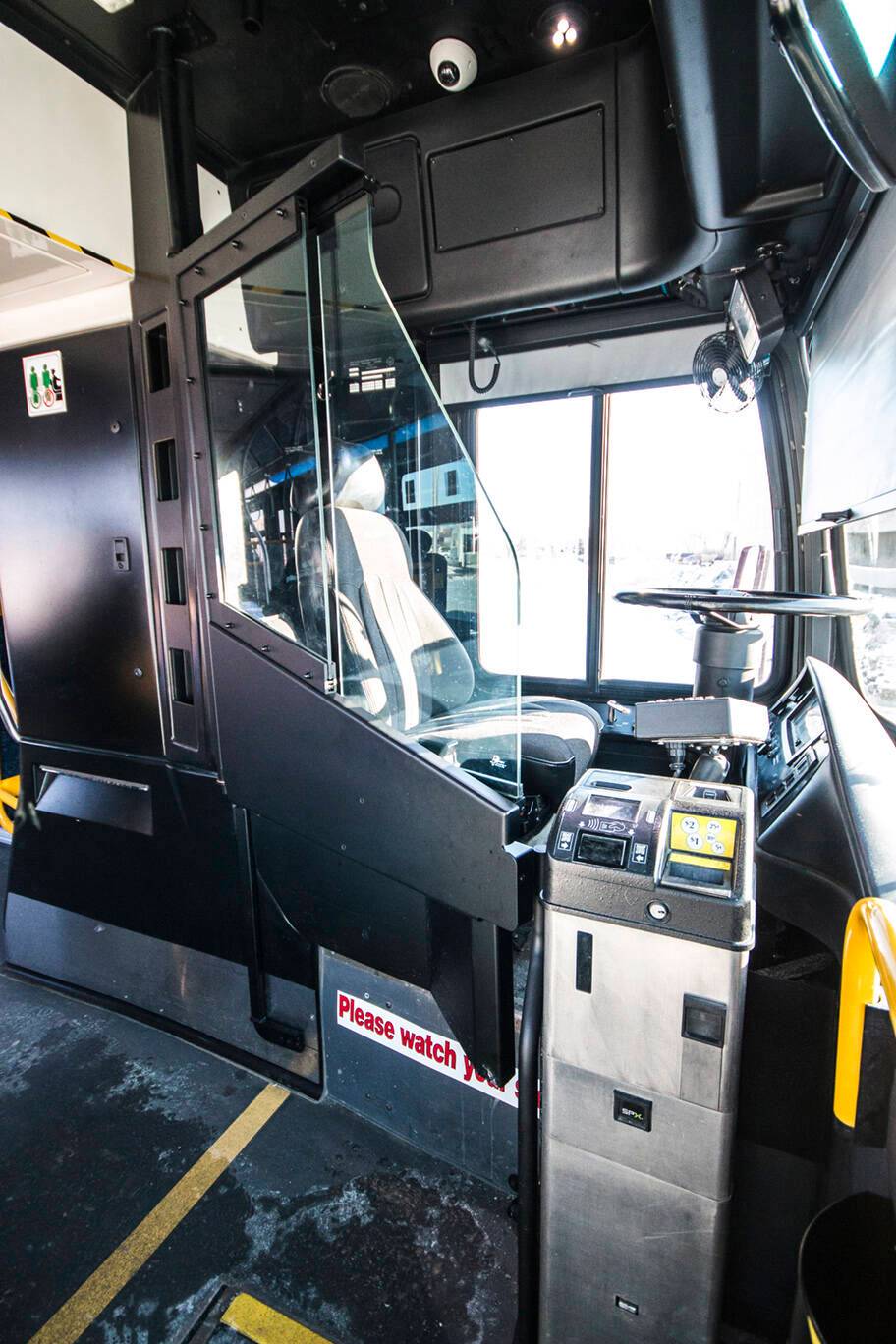
SUPPLIED
The latest violent incidents against Winnipeg Transit drivers should make the case for full driver shields impossible to ignore.
The hatchet incident last week was particularly frightening. A bus was waiting at the St. Vital terminal outside St. Vital Centre when a passenger repeatedly demanded that the driver leave.
After the bus started moving, the passenger pulled a hatchet from a bag, reached around the partial safety shield and threatened the driver.
Fortunately, a police cruiser happened to be travelling alongside the bus. The driver was able to flag it down.
The bus driver wasn’t physically hurt, but she is now off work. She’s only a year into her career.
That kind of experience can stay with someone for a long time.
And she isn’t the only Transit employee dealing with the consequences of violence.
Just days earlier, police announced charges in two separate incidents involving Transit employees. In one case, a man allegedly threw a beer can at a driver, then bit him when the driver tried to restrain him. In another, a woman accused of refusing to pay a fare allegedly punched a Transit supervisor in the face.
Earlier this month, another driver was stabbed twice in the leg with a syringe after a passenger reached around the existing shield.
The city recorded 104 assaults on Transit bus drivers in 2025. There have already been 42 this year.
Those numbers should be enough to demand action.
Instead, Winnipeg Transit is still talking about studying the installation of full, floor-to-ceiling driver compartments.
The partial shields currently installed on buses were put in place in 2019. They offer some protection, but they leave an opening that allows a passenger to reach around and strike or stab the operator.
That is a fundamental design problem.
A safety barrier that can be circumvented by simply reaching around it is not much of a safety barrier.
Transit said last November it was exploring replacing the partial shields with full compartments. The preliminary estimate was about $15 million.
The city had already set aside roughly $2.7 million in its 2024 capital budget for a pilot project to test the effectiveness of full shields.
That pilot hasn’t happened.
Now the city is revising its cost estimates, with the intention of potentially including a pilot in next year’s Transit capital budget.
That’s far too slow.
There are plenty of legitimate questions to ask before spending $15 million. But there should be no question about whether Transit operators deserve meaningful protection from passengers who become violent.
The city and province still need to address the underlying problems of addiction, mental illness and homelessness that often lead to these altercations. Police need to deal with people who pose a threat. Social agencies need resources to help people before they reach a crisis.
But none of those things changes the immediate reality facing Transit operators.
If someone can reach around a shield and stab a driver with a syringe, or threaten a driver with a hatchet, the existing protection isn’t doing its job.
There is also a very practical reason for the city to move quickly: recruitment.
Winnipeg Transit needs drivers. It is asking people to take jobs that involve shift work, long hours, heavy traffic, difficult weather and, increasingly, passengers who can become aggressive or violent.
What kind of message does it send to prospective employees when they see Transit workers being assaulted and know the city has a better protective system sitting on the shelf?
Who wants to take a job where an angry passenger can still reach around the driver’s safety barrier?
The city should be selling Transit as a stable, respectable public-service career. It shouldn’t be giving prospective drivers another reason to think twice.
Transit has a chronic shortage of operators. The worse that situation gets, the fewer buses Transit can put on the road and the less reliable bus service becomes. That hurts ridership numbers (which have fallen in recent years) even further.
There’s a financial argument, too.
The union representing Transit operators says Workers Compensation Board claims associated with injured operators could cover the cost of the shields within two years.

That calculation should be scrutinized, but the city should be including the full cost of workplace violence — lost work, overtime, recruitment, training, compensation claims and psychological injuries.
There are 64 operators currently off work because of psychological injuries. That represents an enormous human and financial cost.
Charleswood-Tuxedo-Westwood city councillor Evan Duncan is right to say that shields aren’t the whole answer. But waiting for Winnipeg to solve every social problem before protecting drivers is simply another way of putting off action.
It’s time to stop studying whether Transit drivers need more protection and start giving it to them.
tom.brodbeck@freepress.mb.ca
Tom Brodbeck is an award-winning author and columnist with over 30 years experience in print media. He joined the Free Press in 2019. Born and raised in Montreal, Tom graduated from the University of Manitoba in 1993 with a Bachelor of Arts degree in economics and commerce. Read more about Tom.
Tom provides commentary and analysis on political and related issues at the municipal, provincial and federal level. His columns are built on research and coverage of local events. The Free Press’s editing team reviews Tom’s columns before they are posted online or published in print – part of the Free Press’s tradition, since 1872, of producing reliable independent journalism. Read more about Free Press’s history and mandate, and learn how our newsroom operates.
Our newsroom depends on a growing audience of readers to power our journalism. If you are not a paid reader, please consider becoming a subscriber.
Our newsroom depends on its audience of readers to power our journalism. Thank you for your support.
Tom Brodbeck is an award-winning author and columnist with over 30 years experience in print media. He joined the Free Press in 2019. Born and raised in Montreal, Tom graduated from the University of Manitoba in 1993 with a Bachelor of Arts degree in economics and commerce. Read more about Tom.
Tom provides commentary and analysis on political and related issues at the municipal, provincial and federal level. His columns are built on research and coverage of local events. The Free Press’s editing team reviews Tom’s columns before they are posted online or published in print – part of the Free Press’s tradition, since 1872, of producing reliable independent journalism. Read more about Free Press’s history and mandate, and learn how our newsroom operates.
Our newsroom depends on a growing audience of readers to power our journalism. If you are not a paid reader, please consider becoming a subscriber.
Our newsroom depends on its audience of readers to power our journalism. Thank you for your support.

Advertisement Advertise With Us
Advertisement Advertise With Us