

Residents who blame civic politicians for all that ails us should know it’s not entirely their fault

Advertisement
Read this article for free:
or
Already have an account? Log in here »
To continue reading, please subscribe:

Digital Subscription
One year of digital access for only $205*
- Enjoy unlimited reading on winnipegfreepress.com
- Read the E-Edition, our digital replica newspaper
- Access News Break, our award-winning app
- Play interactive puzzles
*First annual payment billed as $205.00 + GST for one year. This annual subscription will automatically renew at $233.00 + GST every 52 weeks (10% off the regular annual price of $259.35). Offer available to new and qualified returning subscribers only. Cancel any time.
To continue reading, please subscribe:
Add Free Press access to your Brandon Sun subscription for only an additional
$1 for the first 4 weeks*
- Enjoy unlimited reading on winnipegfreepress.com
- Read the E-Edition, our digital replica newspaper
- Access News Break, our award-winning app
- Play interactive puzzles
*Your next Brandon Sun subscription payment will increase by $1.00 and you will be charged $17.95 plus GST for four weeks. After four weeks, your payment will increase to $24.95 plus GST every four weeks.
Read unlimited articles for free today:
or
Already have an account? Log in here »
It was the spring of 1993, and Gary Filmon’s Progressive Conservative government introduced a tough-love budget designed to bring the province’s chronic deficit-financing to heel.
Among the toughest measures was a decision to cut the basic education property tax credit from $325 to $250. The Tories also decided that every home, regardless of value, had to pay at least $250 and the enhanced seniors’ tax credit was eliminated for wealthy homeowners.
Cutting a tax credit is tantamount to a tax hike, and Winnipeggers were outraged. The only problem was that when it came time to express that outrage, citizens did not picket the Legislative Building on Broadway.
They picked up the phone and called city hall to complain.
It’s not hard to understand why some citizens were confused about who was responsible for the tax hike. Property taxes are largely viewed as a vehicle for municipalities to raise money, even though half goes to support education, a provincial responsibility, and the tax credit is a 100 per-cent provincial mechanism.
Still, city councillors’ voice mails were overflowing with angry rants in the wake of the Filmon budget. That’s right, even though the provincial government cut the tax credit, it was city hall that bore the brunt of homeowners’ outrage.
That anecdote is proof that although the federal and provincial governments are way bigger and more impactful in many ways, local government is where the proverbial rubber of direct services meets the road of citizen expectations.
Although the federal and provincial governments are way bigger and more impactful in many ways, local government is where the proverbial rubber of direct services meets the road of citizen expectations.
Think of all the city does: parks, recreational facilities, libraries, roads and bridges, water and sewer, transit, police, firefighters and paramedics and garbage collection. Winnipeggers are reminded of problems with these services every time they go downtown, drive on a pothole-filled road or visit a dilapidated recreation centre.
Few, if any, of the people who are shaking their fists at the city recognize that because the costs of these services are so enormous, and local government’s revenue opportunities are so limited, the only way to make ends meet is with support from the federal and provincial governments.
Unfortunately, the senior levels of government, as a rule, never provide enough. However, they shortchange municipalities with the comfort of knowing that while all levels of government share the responsibility of paying for these services and amenities, it’s city hall that will bear the brunt of anger.
In that context, it’s hardly surprising that an Abacus Data (formerly Probe Research) poll commissioned by the Free Press shows Winnipeggers are decidedly unsatisfied about the state of civic services and the overall future fate of the city.
Half of the poll respondents said they think the city is regressing and getting worse; only 21 per cent think the state of the city and its services are getting better.
A majority of respondents are pleased with the job the city is doing on garbage collection and the maintenance of parks and open spaces. The cranky discontent, however, grows significantly about the state of recreation facilities, Winnipeg Transit and street maintenance.
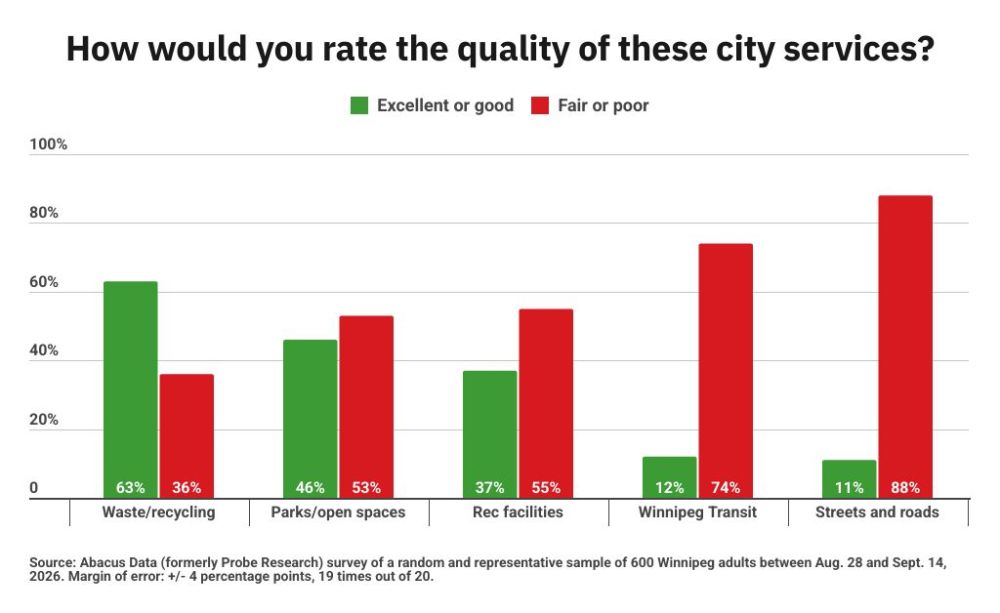
The poll results are a very good reflection of the way in which services are funded.
Garbage and parks are uncomplicated municipal responsibilities covered by property taxes. However, with big capital items — recreation facilities, water and sewer treatment, transit and roads — the costs are so enormous they must be shared among three levels of government.
It’s a system that occasionally works well.
The three levels of government have collaborated on projects such as the downtown arena, expansion of the Red River Floodway and the ongoing development of Centre Port. All with a minimal impact on Winnipeg property taxes.
However, it doesn’t work all of the time because the federal and provincial governments are unpredictable when it comes to supporting municipalities.
MIKAELA MACKENZIE / FREE PRESS Local government is where the proverbial rubber of direct services meets the road of citizen expectations.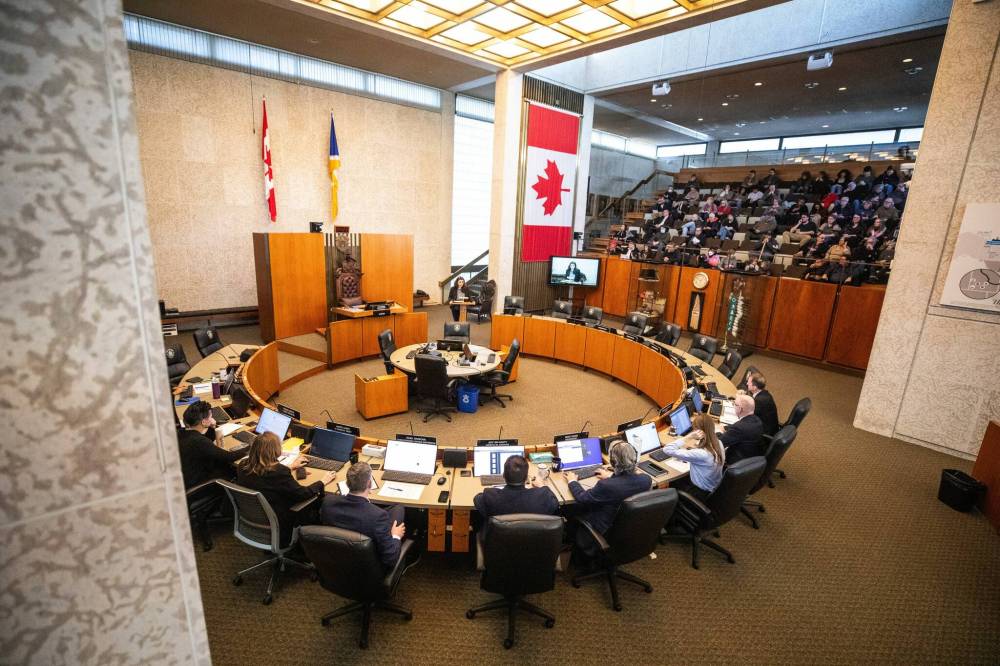
Ottawa reviews and sets funding for provinces and municipal projects on an annual basis. And the NDP government reveals current-year funding when it tables its annual budget.
Pledges of future funding for municipalities often fluctuate with fiscal pressures faced by the senior levels of government. However, if Ottawa or the provincial government decide they need to reduce spending, they often start by freezing or reducing support to local government. Generosity and austerity, in this equation, both run downhill.
That brings us to those moments when the citizenry assigns blame to the wrong level of government.
Consider the problems of homelessness and open drug use downtown, one of the things Winnipeggers complain about most when asked about municipal government. However, which level of government is actually responsible for dealing with these massive social challenges?
Winnipeggers see dysfunction on city streets and assume it is a failure by the city; in fact, this failure is more fairly assigned to the senior levels of government.
All governments have some responsibility, but more so the federal and provincial governments, which lead on housing, income support and primary and mental-health services. Winnipeggers see dysfunction on city streets and assume it is a failure by the city; in fact, this failure is more fairly assigned to the senior levels of government.
None of the above will calm angry voters who — as our poll clearly demonstrated — are intent on using the upcoming civic elections to lash out at the municipal officials they believe have failed them.
We should remember that municipal officials are not always the authors of these shortcomings. They are, however, in the closest proximity when voters lash out.
dan.lett@freepress.mb.ca
Dan Lett is a columnist for the Free Press, providing opinion and commentary on politics in Winnipeg and beyond. Born and raised in Toronto, Dan joined the Free Press in 1986. Read more about Dan.
Dan’s columns are built on facts and reactions, but offer his personal views through arguments and analysis. The Free Press’ editing team reviews Dan’s columns before they are posted online or published in print — part of the our tradition, since 1872, of producing reliable independent journalism. Read more about Free Press’s history and mandate, and learn how our newsroom operates.
Our newsroom depends on a growing audience of readers to power our journalism. If you are not a paid reader, please consider becoming a subscriber.
Our newsroom depends on its audience of readers to power our journalism. Thank you for your support.
Dan Lett is a columnist for the Free Press, providing opinion and commentary on politics in Winnipeg and beyond. Born and raised in Toronto, Dan joined the Free Press in 1986. Read more about Dan.
Dan’s columns are built on facts and reactions, but offer his personal views through arguments and analysis. The Free Press’ editing team reviews Dan’s columns before they are posted online or published in print — part of the our tradition, since 1872, of producing reliable independent journalism. Read more about Free Press’s history and mandate, and learn how our newsroom operates.
Our newsroom depends on a growing audience of readers to power our journalism. If you are not a paid reader, please consider becoming a subscriber.
Our newsroom depends on its audience of readers to power our journalism. Thank you for your support.
Related Articles
The election of our discontent: City at a crumbling crossroads, grumbling residents say in poll



Advertisement Advertise With Us
Advertisement Advertise With Us