

Intersection inflection
Opening of Portage and Main shows even seemingly insurmountable impasses can be overcome
Advertisement
Read this article for free:
or
Already have an account? Log in here »
To continue reading, please subscribe:
Digital Subscription
One year of digital access for only $1.44 a week*
- Enjoy unlimited reading on winnipegfreepress.com
- Read the E-Edition, our digital replica newspaper
- Access News Break, our award-winning app
- Play interactive puzzles
*Billed as $5.77 plus GST every four weeks. After 52 weeks, price increases to the regular rate of $19.95 plus GST every four weeks. Offer available to new and qualified returning subscribers only. Cancel any time.
To continue reading, please subscribe:
Add Free Press access to your Brandon Sun subscription for only an additional
$1 for the first 4 weeks*
- Enjoy unlimited reading on winnipegfreepress.com
- Read the E-Edition, our digital replica newspaper
- Access News Break, our award-winning app
- Play interactive puzzles
*Your next Brandon Sun subscription payment will increase by $1.00 and you will be charged $17.95 plus GST for four weeks. After four weeks, your payment will increase to $24.95 plus GST every four weeks.
Read unlimited articles for free today:
or
Already have an account? Log in here »
There are places in a city that become more than places. Portage and Main is one of them. For generations of Winnipeggers, the intersection has represented downtown, traffic, development and civic identity. Its reopening to pedestrians in 2025, after 46 years of closure, was about more than crossing a street. It was a reminder that decisions made by one generation can shape the choices available to another — and that even seemingly permanent decisions can be reconsidered.
I have spent much of my professional life thinking about Winnipeg as a planner, working in public, private and non-profit settings. My PhD research gave me an opportunity to examine Portage and Main differently: not simply as a debate about cars and pedestrians, but as a window into how power operates in a city. I reviewed 569 archival documents spanning the 1960s to the present, interviewed 48 planners with experience in Winnipeg, and mapped the relationships between planners, politicians, developers, engineers, residents, businesses and advocacy groups.
What emerged was a story about how planning decisions become embedded in a city’s institutions, agreements, infrastructure, professional practices and political expectations — shaping not only what gets built, but who gets to influence what gets built.
MIKAELA MACKENZIE / FREE PRESS files
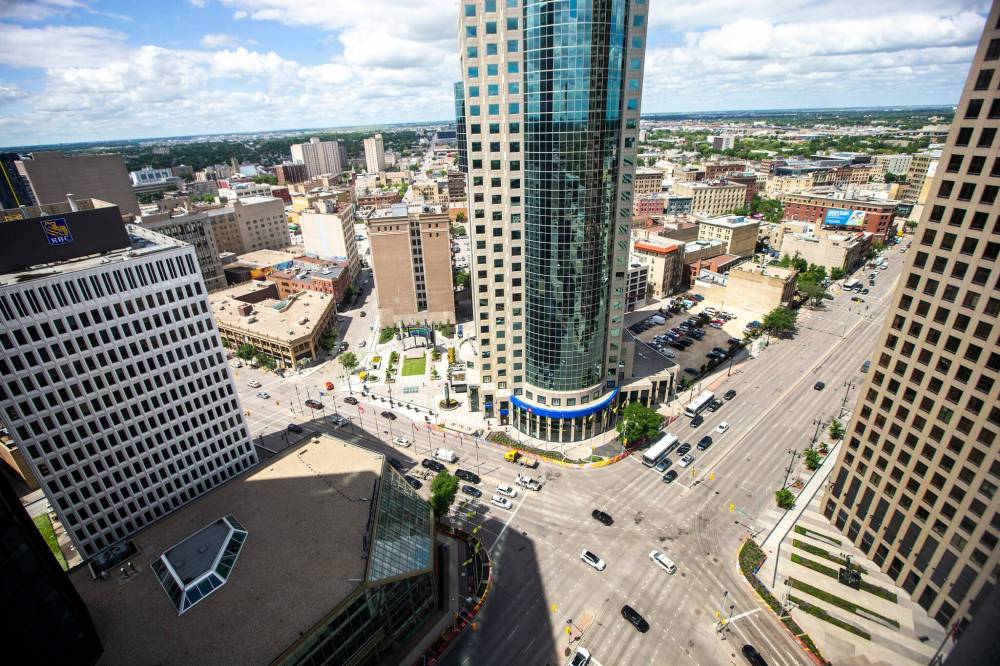
In a car-dominant city like Winnipeg, it’s no surprise that vehicle traffic at Portage and Main took priority for years.
The closure of Portage and Main in 1979 did not remain a decision confined to a particular political moment. Over time, it was reinforced by development agreements, physical infrastructure, property relationships, traffic-engineering practices, administrative routines, and public narratives about mobility and downtown revitalization. The people who made many of those original decisions eventually left office. The arrangements they created remained. Later planners inherited them.
This is what I call “embedded planning power.” Power is not exercised only when a politician casts a vote, a developer advances a proposal or a planner recommends an option. It accumulates. An agreement can outlast the government that signed it. Infrastructure can make one future easier and another more expensive. Professional hierarchies can determine whose expertise matters most, while familiar narratives can make established approaches seem inevitable.
The past does not simply constrain us because it happened. It constrains us because we build the future around it.
Who shapes the city?
My research also led me to reconsider the role of planners themselves. Planning scholarship often asks what planners should do: advocate, facilitate, advise, mediate or provide technical expertise. But there is another question worth asking: What forms of influence does the planning system actually allow them to exercise?
The planners I interviewed described four broad patterns of behaviour. Some acted as commanders, shaping narratives, advising elected officials and championing a vision. Others were compromisers, building relationships, facilitating dialogue and finding common ground among competing interests. Some became subordinates, taking direction from elected officials and demonstrating accountability with follow through. Others operated as solitarians, gathering information, conducting analysis and providing technical clarity.
These are not personality types or a hierarchy of better and worse planners. They are different configurations of professional agency. A planner may lead in one circumstance and defer in another, depending on their relationships, authority, expertise and institutional environment.
The distinction matters because we often tell planners to be more courageous, collaborative or strategic without asking whether their organizations enable them to act that way. A planner can understand precisely what a city needs and still lack the authority, resources, relationships or political support to make it happen.
Portage and Main illustrates this challenge. For much of its history, planning occupied a relatively peripheral position in a network where engineering, development interests and political decision-making often carried greater influence. That position was not inevitable. It was shaped by institutional decisions, the prioritization of traffic and engineering rationalities, changes in planning resources and organizational status, and development arrangements that gave other actors considerable influence.
Position is itself a product of power. This finding has implications beyond Winnipeg. If planners occupy the margins of a decision, we should ask why. If engineers dominate a conversation, what has made their expertise central? If developers have privileged access to decision-makers, what arrangements sustain that influence?
The question being asked also determines who becomes powerful in answering it. Frame Portage and Main as a traffic problem, and engineering expertise moves to the centre. Frame it as a development opportunity, and property and economic interests become more prominent. Frame it around accessibility, urban design or civic identity, and planning knowledge becomes more consequential. The framing of a problem is itself a form of power.
Recognizing constraints we reproduce
Institutions do more than constrain planners. Planners can also reproduce the very arrangements that limit their influence.
When a particular way of working becomes routine, professionals may stop questioning its origins. A planner who learns that an issue is “not really planning” may withdraw from the conversation. Someone who sees certain stakeholders consistently influencing decisions may focus on incremental improvements rather than challenging the underlying relationships. An organization may continue a practice long after the circumstances that created it have changed.
Power does not always need to tell people what they cannot do. Over time, it can teach them what they should not attempt.
This is not a criticism of individual planners. Often, these behaviours are rational responses to professional realities. Public-sector planners may face political expectations or restrictions on speaking publicly. Private-sector planners may worry about losing clients or damaging relationships with government. Telling someone simply to “speak truth to power” overlooks the institutional conditions that determine the consequences of doing so.
But if institutions can reproduce power, they can also interrupt it.
The reopening of Portage and Main demonstrates that embedded power is not permanent power. The agreements, infrastructure, political narratives and professional assumptions that sustained the closure for decades did not disappear overnight. They were challenged, renegotiated and eventually changed.
The chains were real. But they were not unbreakable. That is an important lesson for Winnipeg as it considers its future. The question is not whether power will exist in planning. It always will. The question is how that power is organized, whose interests it serves and whether the institutions of the city can adapt when circumstances change.
Building a planning powerhouse
If Winnipeg wants to become a planning powerhouse, the opportunity lies in strengthening both the capacity of planners and the institutions in which they work.
We need planning expertise close enough to political decision-making to influence it, while retaining sufficient professional independence to provide honest advice. We need planners who understand transportation, land use and infrastructure, but who can also explain how decisions shape everyday life. We need professionals who can build relationships with developers and businesses without becoming captive to their interests, engage communities without simply collecting preferences, and understand politics without becoming partisan.
Most importantly, we need planners who can move between different forms of agency. Winnipeg needs the solitarian who conducts rigorous analysis, the compromiser who brings competing interests together and the subordinate who respects democratic accountability. But it also needs the commander: the planner who can articulate a vision, shape a civic narrative and explain with professional confidence where the city should go and why.
We need institutions that allow planners to shift among these roles.
A healthy planning system is not one in which every planner holds power. It is one that gives planners meaningful opportunities to exercise different forms of influence when circumstances demand it. That means moving beyond a reactive approach to city-building. Too often, planning responds to development applications, infrastructure projects and political priorities after fundamental questions have already been settled. A stronger planning culture would ask those questions earlier: What kind of downtown do we want? How should transportation support that vision? Where should growth occur? What public spaces do we need? How do we build a city that serves today’s residents while creating opportunities for generations to come?
Answering these questions requires political leadership, institutional memory and professional capacity. It requires departments and agencies to work across organizational boundaries, long-term plans to guide actual investment, and relationships among planners, elected officials, engineers, developers, businesses and communities that are established before the next controversy begins.
It also requires acknowledging that planning is not neutral. Every plan reflects choices about whose needs matter, what knowledge counts, which priorities receive investment and which futures are considered realistic. The goal cannot be to eliminate politics from planning. It must be to make the politics of city-building more transparent, informed and responsive to long-term public interests.
Next set of chains
Portage and Main offers Winnipeg a powerful lesson. When decisions become embedded in institutions, changing them can take decades. But embedded does not mean permanent.
The intersection reopened after 46 years. That alone should make us reconsider the language we use when confronting difficult urban challenges. “It can’t be done” may simply mean institutional arrangements surrounding a problem currently make change difficult.
Those arrangements can shift. Stakeholder relationships, political priorities, professional cultures, infrastructure and public expectations can change. Planners can move from the margins toward the centre of the conversation.
But there is a harder lesson, too. If today’s decisions become tomorrow’s institutional realities, planning is not simply about solving the problems immediately before us. It is about deciding what conditions we are creating for the people who come next.

We inherit the decisions of the past, along with their consequences. Our responsibility is not only to navigate the constraints we inherit, but also to recognize the constraints we are reproducing ourselves.
That is where I find hope in this research. The same institutions that reinforce power can end up being where it is ultimately interrupted. The same professional practices that sustain the status quo can become vehicles for change. And the same planners who learn to work within existing boundaries can, under different conditions, help redraw them.
A planning powerhouse is not a city that gets every decision right. It is a city with the capacity to think ahead, question its assumptions, bring different forms of knowledge together and change course when evidence and the public interest demand it.
Portage and Main taught Winnipeg that even deeply embedded decisions can change. The next challenge is to build a city where we do not need 46 years to break the next set of chains.
Jason Syvixay is a registered professional planner and vice-president of BILD Edmonton Metro. Passionate about cities, planning and the communities that shape them, he maintains a deep connection to his hometown of Winnipeg.