

Sponsored Content
More Time for What Matters

Advertisement
Read this article for free:
or
Already have an account? Log in here »
To continue reading, please subscribe:
Digital Subscription
One year of digital access for only $1.44 a week*
- Enjoy unlimited reading on winnipegfreepress.com
- Read the E-Edition, our digital replica newspaper
- Access News Break, our award-winning app
- Play interactive puzzles
*Billed as $5.77 plus GST every four weeks. After 52 weeks, price increases to the regular rate of $19.95 plus GST every four weeks. Offer available to new and qualified returning subscribers only. Cancel any time.
To continue reading, please subscribe:
Add Free Press access to your Brandon Sun subscription for only an additional
$1 for the first 4 weeks*
- Enjoy unlimited reading on winnipegfreepress.com
- Read the E-Edition, our digital replica newspaper
- Access News Break, our award-winning app
- Play interactive puzzles
*Your next Brandon Sun subscription payment will increase by $1.00 and you will be charged $17.95 plus GST for four weeks. After four weeks, your payment will increase to $24.95 plus GST every four weeks.
Read unlimited articles for free today:
or
Already have an account? Log in here »
Hey there, time traveller!
This article was published 02/03/2022 (1700 days ago), so information in it may no longer be current.
Brian Kozak was 58 before he knew he’d been living with a congenital heart defect that could have led to sudden death.
“I was having breathing issues at first thought to be lung-related,” said the Winnipeg resident, now 64. “My new family doctor detected the faintest murmur in my heart.”
Kozak learned he had a bicuspid aortic valve. It’s an abnormality in which the valve has just two small parts – leaflets – instead of the normal three that open and close to regulate blood flow between the heart and the body. It’s common for these two leaflets to be thicker and stiffer than optimal, as well.
In Kozak’s case, the result was aortic stenosis. The aortic valve narrows to the point that it no longer opens fully, reducing blood flow and making the heart work harder than normal to get blood out to the body.
In November 2016 Kozak underwent surgery at St. Boniface Hospital to receive a mechanical replacement valve. Surgery also repaired an aortic aneurysm, a balloon- like bulge in the aorta, which can rupture, causing life-threatening internal bleeding.
As Manitoba’s Cardiac Centre of Excellence, the Hospital’s Cardiac Sciences Program receives approximately 51,000 patient visits annually. The program consistently ranks at the top in the Canadian Institute for Health Information’s ratings for quality of cardiac care.
Donors play a big role in the care that patients like Kozak receive. They’ve supported everything from the heart pillows that give comfort after surgery to advanced cardio-pulmonary testing equipment, a dedicated CT scanner, and Manitoba’s first Endovascular Hybrid Operating Room, expected to open this year.
Last fall Kozak said thanks with a heartfelt social media post.
“Five years ago today, I went in for open-heart surgery… 8.5 hours on the table (or so I’m told – I was right out of it.) Almost didn’t make it because of complications, apparently,” he wrote.
“But I’m here and I’m grateful to the wonderful medical staff at St. Boniface Hospital, my GP and Cardiologist and to my wife, friends and family who took such good care of me.”
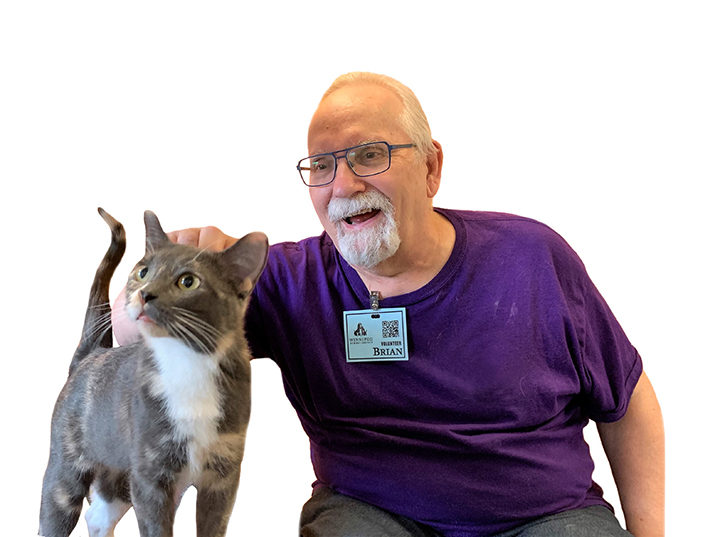
Retired from a career in communications, Kozak is a passionate volunteer with the Winnipeg Humane Society. He writes monthly profiles of his fellow volunteers. On Tuesdays, he takes his shift in one of the ‘kitty condos”, where he socializes the cats in anticipation of them being adopted.
Kozak also makes time to share his experiences in an online group for heart surgery patients.
“They’re of all ages and circumstances, all over the world. Often, they’re terrified, like I was. It’s scary – the actor John Ritter died because of aortic stenosis and an aortic aneurysm. I can encourage other people because I can relate.”
Kozak looks forward to his wife Monique joining him in retirement soon. And even as he waits for knee surgery, he remains grateful for the care he received at St. Boniface.
“It opened my eyes to the dedication of the caregivers.”

February is Heart Month, a time to bring attention to the importance of cardiovascular health. You can be a lifeline for Cardiac Sciences Manitoba patients like Brian Kozak. Donating today will enhance patient care throughout the Hospital: in the Cardiac Centre, the Neonatal Intensive Care Unit, the Emergency Department, Palliative Care, and many other units.
Manitoba’s Cardiac Centre of Excellence at St. Boniface Hospital performed more than 1,100 cardiac surgeries last year. Consider becoming a monthly donor – your gift will ensure Cardiac Sciences Manitoba is always ready to provide the best care possible.
Help write the next chapter. Donate today.
This article is produced by the Advertising Department of the Winnipeg Free Press, in collaboration with St. Boniface Hospital Foundation