

Alf Warkentin battling cancer but stays on flood watch
Advertisement
Read this article for free:
or
Already have an account? Log in here »
To continue reading, please subscribe:
Monthly Digital Subscription
$1 per week for 24 weeks*
- Enjoy unlimited reading on winnipegfreepress.com
- Read the E-Edition, our digital replica newspaper
- Access News Break, our award-winning app
- Play interactive puzzles
*Billed as $4.00 plus GST every four weeks. After 24 weeks, price increases to the regular rate of $19.95 plus GST every four weeks. Offer available to new and qualified returning subscribers only. Cancel any time.
Monthly Digital Subscription
$4.99/week*
- Enjoy unlimited reading on winnipegfreepress.com
- Read the E-Edition, our digital replica newspaper
- Access News Break, our award-winning app
- Play interactive puzzles
*Billed as $19.95 plus GST every four weeks. Cancel any time.
To continue reading, please subscribe:
Add Free Press access to your Brandon Sun subscription for only an additional
$1 for the first 4 weeks*
*Your next subscription payment will increase by $1.00 and you will be charged $16.99 plus GST for four weeks. After four weeks, your payment will increase to $23.99 plus GST every four weeks.
Read unlimited articles for free today:
or
Already have an account? Log in here »
Hey there, time traveller!
This article was published 01/04/2019 (2558 days ago), so information in it may no longer be current.
Former Manitoba flood forecaster Alf Warkentin, who guided the province through at least 10 major floods during his tenure, is battling cancer these days but he’s still watching our rivers.
And Warkentin has an interesting perspective on what’s happening right now.
“This is an amazing spring breakup. The slowness is incredible,” Warkentin said in an interview, referring to the ice break-up on the Red River and its tributaries.
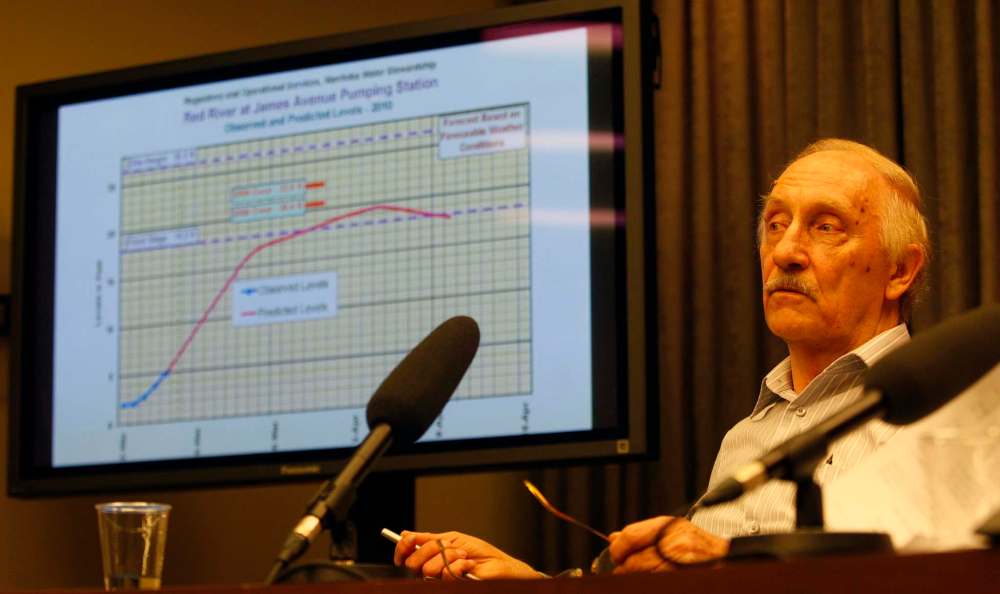
Warkentin said this year reminds him of 1966 “when we had a flood potential bigger than 1950.”
There was a huge snowpack in the Red River Valley and people in Winnipeg were panicked. Construction had only started on the floodway and the city now expected a flood larger than in 1950, when 10,000 homes were flooded and 100,000 residents evacuated.
The heavy equipment set up outside Winnipeg to build the floodway was mobilized to move dirt and build dikes inside the city. For example, a big earthen dike was built the length of the northbound lane on Pembina Highway.
But the weather had other plans.
“The flood potential didn’t turn out because of this very, very slow melt and dry weather, just like we’re having this year,” said Warkentin. That spread out the spring runoff and lowered the eventual crest.
The Red River still reached about 25 feet above datum (the long-term winter ice level) but wasn’t the disaster it could have been with a normal melt. (In 1950 the crest was 30.3 feet.)
“It was still a significant event but much less than had been feared,” said Warkentin. (Warkentin wasn’t the flood forecaster in 1966 but it’s a much-studied flood because of the dramatic turnaround, he said.)
This year’s freezing and thawing conditions have been excellent for reducing flood size: temperatures above freezing during the day and below freezing at night. As well, the Colorado lows that dumped big snowfalls in North Dakota mostly missed Manitoba’s Red River Valley.
“Two more weeks of this ideal weather, I think, will reduce the flood potential a lot, just like 1966,” Warkentin said.
U.S. National Weather Service made a similar observation at the end of last week, saying flood levels could be 25 per cent lower than its earlier predictions. “That’s pretty significant,” Warkentin said.
Manitoba’s Hydrologic Forecaster Centre said last week it still is expecting a flood of 2009 proportions but maintained the slow melt is a big help.
Warkentin added the ground seems to be absorbing large amounts of snowmelt in Manitoba.
“I’ve talked to people in southern Manitoba who say there’s some standing water at the end of the day but by the next morning it’s gone.”
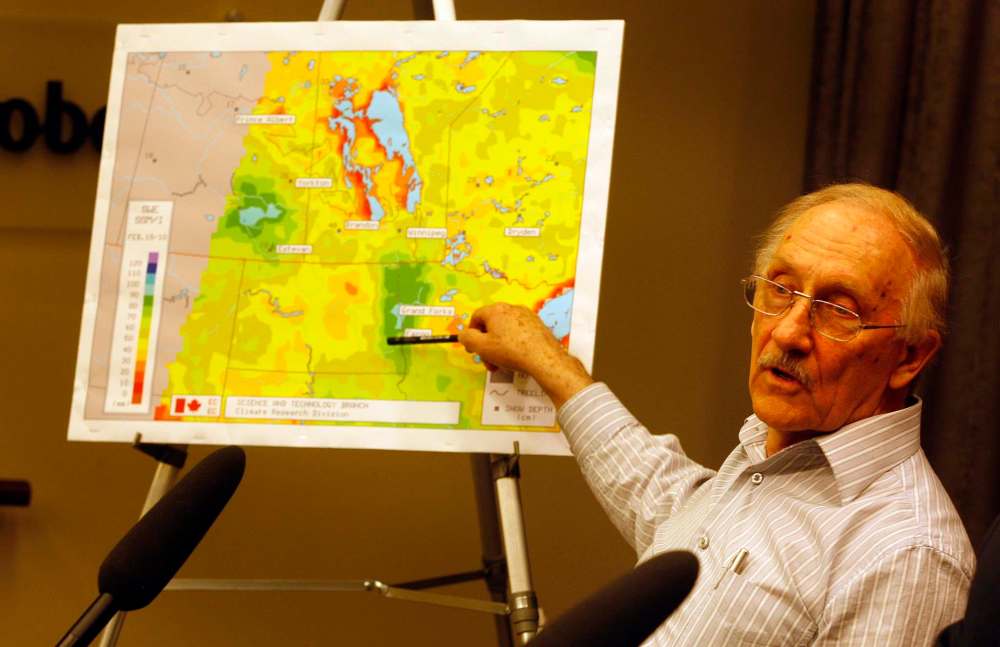
Some of that water disappears due to sublimation, which is the evaporation of snow, but mostly it’s because the ground is absorbing the water, which is another good sign.
Warkentin added that even if the U.S. experiences serious flooding — Fargo is still bracing for a flood — it doesn’t follow that Manitoba will get it as bad.
“There’s a lot of channel storage and overbank flow that tends to reduce the flood, and the channel capacity up here is larger — the river gets bigger downstream,” he said.
Warkentin was the flood forecaster for 41 years before he retired in 2010. There wasn’t even such a position back in 1970 until he talked the province into it.
Warkentin graduated from the University of Manitoba in the 1960s as a meteorologist and became a weather forecaster for Environment Canada. But the shift work — five days, five nights, five midnight shifts, and repeat — didn’t agree with him.

So he famously persuaded the province’s water resources branch it needed a meteorologist, a position the government never had before. It hired him in 1970 as its first “hydro meteorologist.” That quickly morphed into the position of flood forecaster.
Warkentin, 76, continued work as a consultant after retirement but cancer has forced him to give that up.
He didn’t want to say much publicly about his health but he contracted cancer shortly after he retired in 2010 at age 67. He has had every available treatment since then, he said. Now he is having mobility issues and has difficulty leaving the house.
“It’s a bit rough these days,” he said.
bill.redekop@freepress.mb.ca