

Amended freedom of information law delays access to budget data

Advertisement
Read this article for free:
or
Already have an account? Log in here »
To continue reading, please subscribe:

Digital Subscription
One year of digital access for only $205*
- Enjoy unlimited reading on winnipegfreepress.com
- Read the E-Edition, our digital replica newspaper
- Access News Break, our award-winning app
- Play interactive puzzles
*First annual payment billed as $205.00 + GST for one year. This annual subscription will automatically renew at $233.00 + GST every 52 weeks (10% off the regular annual price of $259.35). Offer available to new and qualified returning subscribers only. Cancel any time.
To continue reading, please subscribe:
Add Free Press access to your Brandon Sun subscription for only an additional
$1 for the first 4 weeks*
- Enjoy unlimited reading on winnipegfreepress.com
- Read the E-Edition, our digital replica newspaper
- Access News Break, our award-winning app
- Play interactive puzzles
*Your next Brandon Sun subscription payment will increase by $1.00 and you will be charged $17.95 plus GST for four weeks. After four weeks, your payment will increase to $24.95 plus GST every four weeks.
Read unlimited articles for free today:
or
Already have an account? Log in here »
Hey there, time traveller!
This article was published 03/06/2022 (1581 days ago), so information in it may no longer be current.
Details of how the Progressive Conservative government plans to spend money in its budget are now being kept from the prying eyes of the public for months, thanks to changes to freedom of information law.
The Freedom of Information and Protection of Privacy Amendment Act passed one year ago says ministerial records are not to be released to the public until within 60 days after the budget (presented in spring) is passed by the legislative assembly (not until late fall).
Budget information that had been available to the public — and the Opposition responsible for holding the government to account — is now being withheld until late in the year.
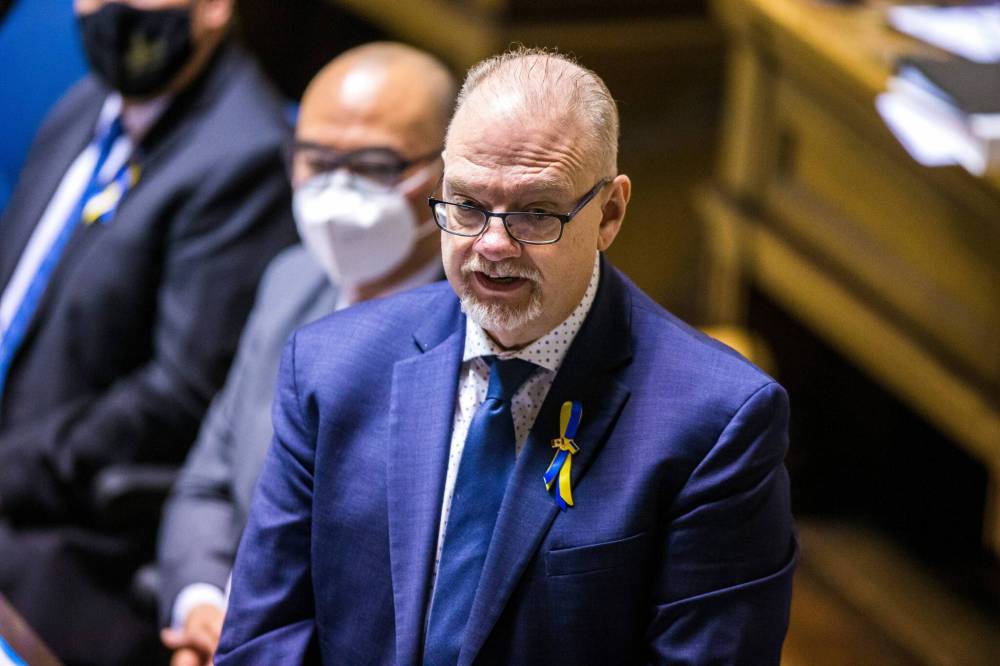
Buried in the 2021 FIPPA bill’s regulations is a section that delays anyone from accessing information in a minister’s spending estimates book. The book contains answers to questions about a department’s programs the minister can expect to be asked when they appear before the committee of supply that scrutinizes spending.
Justice Minister Kelvin Goertzen, who introduced the bill in 2020, was not available for comment Friday.
Getting just the table of contents for an estimates book can provide the Opposition with information about where to probe and what to ask, said NDP finance critic Mark Wasyliw.
“It would give us information for which we could then file more FIPPA requests that we targeted because we could see that there’s an area that we need to investigate and to explore,” he said Friday, pointing to two recent examples.
A freedom of information request in January of 2021, asking for the education department’s comparison of school division expenses to provincial funding, was granted in March. It showed a 0.3 per cent decrease in funding in 2020-21.
In June 2021, a request for the table of contents to the infrastructure minister’s estimates book revealed a $67-million cost increase for the Lake St. Martin and Lake Manitoba flood outlet channels project.
In May, a freedom of information request for the table of contents to the 2022 committee of supply was refused.
The province cited the section of the new FIPPA legislation that says government has 60 days from passage of the budget (expected in November) to provide any ministerial records.
“One of the main jobs of being the official Opposition is to hold the government to account,” said Wasyliw. “We need to have the information in order to question the government and to challenge what they’re doing in a constructive way.”
Manitoba’s ombudsman, who has the authority to ensure there’s compliance with freedom of information legislation by reviewing the decisions of public bodies and reviewing citizen complaints, raised other concerns about the FIPPA bill before it passed — some of which were addressed.

In a letter to Goertzen in April 2021, Jill Perron said the bill expands the grounds for disregarding or extending the timeline for a response to a request for access. It would allow a public agency to refuse a request deemed “unduly repetitive or systematic” or “excessively broad” or one it deems to be “trivial, frivolous or vexatious.”
Perron complained waiting 10 years before holding a comprehensive public review of the legislation was too long; government responded, changing it to five years.
The legislation increases the time for responding to a request for information to 45 days from 30 days, and says a request may be considered abandoned if the person requesting it fails to provide the information requested of them needed to process the request.
It also streamlined the process for correcting personal information and required people are notified if there is a real risk they will be significantly harmed as a result of a privacy breach concerning personal information.
carol.sanders@freepress.mb.ca
Carol Sanders
Legislature reporter
Carol Sanders is a reporter at the Free Press legislature bureau. The former general assignment reporter and copy editor joined the paper in 1997. Read more about Carol.
Every piece of reporting Carol produces is reviewed by an editing team before it is posted online or published in print — part of the Free Press‘s tradition, since 1872, of producing reliable independent journalism. Read more about Free Press’s history and mandate, and learn how our newsroom operates.
Our newsroom depends on a growing audience of readers to power our journalism. If you are not a paid reader, please consider becoming a subscriber.
Our newsroom depends on its audience of readers to power our journalism. Thank you for your support.
Carol Sanders
Legislature reporter
Carol Sanders is a reporter at the Free Press legislature bureau. The former general assignment reporter and copy editor joined the paper in 1997. Read more about Carol.
Every piece of reporting Carol produces is reviewed by an editing team before it is posted online or published in print — part of the Free Press‘s tradition, since 1872, of producing reliable independent journalism. Read more about Free Press’s history and mandate, and learn how our newsroom operates.
Our newsroom depends on a growing audience of readers to power our journalism. If you are not a paid reader, please consider becoming a subscriber.
Our newsroom depends on its audience of readers to power our journalism. Thank you for your support.
Advertisement Advertise With Us
Advertisement Advertise With Us