

Corner stores are disappearing, but for immigrants they represent a new lease on life

Advertisement
Read this article for free:
or
Already have an account? Log in here »
To continue reading, please subscribe:
Monthly Digital Subscription
$1 per week for 24 weeks*
- Enjoy unlimited reading on winnipegfreepress.com
- Read the E-Edition, our digital replica newspaper
- Access News Break, our award-winning app
- Play interactive puzzles
*Billed as $4.00 plus GST every four weeks. After 24 weeks, price increases to the regular rate of $19.95 plus GST every four weeks. Offer available to new and qualified returning subscribers only. Cancel any time.
Monthly Digital Subscription
$4.99/week*
- Enjoy unlimited reading on winnipegfreepress.com
- Read the E-Edition, our digital replica newspaper
- Access News Break, our award-winning app
- Play interactive puzzles
*Billed as $19.95 plus GST every four weeks. Cancel any time.
To continue reading, please subscribe:
Add Free Press access to your Brandon Sun subscription for only an additional
$1 for the first 4 weeks*
- Enjoy unlimited reading on winnipegfreepress.com
- Read the E-Edition, our digital replica newspaper
- Access News Break, our award-winning app
- Play interactive puzzles
*Your next Brandon Sun subscription payment will increase by $1.00 and you will be charged $17.95 plus GST for four weeks. After four weeks, your payment will increase to $24.95 plus GST every four weeks.
Read unlimited articles for free today:
or
Already have an account? Log in here »
Hey there, time traveller!
This article was published 01/03/2013 (4819 days ago), so information in it may no longer be current.
Paul’s Solo Store is owned by a guy named Changhee.
Paul doesn’t work here anymore.
Instead, Changhee Lee and his wife and two sons, both teenagers, spend 13 hours a day, seven days a week, operating a corner store on Mountain Avenue that is a world away from their former life in South Korea.
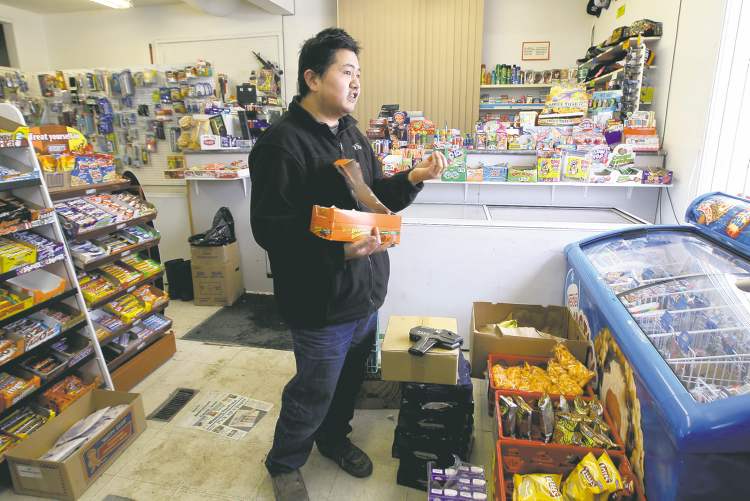
“It’s hard to keep business,” Lee explained. “There’s going to be more 7-Elevens and Safeways. A bunch of them are already around here.”
For the Lees, the modest North End corner store is their home, their business and their stake in a new country. It’s their present and future.
Yet corner stores, once a staple of urban existence, are disappearing from the city’s ever-evolving landscape. Since the turn of the century, corner stores had been a sentimental and necessary form of local commerce, at first providing all kinds of groceries to neighbourhood families, many of whom didn’t own vehicles.
By the 1950s and ’60s, the corner store became a place where children bought penny candy and treats, and where parents grabbed whatever was missing from the pantry shelves or fridge.
For many Winnipeggers of a certain age, the corner store was the site of their first independent transaction — a chocolate bar, a bag of chips, bubble gum.
But nothing lasts forever, even one of those giant jawbreakers.
“Then came the mini-marts,” noted Reg Litz, a professor of entrepreneurial studies at the University of Manitoba’s Asper School of Business.
“Then came the 7-Elevens. Bit by bit, piece by piece, we pushed these guys out of the market. There just isn’t enough volume or margin left to sustain. So that real estate got employed for something else.”
Now the suburbs are littered with the skeletons of old corner stores or they have vanished outright. Where there were once hundreds of similar neighbourhood groceries in the early part of the last century, there are now just a handful of survivors.
In Winnipeg’s North End, the bulk of those remaining stores are owned and operated by Korean families — first-generation immigrants who live above or behind the grocery, living a life that has nothing to do with convenience.
At the Redwood Grocery, Jang-Whan Lee and his wife, Hyunhee, have manned the counter every day since arriving from Korea four years ago. Lee didn’t know English, much less the difference between the caffeinated and decaffeinated coffee on his shelves.
“Right now,” he said, in broken English, “my customers teach me (the language). I learned pronunciation.”
Lee said the advantage of owning the corner store was that customers knew what they wanted and could simply grab the item or point to it. The rest was math, and for Lee, every transaction was a lesson.
Don Lee bought Royal Grocery seven years ago, and since that time, he and his wife take exactly three days off each year — two on the July long weekend and Christmas.
Sam Ma, who owns Sunny’s Foods, takes two days off a year, also on July long weekend. Last year, he, his wife and two children went camping.
“It’s hard work,” Ma said. “Not many spend time with their family. All day long, work.”
The main traffic for corner stores such as Ma’s and the Lees’ is for sports betting and lottery tickets, cigarettes and pop.
How’s business?
“That’s a good question,” Lee said. “There used to be a lot of grocery stores, but they’ve become extinct, like dinosaurs. If you want a Slurpee, go to 7-Eleven, but their prices are a little higher.”
As Lee is speaking, in walks regular customer Alice Ronn to buy a newspaper and, upon being asked, expresses her solidarity with the small corner store. “It’s so handy,” Ronn said. “(But) they’re having a hard time. I don’t know how they survive.
“It’s not fair. I mean, look how friendly they are. Here, you feel comfortable.”
Over at the Redwood Grocery, a string of customers that ring the bell walking through Jang-Whan’s door call him Joe, their anglofied version of Jang, who doesn’t mind at all.
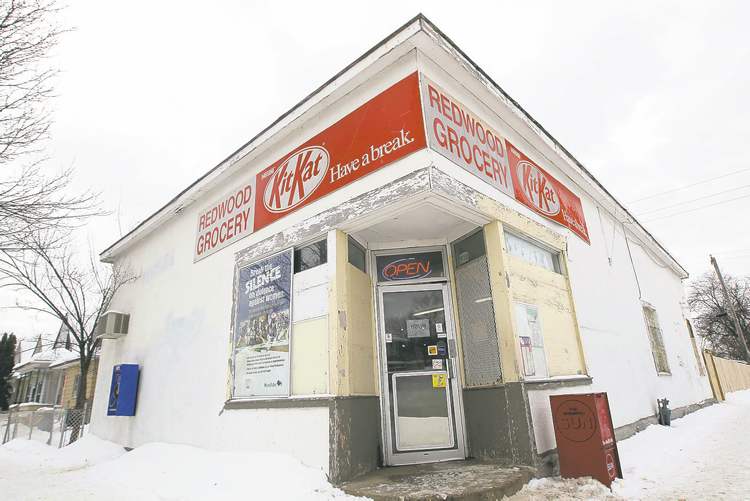
“Have a good one, Joe,” Ellen Deschutter said, after picking up some potato chips and dip.
Litz said the extinction of the corner store is just another example of urban Darwinism at work.
“In some cases, stores are existing when they don’t have any business existing,” he said.
“They have a very difficult time facing the reality that the world has changed. People in retail, like people in general, are subject to self-deception.
“That said, you have to recognize that some small stores still have, and are going to continue to have, a reason to stay in business. They create value for their customers. That value is something big-box stores can’t create.
“Is it sad? I suppose from the standpoint of knowing the people who are serving you, having a history there, being recognized and treated as an individual, yes, that’s sad. The big-box is comparatively impersonal.
But as a society, we’ve brought it on ourselves. We’ve chosen what appears to be more efficient.”
Although a century has passed since the birth of the corner store, some human elements of the dwindling business model haven’t changed.
All the Lees (not related) interviewed for this story have children (the oldest in the three families was 19), the sole reason for picking up their life in Korea and plunking it in the middle of a Canadian Prairie city.
“My two kids gained more chance,” Jang-Whan said. “I want them to have a better future. I tell them, ‘You are very, very lucky.’ They know that now.”
Changhee wants his sons, Jay and Brandon, to get a better education. He doesn’t want them standing behind a counter 12 hours a day selling lottery tickets and cigarettes.
In fact, at the stores visited, the children often served as translators for their parents.
The high number of Korean owners isn’t coincidence, but represents not just a cultural pipeline — most current Korean owners bought from former Korean owners — but the changing ethnic makeup of the neighbourhood, which has a large number of Asian immigrants.
“If you went into those same stores 100 years ago, the owners would have been speaking Yiddish or Polish or Ukrainian,” said architectural historian Randy Rostecki, a longtime North End resident. “You would have been talking to their children, who were going to university.
“They are operating (their businesses) the same way, on a tiny profit,” Rostecki added.
“It’s been the same for a lot of immigrant groups. The first generation takes the hit. They get established. They’re the ones who stick it out at these places.”
Corner stores have always represented, at least in the last half-century, a quaint remnant of a simpler past before everything got faster, even the food. Said Litz: “Is it sort of a warm place in your heart? Certainly it is.”
Though the number of corner grocers will probably continue to fall — or at least have trouble eking out a living — Rostecki believes a few will survive for the same reason they have for more than a century.
“As long as you’ve got immigrant groups coming over with some business smarts, they will try to make a go of it,” he said.
Some are escaping devastating poverty or tyranny or famine or war. Some things in this world are worse than selling pop to schoolchildren.
Every so often, Jang-Whan Lee will reflect on his life in Korea, where the competition for middle-class jobs was intense, where students study for 13 hours a day and workers over age 40 are commonly replaced by the next generation.
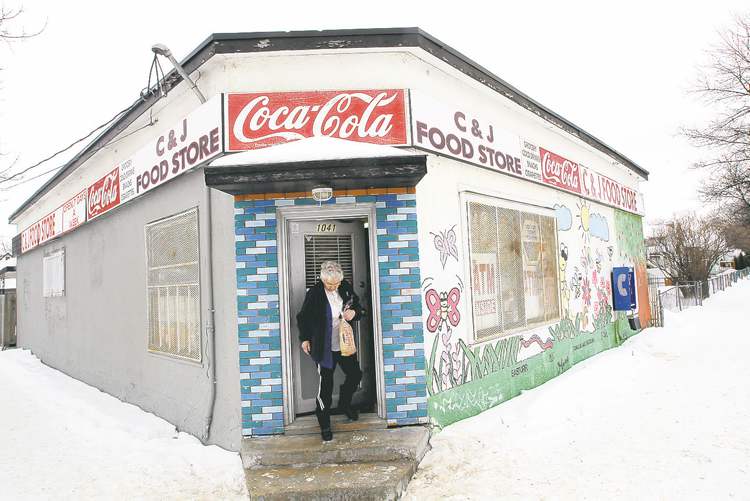
In Canada, Lee understands his humble business empire, where he sells everything from children’s toys to canned tuna, might not make him rich. At least monetarily.
“It’s mine,” said the man they call Joe. “I’m happy. Don’t worry about it.”
randy.turner@freepress.mb.ca
Danger on the job
ONE day, Jang-Whan Lee was smiling and chatty.
The next, the look on his face signalled trouble.
Only a few days after a Free Press reporter had dropped in on Lee’s Redwood Grocery, we returned with a photographer, as promised, to take some pictures.
Instead, a shaken Lee described a robbery that had occurred after the first interview.
“Two men,” he said. “It happened at 8:30 (Wednesday night). One had a long knife — this long.”
Lee’s hands spread apart more than 30 centimetres. Sounds like a machete, he was told.
“Yes, machete,” Lee replied.
The thugs also robbed one of Lee’s customers who was in the store at the time. The hooded bandits, both armed, made off with an undisclosed amount of cash and a few packs of cigarettes.

“I was scared,” Lee said. “My wife, she not sleep.”
Corner stores are a source of income and a steady job for new immigrants, but they also face the danger of robbery and violence commonly associated with convenience stores.
Sam Ma, owner of Sunny’s Foods, said security is his No. 1 concern. Asked if he’d ever been robbed, Ma replied, “Not yet.”
It’s why Ma vows his school-age children won’t ever work behind his store counter.
“Security reasons,” he said, noting he reads accounts of convenience-store robberies in the newspaper “almost every day.”
Randy Turner
Reporter
Randy Turner spent much of his journalistic career on the road. A lot of roads. Dirt roads, snow-packed roads, U.S. interstates and foreign highways. In other words, he got a lot of kilometres on the odometer, if you know what we mean.
Our newsroom depends on a growing audience of readers to power our journalism. If you are not a paid reader, please consider becoming a subscriber.
Our newsroom depends on its audience of readers to power our journalism. Thank you for your support.
Randy Turner
Reporter
Randy Turner spent much of his journalistic career on the road. A lot of roads. Dirt roads, snow-packed roads, U.S. interstates and foreign highways. In other words, he got a lot of kilometres on the odometer, if you know what we mean.
Our newsroom depends on a growing audience of readers to power our journalism. If you are not a paid reader, please consider becoming a subscriber.
Our newsroom depends on its audience of readers to power our journalism. Thank you for your support.
Advertisement Advertise With Us
Advertisement Advertise With Us