

Couple shares harrowing COVID experience
Both contracted virus a week after receiving first dose of vaccine

Advertisement
Read this article for free:
or
Already have an account? Log in here »
To continue reading, please subscribe:

Digital Subscription
One year of digital access for only $205*
- Enjoy unlimited reading on winnipegfreepress.com
- Read the E-Edition, our digital replica newspaper
- Access News Break, our award-winning app
- Play interactive puzzles
*First annual payment billed as $205.00 + GST for one year. This annual subscription will automatically renew at $233.00 + GST every 52 weeks (10% off the regular annual price of $259.35). Offer available to new and qualified returning subscribers only. Cancel any time.
To continue reading, please subscribe:
Add Free Press access to your Brandon Sun subscription for only an additional
$1 for the first 4 weeks*
- Enjoy unlimited reading on winnipegfreepress.com
- Read the E-Edition, our digital replica newspaper
- Access News Break, our award-winning app
- Play interactive puzzles
*Your next Brandon Sun subscription payment will increase by $1.00 and you will be charged $17.95 plus GST for four weeks. After four weeks, your payment will increase to $24.95 plus GST every four weeks.
Read unlimited articles for free today:
or
Already have an account? Log in here »
Hey there, time traveller!
This article was published 24/05/2021 (1960 days ago), so information in it may no longer be current.
The tubes down her throat kept her from speaking, but Sharron Champagne waved to the screen from her hospital bed, blowing kisses. At home, as he struggled to recover from the same virus that required his wife to be on a ventilator, Ron Champagne perked up at the sight of her. He adjusted his collar and smoothed his hair, trying to look his best over FaceTime.
The couple in their 70s contracted COVID-19 one week after receiving their first doses of vaccine and were both hit hard by the virus in late April. They both spent time in the hospital, but Sharron had to be intubated in intensive care and Ron was sent home, where he couldn’t care for himself as he normally would because the virus on top of his chronic obstructive pulmonary disease left him weak and barely able to catch his breath.
For a month, virtual visits kept the couple going. It’s how they celebrated their 44th wedding anniversary — the first they’ve ever spent apart.
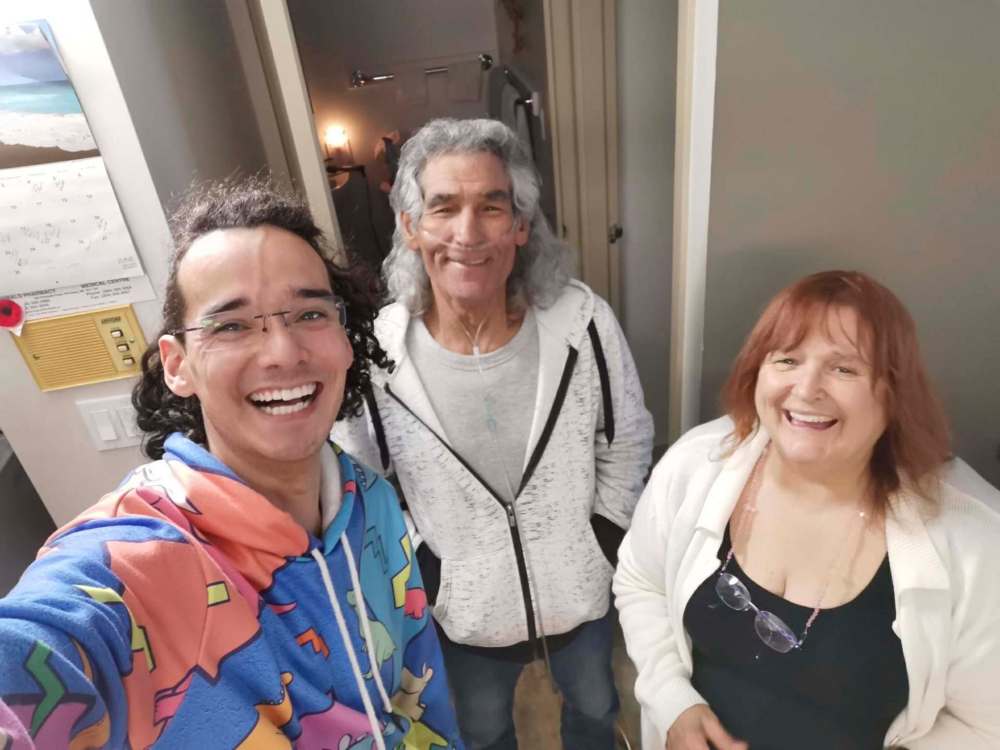
“My dad said that while he was recovering, it was those conversations, those FaceTime calls with my mom, that were pushing him to get better,” said their son Michael Redhead Champagne.
“I noticed every time when we were finished the call, he had a renewed passion for his recovery. He’s like, ‘I gotta eat more. I gotta rest more. I have to do everything I can do to get better so that when your mom comes home, I’m healthy,’” said Redhead Champagne, who was on hand during the visits to offer technical assistance to his dad and see his mom.
Sharron spent Mother’s Day in the hospital before she was able to return home May 19.
“She also shared, as soon as she came home, how much she looked forward to always being able to visit with the family by those FaceTime calls,” Redhead Champagne said.
“Now it’s nice that they are together at home, recovering together.”
The couple didn’t want to be interviewed as they continue their recovery, but they gave their son permission to share their story in hopes of helping others. They’ve been encouraging everyone in their circle to get vaccinated, and with second-dose bookings now open to all Indigenous people in Manitoba, Redhead Champagne said he’s getting his second shot at the earliest opportunity and is urging people to keep wearing masks, staying home and maintaining good hygiene. For his family, it’s been “an entire month of difficult sleeps and being in a constant state of worry.”
“What I want people to understand is how helpless we truly feel when our loved one is sick with COVID-19 and you can’t go and be close to them as they are struggling with that sickness in the hospital. It’s a special kind of pandemic helplessness that everyone is feeling right now, but it’s especially hard for people who have relatives that are being intubated,” he said. “What I want people to know is that they are not helpless. There are things that we can do to fight back against COVID.”
On Friday, Dr. Marcia Anderson, public health lead of the First Nations Pandemic Response Co-ordination Team, said Indigenous people, most of whom live off-reserve, are still being disproportionately admitted to intensive care units after being infected with COVID-19. They’ve accounted for 40 to 60 per cent of ICU admissions throughout the pandemic.

Anderson said they are still trying to encourage vaccine uptake among Indigenous people who live in urban areas in Manitoba. So far, the uptake rate is lower than the general population, at around 30 per cent, compared with 67 per cent for on-reserve residents. Anderson said the First Nations pandemic response team is confronting issues such as systemic racism, lack of access to transportation and mistrust of the medical system — with trust being the main factor.
That’s why, Redhead Champagne said, he’s trying to raise awareness of the benefits of the vaccines. His parents are glad they got vaccinated, he said.
“There are many examples of why people wouldn’t trust the health system in general, and so that’s how come I want to be a part of encouraging people to get the vaccine, because I share those same reservations that they do, but I also trust First Nations doctors like Marcia Anderson or Dr. Barry Lavallee that are doing an amazing job explaining how taking the vaccine is one way to protect the people we love,” he said.
katie.may@freepress.mb.ca
Twitter: @thatkatiemay
Katie May is a multimedia producer for the Free Press.
Our newsroom depends on a growing audience of readers to power our journalism. If you are not a paid reader, please consider becoming a subscriber.
Our newsroom depends on its audience of readers to power our journalism. Thank you for your support.
Katie May is a multimedia producer for the Free Press.
Our newsroom depends on a growing audience of readers to power our journalism. If you are not a paid reader, please consider becoming a subscriber.
Our newsroom depends on its audience of readers to power our journalism. Thank you for your support.
Advertisement Advertise With Us
Advertisement Advertise With Us