

Coverup just as destructive as the crime

Advertisement
Read this article for free:
or
Already have an account? Log in here »
To continue reading, please subscribe:
Monthly Digital Subscription
$1 per week for 24 weeks*
- Enjoy unlimited reading on winnipegfreepress.com
- Read the E-Edition, our digital replica newspaper
- Access News Break, our award-winning app
- Play interactive puzzles
*Billed as $4.00 plus GST every four weeks. After 24 weeks, price increases to the regular rate of $19.95 plus GST every four weeks. Offer available to new and qualified returning subscribers only. Cancel any time.
Monthly Digital Subscription
$4.99/week*
- Enjoy unlimited reading on winnipegfreepress.com
- Read the E-Edition, our digital replica newspaper
- Access News Break, our award-winning app
- Play interactive puzzles
*Billed as $19.95 plus GST every four weeks. Cancel any time.
To continue reading, please subscribe:
Add Free Press access to your Brandon Sun subscription for only an additional
$1 for the first 4 weeks*
*Your next subscription payment will increase by $1.00 and you will be charged $16.99 plus GST for four weeks. After four weeks, your payment will increase to $23.99 plus GST every four weeks.
Read unlimited articles for free today:
or
Already have an account? Log in here »
Hey there, time traveller!
This article was published 05/02/2018 (2958 days ago), so information in it may no longer be current.
As the number of prominent men accused of sexual misconduct grows, it’s important for just about everyone involved to remember a fundamental truth about scandal.
The coverup is almost always as bad or worse than the original crime.
Take the recent allegations rocking USA Gymnastics (USAG), the U.S. Olympic Committee and Michigan State University. A court in Indianapolis sentenced Dr. Larry Nassar, a osteopathic physician employed by the school and governing bodies, to 175 years in prison for molesting hundreds of girls and young women under his charge.
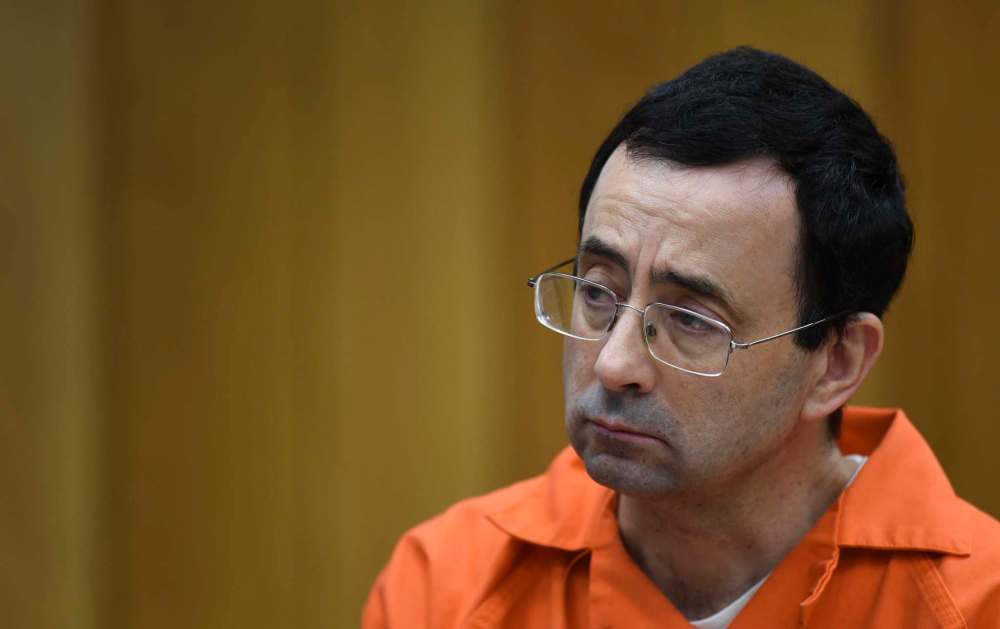
The only thing more horrendous than the stories of Nassar’s relentless, predatory behaviour was the revelation that the boards of the governing bodies, officials at the school and the FBI had known for years that something was not quite right about the doctor’s relationships with young, elite athletes.
One of the most offensive revelations to come out of Nassar’s trial was confirmation that USAG paid a US$1.25-million settlement in 2016 to one of its medal-winning gymnasts who had been molested by Nassar. The settlement included a non-disparagement clause that carried a US$100,000 penalty should the gymnast publicly disclose the incident or the settlement. It is alleged that USAG tried to hush the gymnast to avoid a scandal heading into the 2016 Rio Olympic games.
It’s not hard to hate a sexual predator, or to wish them a lifetime of pain and suffering. But if there is a God, there will be a special place in hell for those who, for their own misguided and selfish reasons, cover up the crimes of a sexual predator.
The Nassar trial and accompanying scandal, which continues to rage through the hierarchies of the organizations involved in covering up or ignoring evidence of his crimes, have raised an important concern about the way in which we respond to allegations of sexual misconduct.
As we have seen with the rising body count in the entertainment industry and in politics, a simple allegation can translate into the sudden, violent end to a career. Those uncomfortable with the growing chorus that urges society to “believe the victim” should remember that it is, in part, a response to the fact that allegations of sexual misconduct have been so poorly handled in the past.
For too long, those levelling such allegations were either discounted entirely or encouraged to stay quiet. If there is a tendency now in the court of public opinion to lean more heavily in the direction of the allegation, it’s understandable; this has been, for some time, an unlevel playing field.
These scandals also reveal the immediate need for public bodies — from governments and registered political parties to educational institutions and sport-governing bodies, to name but a few — to carefully consider how they treat allegations of sexual misconduct.
To date, organizations both public and private have relied heavily on internal mechanisms to vet allegations and determine a course of action. In cases where the alleged perpetrator has denied the allegation, those internal mechanisms have almost always defaulted to a “let’s-keep-it-in-the-family” posture.
Serious allegations of criminal behaviour should, at some point, go to law enforcement. For many victims, that will hardly come as a relief; police and prosecutors have for many years underperformed on such cases.
Part of this is due to the fact that the justice system is largely unable to untangle a case that involves an allegation, a denial and a complete absence of independent evidence. But it’s also true the justice system has not always looked hard enough at the allegations to find that independent evidence.
All of this adds up to a pressing need for a new approach for allegations of sexual misconduct. No legal or administrative process will ever be able to reach a conclusion in the absence of corroborating evidence. But there are most definitely steps that can be taken to more thoroughly examine allegations to ensure that legitimate complaints — ones that have independent evidence — are not sacrificed on the altar of privacy and expediency.
This new approach will not just benefit individuals, organizations will also be well served by a process that ensures it doesn’t — either deliberately or by accident — engineer a coverup. We need to develop more transparent, more thorough processes to handle allegations when they come forward. Processes that must, above all, be built on a foundation of independence.
This has certainly been true in the case of wrongful convictions. Although the initial miscarriage of justice is horrible, what is unforgivable has been the systemic, deliberate efforts to ignore obvious problems or new evidence. This is largely the result of an inability to objectively assess the integrity of the original conviction, and a refusal to establish a truly independent body to vet allegations of wrongful conviction.

Hiring investigators or lawyers, and giving them a mandate to operate beyond arm’s length from the organization that hired them, could be a solution. Whatever the structure, we have to acknowledge that turning over allegations of this kind to human resources, or the board of directors, or an internal committee of some sort, is not working.
In many respects, it is unfair to ask an organization to investigate allegations of this kind. Organizations are structured to support and defend the organization, many times at the expense of the people that belong to, or work for, them.
Ironically, it will likely take an act of naked self-interest to improve the situation. It starts when those in charge of dealing with the allegation take time to ask themselves one important question.
If an allegation of sexual misconduct that was handled and dismissed internally becomes public, could you justify your decision to do nothing?
dan.lett@freepress.mb.ca
Dan Lett is a columnist for the Free Press, providing opinion and commentary on politics in Winnipeg and beyond. Born and raised in Toronto, Dan joined the Free Press in 1986. Read more about Dan.
Dan’s columns are built on facts and reactions, but offer his personal views through arguments and analysis. The Free Press’ editing team reviews Dan’s columns before they are posted online or published in print — part of the our tradition, since 1872, of producing reliable independent journalism. Read more about Free Press’s history and mandate, and learn how our newsroom operates.
Our newsroom depends on a growing audience of readers to power our journalism. If you are not a paid reader, please consider becoming a subscriber.
Our newsroom depends on its audience of readers to power our journalism. Thank you for your support.
Dan Lett is a columnist for the Free Press, providing opinion and commentary on politics in Winnipeg and beyond. Born and raised in Toronto, Dan joined the Free Press in 1986. Read more about Dan.
Dan’s columns are built on facts and reactions, but offer his personal views through arguments and analysis. The Free Press’ editing team reviews Dan’s columns before they are posted online or published in print — part of the our tradition, since 1872, of producing reliable independent journalism. Read more about Free Press’s history and mandate, and learn how our newsroom operates.
Our newsroom depends on a growing audience of readers to power our journalism. If you are not a paid reader, please consider becoming a subscriber.
Our newsroom depends on its audience of readers to power our journalism. Thank you for your support.
Related Articles
Former gymnast Rachael Denhollander describes difficult split with her church in midst of Nassar sex abuse case
Advertisement Advertise With Us
Advertisement Advertise With Us
History
Updated on Monday, February 5, 2018 6:55 AM CST: Adds photo