

Deaths related to extreme heat not tracked
Advertisement
Read this article for free:
or
Already have an account? Log in here »
To continue reading, please subscribe:

Digital Subscription
One year of digital access for only $205*
- Enjoy unlimited reading on winnipegfreepress.com
- Read the E-Edition, our digital replica newspaper
- Access News Break, our award-winning app
- Play interactive puzzles
*First annual payment billed as $205.00 + GST for one year. This annual subscription will automatically renew at $233.00 + GST every 52 weeks (10% off the regular annual price of $259.35). Offer available to new and qualified returning subscribers only. Cancel any time.
To continue reading, please subscribe:
Add Free Press access to your Brandon Sun subscription for only an additional
$1 for the first 4 weeks*
- Enjoy unlimited reading on winnipegfreepress.com
- Read the E-Edition, our digital replica newspaper
- Access News Break, our award-winning app
- Play interactive puzzles
*Your next Brandon Sun subscription payment will increase by $1.00 and you will be charged $17.95 plus GST for four weeks. After four weeks, your payment will increase to $24.95 plus GST every four weeks.
Read unlimited articles for free today:
or
Already have an account? Log in here »
Hey there, time traveller!
This article was published 09/07/2020 (2259 days ago), so information in it may no longer be current.
NO deaths were reported to Manitoba’s chief provincial public health officer in connection to the recent heat wave.
Dr. Brent Roussin said there is no requirement to report such deaths to health authorities.
“This is something we’ve been looking at: to have that better reported to us. That requires a case definition and often work with medical examiners and things like this. So, it’s not a reportable condition. Sometimes we do hear of reports of (heat-related deaths), but I have not heard any reports this summer yet,” Roussin said Thursday.
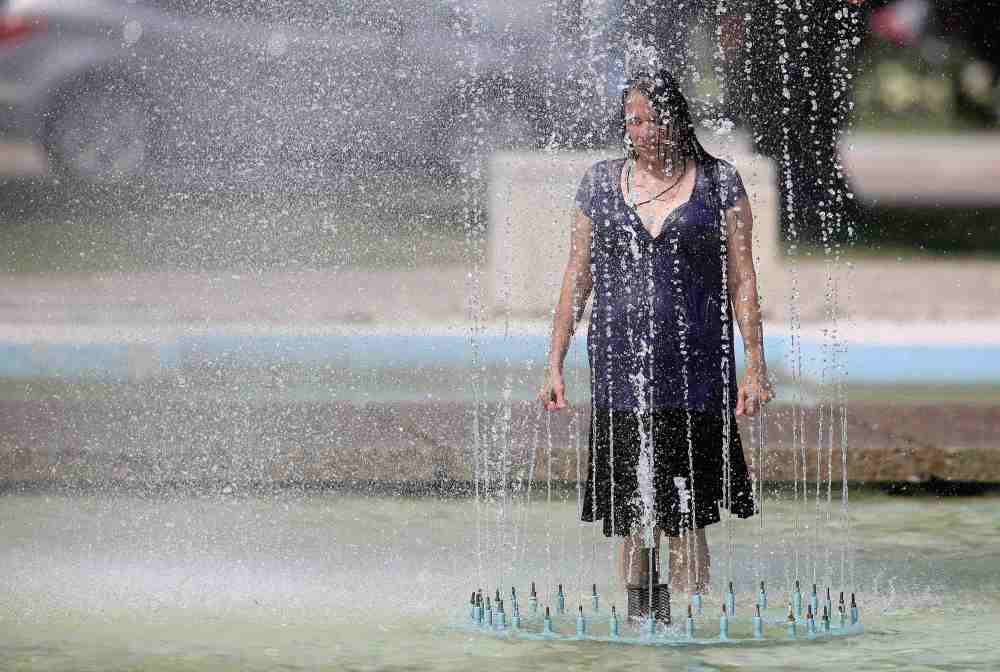
An increase in heat-related deaths is expected to be one of the most significant effects of climate change in Canada as the frequency and intensity of heat waves will ramp up.
In Manitoba, in a projection scenario where emissions continue unabated, the number of days in which the temperature is 30 C or higher is expected to rise to 52.1 days, on average, between 2050 and 2080, says the Prairie Climate Centre’s Climate Atlas.
It was an average of 14.2 days per year from 1976 to 2005.
Quebec has adopted mechanisms to identify heat-related deaths in response to this mounting problem. The province has also started to track hospitalizations, ambulance trips and emergency admissions related to extreme heat events. Quebec made international headlines in July 2018 when it estimated 89 people had died during a heat wave. Health authorities had formally listed a death of a senior, for example — whose cause of death may have been heart disease or stroke, but whose pre-existing condition was exacerbated by heat — as a death linked to heat distress.
Roussin said some indicators flag such cases in Manitoba, but with no formal reporting figure, it is impossible to say for certain when a death is linked to an extreme heat event.

“It’s a significant public health issue and it’s becoming more important over time. So, it is something we’re working on to be able to have better information on it,” Roussin said.
Tracking the number of deaths and hospitalizations related to extreme heat events will allow for tailored public health responses, said Robin Edger, the executive director and CEO of the Canadian Association of Physicians for the Environment.

“For provinces like Manitoba and Ontario that don’t do this tracking, and instead these deaths or illnesses perhaps show up as something like a stroke, they’re just not in the same place to be able to organize their (response) strategy,” Edger said.
sarah.lawrynuik@freepress.mb.ca
Twitter: @SarahLawrynuik
History
Updated on Thursday, July 9, 2020 7:26 PM CDT: Updates main photo.