

‘Enough!’ in Black and white
Tens of millions join forces, raise voices across North America -- including Winnipeg -- in powerful summer storm demanding long-overdue justice for people of colour, end to police brutality

Advertisement
Read this article for free:
or
Already have an account? Log in here »
To continue reading, please subscribe:
Monthly Digital Subscription
$1 per week for 24 weeks*
- Enjoy unlimited reading on winnipegfreepress.com
- Read the E-Edition, our digital replica newspaper
- Access News Break, our award-winning app
- Play interactive puzzles
*Billed as $4.00 plus GST every four weeks. After 24 weeks, price increases to the regular rate of $19.95 plus GST every four weeks. Offer available to new and qualified returning subscribers only. Cancel any time.
Monthly Digital Subscription
$4.99/week*
- Enjoy unlimited reading on winnipegfreepress.com
- Read the E-Edition, our digital replica newspaper
- Access News Break, our award-winning app
- Play interactive puzzles
*Billed as $19.95 plus GST every four weeks. Cancel any time.
To continue reading, please subscribe:
Add Free Press access to your Brandon Sun subscription for only an additional
$1 for the first 4 weeks*
*Your next subscription payment will increase by $1.00 and you will be charged $16.99 plus GST for four weeks. After four weeks, your payment will increase to $23.99 plus GST every four weeks.
Read unlimited articles for free today:
or
Already have an account? Log in here »
Hey there, time traveller!
This article was published 31/12/2020 (1917 days ago), so information in it may no longer be current.
In a summer marked by pandemic lockdowns and political unrest, the Black Lives Matter movement gained spirited momentum across Canada and the United States, as thousands upon thousands rose up against racial injustice and police brutality.
Though the movement had existed for several years, it gained new strength and conviction in Minneapolis in late May when George Floyd — a 46-year-old Black father who had lost his job during the pandemic — was killed by police officer Derek Chauvin.
Video of the incident circulated quickly: Chauvin with a knee to Floyd’s neck for eight minutes and 46 second and Floyd’s repeated cries of ‘I can’t breathe’ reignited a long-fought battle between Black communities and the officers who police them, often with disproportionate rates of violence and brutality.
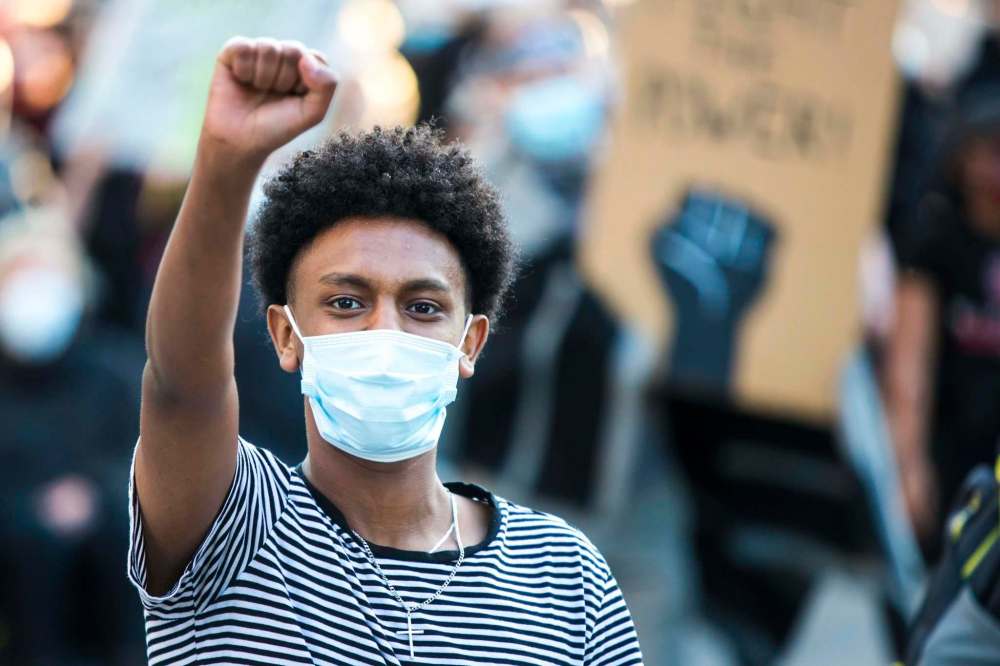
Demonstrations erupted the next day in Minneapolis. Hundreds, then thousands of protesters flooded the streets, targeting the police precinct where Chauvin worked, to demand the officers involved in Floyd’s death be fired and criminally charged.
Chauvin, along with Thomas Lane, J. Alexander Kueng and Tou Thao — the other officers involved in Floyd’s arrest — were quickly fired.
Restaurants and local businesses went up in flames.
The movement caught on quickly in cities around the United States. The deaths of 26-year-old Lousiville, Ky., emergency-room technician Breonna Taylor by police executing a no-knock warrant arrest on her boyfriend March 13 and of 25-year-old Ahmaud Arbery, killed by white residents in Georgia while jogging on Feb. 23, further fuelled the unrest.
By May 28, protests had emerged in major cities including Los Angeles, Memphis, Chicago and New York, with activists and demonstrators demanding cities defund their police departments, and pursue justice in the deaths of Black people killed by local officers.
Large protests drew strong responses from law enforcement.
In Minnesota, Gov. Tim Walz sent in the National Guard, saying the unrest in Minneapolis was “no longer, in any way, about the murder of George Floyd” and instead about “attacking civil society, instilling fear and disrupting our great cities.”
U.S. President Donald Trump called protesters and activists “thugs” on Twitter, adding “when the looting starts, the shooting starts.”
In some cities the protests became violent, prompting the imposition of curfews. Police enforced them with tear gas, rubber bullets and other “non-lethal” mechanisms, in some cases causing severe injuries. The National Guard was deployed in more than two dozen states.
By June 3, nine days after Floyd’s death, all four Minneapolis officers had been charged in the killing: Chauvin with second-degree murder, the others with aiding and abetting the killing.
Still, with much of the world shut down because of pandemic restrictions, the protests rode on through the summer and fall, reaching more than 2,000 cities and towns in 60 countries, as people stood together against runaway police budgets and unchecked violence, rallying behind cries of “Defund the police!”
North of the 49th parallel, Canadian cities faced their own reckonings with police brutality towards Black and Indigenous people.
The Winnipeg Police Service was forced to publicly defend itself after officers killed three Indigenous people in separate incidents over 10 days in April.
By June 5, members of the group Justice 4 Black Lives Winnipeg organized a rally that drew an estimated 15,000 people to the Manitoba Legislative Building to raise their voices against police brutality, recalling the stories of Black and Indigenous people such as Eishia Hudson, Machuar Madut and Jason Collins, killed at the hands of Winnipeg Police Service members.
Cities across the nation joined protests that same Friday: from Vancouver’s Olympic Cauldron to a thousands-strong march in the streets of Charlottetown to the eight-minute, 46-second silence observed in Iqaluit.
In Toronto, the May 27 death of 29-year-old Regis Korchinski-Paquet, who fell from her 24th-storey apartment during a police wellness check, further ignited calls for police reform.
Canada’s countrywide protest took place on what would have been Breonna Taylor’s 27th birthday. In Winnipeg, thousands joined together to sing Happy Birthday in her honour.
Protests continued in Winnipeg through the summer, with eight days of pop-up rallies in late June to demand the city divert funds from the police budget to community supports and reopen investigations into the deaths of several people shot and killed by officers.
Polls in early June indicated upwards of 20 million Americans had taken part in a Black Lives Matter protest, making the summer’s movement potentially the largest in American history.
In response to such fervent public outcry, policy-makers in cities such as Philadelphia, Baltimore, Washington, New York and San Francisco offered some public support of defunding, opposing budget increases for local forces or banning some police practices, including choke-holds.
Minneapolis city council pledged, in one case, to dismantle its police department entirely and replace it with a department of community safety and violence prevention.

Professional athletes across the United States took action, starting with the NBA’s Milwaukee Bucks, who refused to take the court in August after a white Wisconsin cop fired seven bullets into the back of Jacob Blake, a Black man walking calmly to his SUV, with his three boys watching.
Confederate monuments were toppled across the U.S. Major corporations were asked to account for racist policies; many publicly voiced support for the Black Lives Matter movement.
Across North America, public attention turned to the movement with unprecedented focus, prompting legislative change, educational change and increased awareness and support of the cause. In Canada, the United States and elsewhere in the world, public pressure is pushing for legislators to effect police reforms in service of justice for Black and Indigenous lives.
julia-simone.rutgers@freepress.mb.ca
Twitter: @jsrutgers
Julia-Simone Rutgers is the Manitoba environment reporter for the Free Press and The Narwhal. She joined the Free Press in 2020, after completing a journalism degree at the University of King’s College in Halifax, and took on the environment beat in 2022. Read more about Julia-Simone.
Julia-Simone’s role is part of a partnership with The Narwhal, funded by the Winnipeg Foundation. Every piece of reporting Julia-Simone produces is reviewed by an editing team before it is posted online or published in print — part of the Free Press‘s tradition, since 1872, of producing reliable independent journalism. Read more about Free Press’s history and mandate, and learn how our newsroom operates.
Our newsroom depends on a growing audience of readers to power our journalism. If you are not a paid reader, please consider becoming a subscriber.
Our newsroom depends on its audience of readers to power our journalism. Thank you for your support.
Julia-Simone Rutgers is the Manitoba environment reporter for the Free Press and The Narwhal. She joined the Free Press in 2020, after completing a journalism degree at the University of King’s College in Halifax, and took on the environment beat in 2022. Read more about Julia-Simone.
Julia-Simone’s role is part of a partnership with The Narwhal, funded by the Winnipeg Foundation. Every piece of reporting Julia-Simone produces is reviewed by an editing team before it is posted online or published in print — part of the Free Press‘s tradition, since 1872, of producing reliable independent journalism. Read more about Free Press’s history and mandate, and learn how our newsroom operates.
Our newsroom depends on a growing audience of readers to power our journalism. If you are not a paid reader, please consider becoming a subscriber.
Our newsroom depends on its audience of readers to power our journalism. Thank you for your support.
Advertisement Advertise With Us
Advertisement Advertise With Us