

Failing jury system in need of reform
Stanley acquittal an example of flawed selection process

Advertisement
Read this article for free:
or
Already have an account? Log in here »
To continue reading, please subscribe:
Monthly Digital Subscription
$1 per week for 24 weeks*
- Enjoy unlimited reading on winnipegfreepress.com
- Read the E-Edition, our digital replica newspaper
- Access News Break, our award-winning app
- Play interactive puzzles
*Billed as $4.00 plus GST every four weeks. After 24 weeks, price increases to the regular rate of $19.95 plus GST every four weeks. Offer available to new and qualified returning subscribers only. Cancel any time.
Monthly Digital Subscription
$4.99/week*
- Enjoy unlimited reading on winnipegfreepress.com
- Read the E-Edition, our digital replica newspaper
- Access News Break, our award-winning app
- Play interactive puzzles
*Billed as $19.95 plus GST every four weeks. Cancel any time.
To continue reading, please subscribe:
Add Free Press access to your Brandon Sun subscription for only an additional
$1 for the first 4 weeks*
*Your next subscription payment will increase by $1.00 and you will be charged $16.99 plus GST for four weeks. After four weeks, your payment will increase to $23.99 plus GST every four weeks.
Read unlimited articles for free today:
or
Already have an account? Log in here »
Hey there, time traveller!
This article was published 19/02/2018 (2943 days ago), so information in it may no longer be current.
I have only been called for jury duty once, and it didn’t work out the way I wanted.
I was part of an enormous throng of people called to the Manitoba Law Courts in early 2000 as part of a jury pool for several trials.
I was very keen to serve on a jury, which was probably my first mistake. After years of writing about the criminal justice system and covering several important trials, I was desperate to see the inner workings of a jury and experience what it was like to decide the future of an accused person. Lamentably, it was not to be.
My number eventually came up and I was seated in the jury box for a sexual assault trial. When my name was called, I stood up to face the Crown and defence lawyers. All the lawyers had in front of them was my name, occupation and address.
The Crown quickly said, “Consent.” The defence attorney, however, took his time.
After a prolonged silence, he looked directly at me and smiled. “Challenge.”
That was it. My desire to see the criminal justice system at work from the jury box had been dashed in two syllables.
It was a bit of a mystery to me, to tell you the truth. I’ll never know exactly why I was deemed unsuitable because the system at work then — and right up to this day — does not require lawyers for either side to give reasons for excluding someone from jury duty.
I was the target of a peremptory challenge, a long-standing tradition in the criminal justice system which allows either the Crown or defence to exclude a potential juror without providing any explanation. The mechanism is based on the idea that allowing both prosecution and defence to vet jurors for potential bias will, eventually, lead to the creation of more balanced juries.
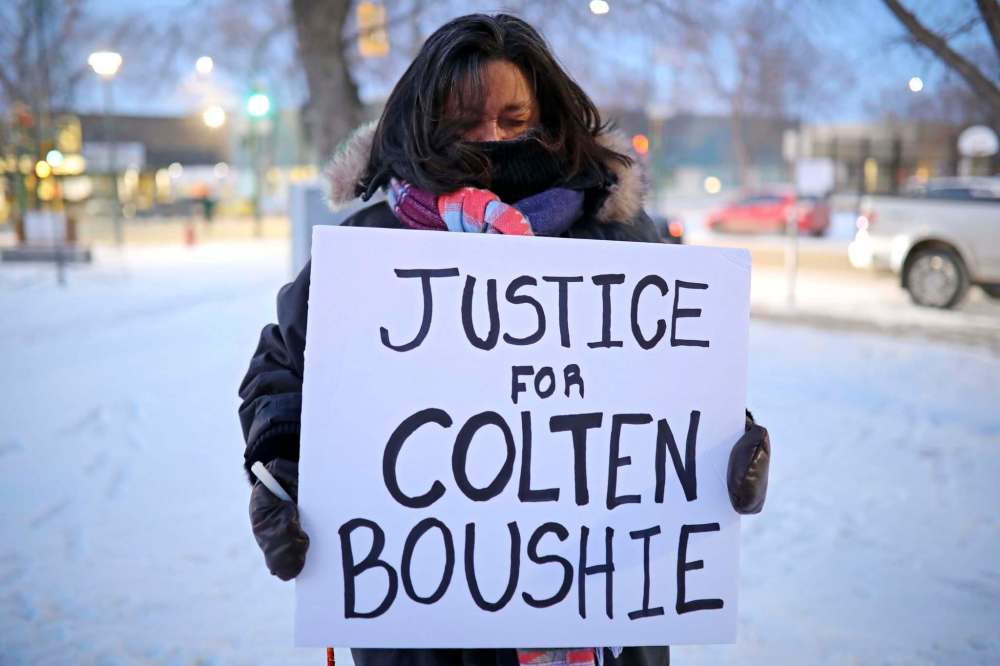
Peremptory challenges have achieved new notoriety after being used to assemble an all-white jury to oversee the trial of Gerald Stanley, who had been charged in August 2016 with second-degree murder in the shooting death of 22-year-old Colten Boushie.
On Feb. 9 of this year, Stanley was acquitted by those jurors of both second-degree murder and the lesser charge of manslaughter after they found the accused’s actions were, under the circumstances, “reasonable.” The decision sparked days of anger, despair and confusion about what really happened, both on Stanley’s farm in 2016 and in a Battleford, Sask., courtroom some 18 months later.
The court verdict has prompted an unprecedented public debate over the way Indigenous people — both as victims and accused persons — are treated by the justice system. It also drew the attention of federal Justice Minister Jody Wilson-Raybould and Prime Minister Justin Trudeau, who both publicly challenged the verdict delivered by a jury that appeared to have been systematically stripped of any Indigenous representation.
Many critics have called for the restriction or complete elimination of peremptory challenges, along with other measures to help draw more Indigenous people into jury pools. Some have pointed out that Manitoba’s landmark Aboriginal Justice Inquiry recommended measures like this more than a quarter-century ago, and that little or nothing has been done to remedy the situation.
When you look at the naked truth of peremptory challenges — and when they are used and by whom — you begin to see a much larger concern with the jury system in general.
First, these challenges are not just used by defence lawyers; prosecutors use challenges to stack juries just as much, if not more, than defence counsel. And it’s not just race that determines who gets excluded. Lawyers are also looking at gender, age and socio-economic status when they are trying to forge a jury.
Before they hear a case, jurors are cautioned to set aside all preconceived notions and biases to reach a fair verdict. However, as a lawyer friend of mine disclosed, “what you’re actually doing is trying to select a jury based on their prejudices.”
In the case of a sexual assault trial involving a male accused, my lawyer friend said, the defence will “bounce all the women that come forward, while the Crown will be trying to bounce all the men.”
If the accused is Indigenous, the prosecution will be using its challenges to get as many white jurors as possible, while the defence will be hoping against hope there will be at least some people of Indigenous descent in the pool, and that they can somehow snooker the Crown into allowing them on the jury.
However, efforts to stack the jury are really just the tip of an iceberg of concern about the frailties of the jury system.
Perhaps as a result of challenges, juries are vulnerable to hyperbole, emotion, conjecture and fear. We also know that the best lawyers — both prosecution and defence — are skilled in the black art of juror manipulation: saying and doing things they know will trigger irrational responses in the jury. In effect, these lawyers know how to game a jury to produce the verdict they desire. The sheer number of wrongful convictions produced by jury trials is, on its own, more than enough to establish that there are deep, underlying flaws in the jury system to go beyond peremptory.
All this makes you wonder whether the entire jury system, and not just peremptory challenges, needs to be reviewed with an eye towards radical reform.

Perhaps we need to restrict jury trials, and allow judges alone or — as is the case in countries like Switzerland — judges supported by lay experts or other trained professionals to adjudicate serious criminal cases.
Trial by judge alone is not necessarily a fix, but in the right type of cases, it seems it would be an upgrade on the current system.
If we really want a dispassionate, objective and fair-minded outcome for criminal proceedings, then maybe we should start by ensuring that we have better juries or, if that is not possible, leave the jurors on the sideline altogether.
dan.lett@freepress.mb.ca
Dan Lett is a columnist for the Free Press, providing opinion and commentary on politics in Winnipeg and beyond. Born and raised in Toronto, Dan joined the Free Press in 1986. Read more about Dan.
Dan’s columns are built on facts and reactions, but offer his personal views through arguments and analysis. The Free Press’ editing team reviews Dan’s columns before they are posted online or published in print — part of the our tradition, since 1872, of producing reliable independent journalism. Read more about Free Press’s history and mandate, and learn how our newsroom operates.
Our newsroom depends on a growing audience of readers to power our journalism. If you are not a paid reader, please consider becoming a subscriber.
Our newsroom depends on its audience of readers to power our journalism. Thank you for your support.
Dan Lett is a columnist for the Free Press, providing opinion and commentary on politics in Winnipeg and beyond. Born and raised in Toronto, Dan joined the Free Press in 1986. Read more about Dan.
Dan’s columns are built on facts and reactions, but offer his personal views through arguments and analysis. The Free Press’ editing team reviews Dan’s columns before they are posted online or published in print — part of the our tradition, since 1872, of producing reliable independent journalism. Read more about Free Press’s history and mandate, and learn how our newsroom operates.
Our newsroom depends on a growing audience of readers to power our journalism. If you are not a paid reader, please consider becoming a subscriber.
Our newsroom depends on its audience of readers to power our journalism. Thank you for your support.
Advertisement Advertise With Us
Advertisement Advertise With Us