

Feds tone down rhetoric on infrastructure funding for provinces
Advertisement
Read this article for free:
or
Already have an account? Log in here »
To continue reading, please subscribe:
Monthly Digital Subscription
$1 per week for 24 weeks*
- Enjoy unlimited reading on winnipegfreepress.com
- Read the E-Edition, our digital replica newspaper
- Access News Break, our award-winning app
- Play interactive puzzles
*Billed as $4.00 plus GST every four weeks. After 24 weeks, price increases to the regular rate of $19.95 plus GST every four weeks. Offer available to new and qualified returning subscribers only. Cancel any time.
Monthly Digital Subscription
$4.99/week*
- Enjoy unlimited reading on winnipegfreepress.com
- Read the E-Edition, our digital replica newspaper
- Access News Break, our award-winning app
- Play interactive puzzles
*Billed as $19.95 plus GST every four weeks. Cancel any time.
To continue reading, please subscribe:
Add Free Press access to your Brandon Sun subscription for only an additional
$1 for the first 4 weeks*
*Your next subscription payment will increase by $1.00 and you will be charged $16.99 plus GST for four weeks. After four weeks, your payment will increase to $23.99 plus GST every four weeks.
Read unlimited articles for free today:
or
Already have an account? Log in here »
Hey there, time traveller!
This article was published 09/05/2019 (2541 days ago), so information in it may no longer be current.
OTTAWA — The Trudeau government is pushing to get infrastructure projects under construction in time for the looming construction season — and the federal election campaign.
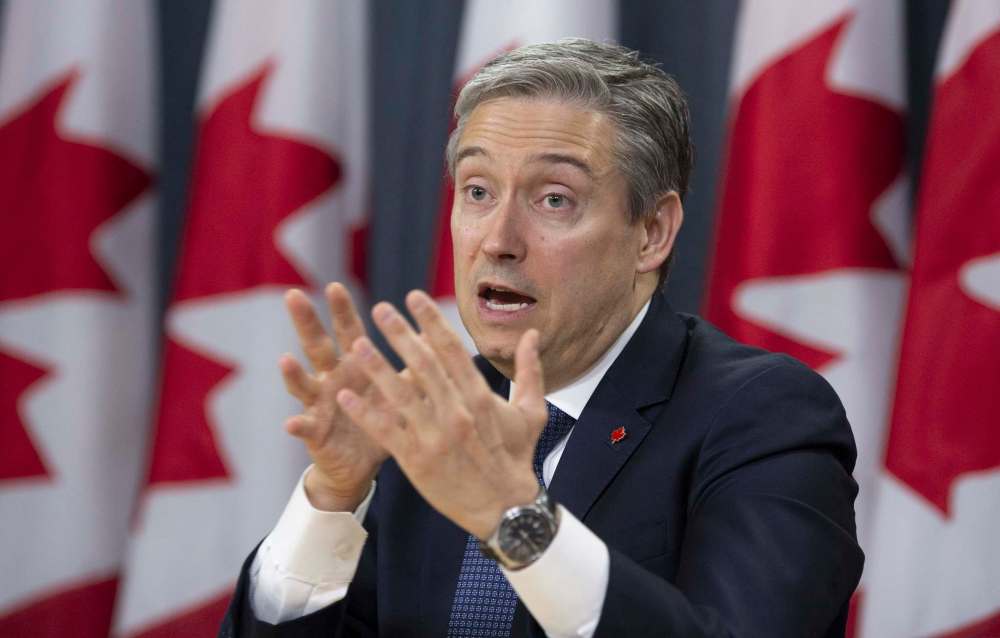
“We must work together, quicker,” said Infrastructure Minister François-Philippe Champagne. “As Canadians, we don’t want to let ourselves miss out.”
Three months after taking the Manitoba government to task over untapped federal funding allocations, the Liberals are taking a softer tone with the provinces, though both blame each other for the slow rollout of Ottawa’s massive infrastructure program.
The Liberals say as of Thursday, they’ve allocated $42 billion of their $118-billion plan, which spans a decade ending in 2026 — though many of the funded projects still don’t have shovels in the ground.
Almost all the funding requires provinces to select projects and prioritize them for federal funds. Champagne admitted to “my own frustrations” at the pace of these projects.
“We are dependent on provinces, obviously, to speed up their own intake processes,” he told reporters.
Conservative MPs have said the Liberals’ introduction of separate funding streams for things such as green infrastructure and trade-related transport may be gumming up funding allocations. The Liberals argue these tiers help them keep track of how money the is spent.
On March 1, Trade Diversification Minister Jim Carr raised the alarm about untapped cash, asking Manitoba’s construction industry to lobby Premier Brian Pallister to get projects green-lighted.
The province shot back it had projects waiting for approval for months, some of which it had raised with Ottawa before signing the bilateral agreement last June.
“Fighting is not the way I would describe it,” Champagne said, adding both governments have been “working very diligently,” suggesting more progress had been made in the past two months. “I always say to my colleagues: politics has no place in infrastructure.”
Pallister’s spokesman also suggested Manitoba is making progress in accessing its $3-billion share.
“We continue to work productively with the federal government,” wrote David von Meyenfeldt, adding “the need to streamline and accelerate federal approval processes remains a focus of our efforts.”
In March, the Liberals doubled this year’s municipal revenue from a longstanding gas tax, which should give their MPs ribbons to cut this summer ahead of October’s federal election.
Winnipeg will received an extra $40 million this year, which city council will likely use for repairing and upgrading roads and bike lanes.
Champagne is trying to make sure cities are able to get projects underway without any holdups at the provincial level, such as through permits.
“It would be disingenuous for anyone to delay that, because this would frustrate the purpose for which this was done,” he said.

Meanwhile, Pallister is closely watching the Lake St. Martin-Lake Manitoba flood outlet channels project, for which Ottawa committed a quarter-billion dollars last summer. A federal assessment agency has flagged the project for a review involving communities far downstream, to the premier’s chagrin.
“History has shown the stakes are too high for lengthy and unnecessary delays,” wrote his spokesman, saying the project “must move forward as soon as possible.”
Champagne said he’s “keeping an eye” on the project, but said the federal spending shows commitment to seeing it through.
“The best way to build things is to do it through a rigorous process,” he said. “While we are committed to move it forward as quickly as possible, it needs to respect the laws and the regulations that apply to the review of projects, which I think is sound.”
dylan.robertson@freepress.mb.ca