

Few riders as Transit launches express route
Advertisement
Read this article for free:
or
Already have an account? Log in here »
To continue reading, please subscribe:
Monthly Digital Subscription
$1 per week for 24 weeks*
- Enjoy unlimited reading on winnipegfreepress.com
- Read the E-Edition, our digital replica newspaper
- Access News Break, our award-winning app
- Play interactive puzzles
*Billed as $4.00 plus GST every four weeks. After 24 weeks, price increases to the regular rate of $19.95 plus GST every four weeks. Offer available to new and qualified returning subscribers only. Cancel any time.
Monthly Digital Subscription
$4.99/week*
- Enjoy unlimited reading on winnipegfreepress.com
- Read the E-Edition, our digital replica newspaper
- Access News Break, our award-winning app
- Play interactive puzzles
*Billed as $19.95 plus GST every four weeks. Cancel any time.
To continue reading, please subscribe:
Add Free Press access to your Brandon Sun subscription for only an additional
$1 for the first 4 weeks*
*Your next subscription payment will increase by $1.00 and you will be charged $16.99 plus GST for four weeks. After four weeks, your payment will increase to $23.99 plus GST every four weeks.
Read unlimited articles for free today:
or
Already have an account? Log in here »
Hey there, time traveller!
This article was published 12/04/2020 (2203 days ago), so information in it may no longer be current.
Winnipeg’s Southwest Transitway, an 11-kilometre express route from downtown to the University of Manitoba and St. Norbert, opened to the public Sunday 11 years after shovels went in the ground.
But the $467-million project, which came in under budget and ahead of schedule, did not have the inaugural run that many expected, due to plummeting transit ridership amid the COVID-19 pandemic.
By April 1, when Manitoba had serious social distancing measures in place, transit ridership had fallen 70 per cent from 2019.

“It’s exciting to see this historic transit infrastructure complete. Between consultation, design, financing and construction, transit staff have built something extraordinary,” said Coun. Matt Allard (St. Boniface), who chairs the public works committee.
“Our city staff and consultants did an incredible job. I took a tour of the nearly complete corridor a few months ago and saw myself how creative and collaborative solutions produced big savings… It’s too bad the pandemic has put a damper on celebrating this accomplishment.”
On Sunday, a Free Press reporter rode the new transitway, which is called the “Blue Line,” from Osborne Village to the University of Manitoba and back. The trip took roughly 13 minutes in each direction.
Only a handful of other people were riding the bus at the time, some of whom were off-duty transit drivers heading to, or leaving, shifts.
Among the other passengers, only one was wearing personal protective equipment. Earlier this week, Canadian public health officials began encouraging citizens to wear homemade face masks while in public.
The new transitway is a high-frequency corridor connected to feeder routes that funnel riders from nearby neighbourhoods into stations along the line.
Since community spread of the virus began in the province, Winnipeg Transit has announced it could be facing a loss of $25 million in fares by July. In addition, the city has been forced to funnel millions of dollars in extra funding to the service to sanitize buses and pay drivers overtime.
Despite this financial shortfall, Winnipeg has decided to operate the Blue Line on a high-frequency schedule. Allard said that while the Blue Line will run as originally planned for the time being, changes could be made in future.
“The level of service in light of this situation is being examined right now on the (Blue Line) and elsewhere. Transit is working on making tactical decisions of how, when, and where. Those decisions haven’t been made yet,” Allard said.
Functional Transit Winnipeg president Derek Koop said he’s pleased the Blue Line is operating at high frequency, hoping that more buses on the route will encourage social distancing for those who have no choice but to use public transit.
“Operating at a higher frequency, even with ridership being down, allows people to have greater distances between riders on the bus… We want people to still be able to travel safely throughout our city during this pandemic,” Koop said.
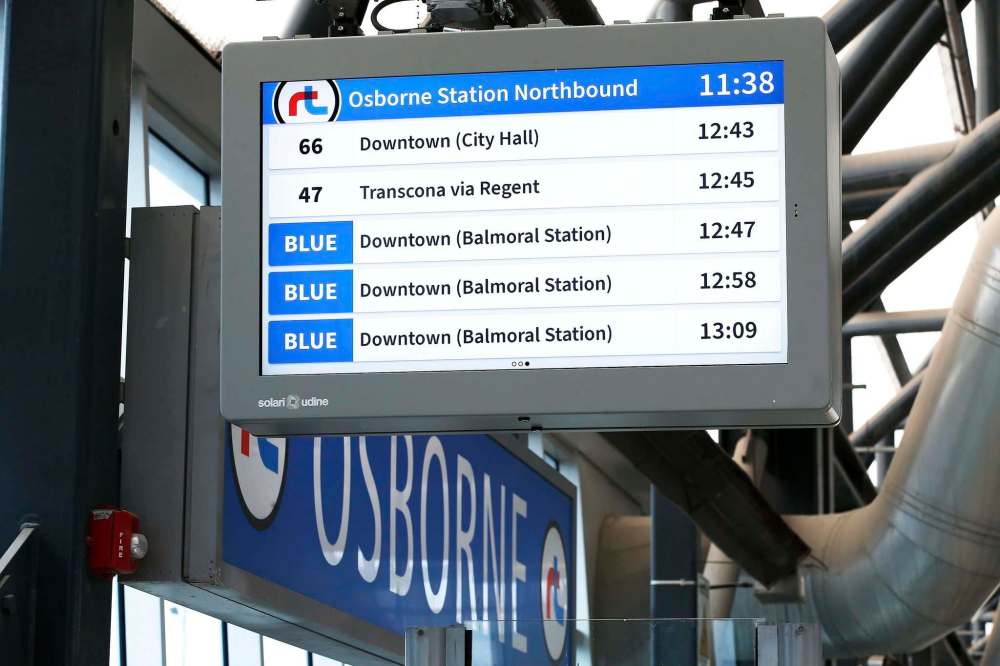
“Keeping that amount of service helps with that, so people know they’re not going to be packed in like sardines on those buses.”
While Koop said he is happy to see the transitway open, he’s disappointed the infrastructure project has come at the cost of transit service in other areas of the city. Winnipeg Transit has added 14 routes, changed 10 routes, and shut down18 others.

Koop said that while he thinks public transit has improved in Winnipeg recently, city council is still operating with a misguided philosophy when it comes to the service.
“When we look at the transit system, the analogy I always use is we’re buying a flat-screen (TV) for a house with a leaky roof. We have fundamental problems with our system and service, and we can’t seem to come up with the money to increase that service,” Koop said.
“We’re buying something new to help improve the service, but we haven’t built our foundation yet. We’re kind of putting the cart before the horse. We need to look at the foundation of the service, which is buses on the road.”
ryan.thorpe@freepress.mb.ca
Twitter: @rk_thorpe