

First Nation on edge as variant feared
Possibility of British strain 'a new threat' for Pauingassi

Advertisement
Read this article for free:
or
Already have an account? Log in here »
To continue reading, please subscribe:
Monthly Digital Subscription
$1 per week for 24 weeks*
- Enjoy unlimited reading on winnipegfreepress.com
- Read the E-Edition, our digital replica newspaper
- Access News Break, our award-winning app
- Play interactive puzzles
*Billed as $4.00 plus GST every four weeks. After 24 weeks, price increases to the regular rate of $19.95 plus GST every four weeks. Offer available to new and qualified returning subscribers only. Cancel any time.
Monthly Digital Subscription
$4.99/week*
- Enjoy unlimited reading on winnipegfreepress.com
- Read the E-Edition, our digital replica newspaper
- Access News Break, our award-winning app
- Play interactive puzzles
*Billed as $19.95 plus GST every four weeks. Cancel any time.
To continue reading, please subscribe:
Add Free Press access to your Brandon Sun subscription for only an additional
$1 for the first 4 weeks*
*Your next subscription payment will increase by $1.00 and you will be charged $16.99 plus GST for four weeks. After four weeks, your payment will increase to $23.99 plus GST every four weeks.
Read unlimited articles for free today:
or
Already have an account? Log in here »
Hey there, time traveller!
This article was published 16/02/2021 (1894 days ago), so information in it may no longer be current.
As Pauingassi First Nation awaits confirmation of seven positive cases of the British COVID-19 variant, the possibility of this new daunting challenge has dealt the community a blow.
“There is a little bit of hope, because the community itself has done a tremendous effort to stamp out the initial outbreak of COVID… however, I think the announcement of the potential of the variant has knocked the wind out of everybody’s sails,” Manitoba Grand Chief Arlen Dumas said Monday.
“It’s a new threat, a variation of a new threat, and I think that causes concern for everybody.”
Dumas said he hadn’t received any updates since the Assembly of Manitoba Chiefs released a statement Saturday confirming seven probable cases of the B.1.1.7 coronavirus variant — first detected in the U.K. — had been detected in Pauingassi, a remote fly-in community 280 kilometres northeast of Winnipeg. Dumas said the First Nation plans to wait for the National Microbiology Lab’s review of the results before taking further steps.
“I think because of the additional screening and the additional oversight during that time will actually serve us well, and as soon as we actually find out if in fact we are dealing with the variant, we’ll be able to pinpoint how things have transpired fairly quickly,” Dumas said Monday.
The seven cases are likely connected to each other, Dumas said, but he was unable to offer specifics on how they are connected or how the variant is believed to have arrived in Pauingassi. All seven people are currently self-isolating.
Meanwhile, Cross Lake First Nation said in a statement Monday that one suspected case of the U.K. variant of the virus has been found there. The positive result is also pending conformation by the National Microbiology Lab.
One person in Winnipeg was diagnosed with the COVID-19 variant after being tested Jan. 21. All 10 provinces in Canada have now identified cases of the variant, which some experts say is as much as 70 per cent more deadly.
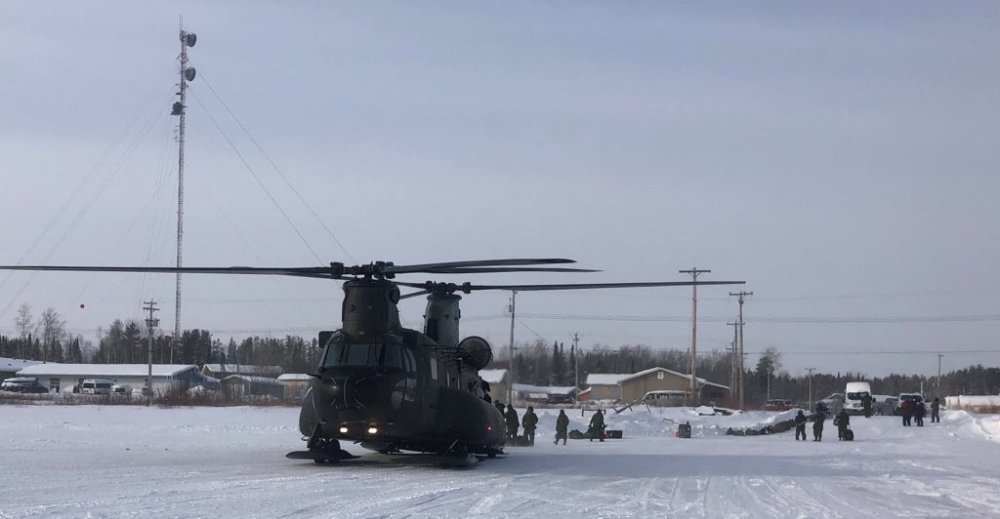
The Canadian Armed Forces touched down in the fly-in community Feb. 6 to help deal with a spike of COVID-19 cases in the area, and remained in Pauingassi as of Monday, Dumas said.
Indigenous Services Minister Marc Miller said cases will be “treated as positive unless confirmed otherwise” in a tweet late Saturday and said the department will offer assistance however possible.

Dumas commended work done by the community and said he hopes that “status quo” continues. He called on the community to avoid COVID-19 information from unverified sources.
“We need to make sure that we’re all getting the best information possible when we’re sharing information, just so that we’re not fear-mongering or causing too much concern with people,” he said.
— with files from staff and The Canadian Press
malak.abas@freepress.mb.ca
Twitter: malakabas_
Malak Abas is a city reporter at the Free Press. Born and raised in Winnipeg’s North End, she led the campus paper at the University of Manitoba before joining the Free Press in 2020. Read more about Malak.
Every piece of reporting Malak produces is reviewed by an editing team before it is posted online or published in print — part of the Free Press‘s tradition, since 1872, of producing reliable independent journalism. Read more about Free Press’s history and mandate, and learn how our newsroom operates.
Our newsroom depends on a growing audience of readers to power our journalism. If you are not a paid reader, please consider becoming a subscriber.
Our newsroom depends on its audience of readers to power our journalism. Thank you for your support.
Malak Abas is a city reporter at the Free Press. Born and raised in Winnipeg’s North End, she led the campus paper at the University of Manitoba before joining the Free Press in 2020. Read more about Malak.
Every piece of reporting Malak produces is reviewed by an editing team before it is posted online or published in print — part of the Free Press‘s tradition, since 1872, of producing reliable independent journalism. Read more about Free Press’s history and mandate, and learn how our newsroom operates.
Our newsroom depends on a growing audience of readers to power our journalism. If you are not a paid reader, please consider becoming a subscriber.
Our newsroom depends on its audience of readers to power our journalism. Thank you for your support.
Advertisement Advertise With Us
Advertisement Advertise With Us
History
Updated on Tuesday, February 16, 2021 6:56 AM CST: Updates with information on Cross Lake First Nation