

Gingerbread man
Architect's career collapsed during city hall's construction
Advertisement
Read this article for free:
or
Already have an account? Log in here »
To continue reading, please subscribe:

Digital Subscription
One year of digital access for only $205*
- Enjoy unlimited reading on winnipegfreepress.com
- Read the E-Edition, our digital replica newspaper
- Access News Break, our award-winning app
- Play interactive puzzles
*First annual payment billed as $205.00 + GST for one year. This annual subscription will automatically renew at $233.00 + GST every 52 weeks (10% off the regular annual price of $259.35). Offer available to new and qualified returning subscribers only. Cancel any time.
To continue reading, please subscribe:
Add Free Press access to your Brandon Sun subscription for only an additional
$1 for the first 4 weeks*
- Enjoy unlimited reading on winnipegfreepress.com
- Read the E-Edition, our digital replica newspaper
- Access News Break, our award-winning app
- Play interactive puzzles
*Your next Brandon Sun subscription payment will increase by $1.00 and you will be charged $17.95 plus GST for four weeks. After four weeks, your payment will increase to $24.95 plus GST every four weeks.
Read unlimited articles for free today:
or
Already have an account? Log in here »
Hey there, time traveller!
This article was published 08/11/2015 (3937 days ago), so information in it may no longer be current.
From the late 1870s to mid-1880s, there was no more prolific a Winnipeg architect than Charles Arnold Barber. His best-known work, the city’s “gingerbread” city hall, should have been his crowning achievement. Instead, it caused his career to implode, and when he died 100 years ago, he didn’t even get a mention in local newspapers.
The Ontario-born Barber came to Winnipeg in spring 1876 and established a home office on McWilliam Avenue (now Pacific Avenue). By September, he was advertising his services as a “Practical Architect, Superintendent and Valuator” on the front page of the Manitoba Free Press.
Some of Barber’s professional qualifications have been questioned, but, fully qualified or not, it didn’t matter much in a frontier boom town straining to keep up with the demand for residential, commercial and institutional buildings. Anyone who considered themselves part of the building trade was put to work.

Within weeks of setting up shop, Barber got his first big commissions, the North Ward School and Central School, thanks to the Winnipeg School Board. In the summer of 1877, he was awarded the contract for the new St. John’s College Ladies’ School. The building was a showcase of what would be Barber’s trademark eclectic — some call gaudy — design. He described it to the school’s board of governors as “a combination of Swiss, English and American gothic, with a mansard roof.”
These school contracts not only paid better than private residences or small stores, they also brought him into contact with the city’s elite who sat on their boards. His connections with the likes of William Nassau Kennedy, James Ashdown and Rev. George Bryce paid off in future commissions.
As 1879 came to a close, Barber had established himself as an architect of note, and his thoughts turned to his personal life. He returned to Ontario to marry Sarah Allison of Tyendinaga Township. In March 1880, they settled into a house on Margaret Street (now Waterfront Drive), where they would soon start their family of seven children.
Barber opened a new office in the Merchant’s Bank block at 282 Main St. Among his staff was his brother, Earle, who came from Ontario to work as a draughtsman. In the remainder of 1880, they designed more than a dozen buildings, mostly private residences and row-housing projects.
Aside from a couple of short-lived partnerships with other architects in 1881 and 1882, it was when Charles and Earle created Barber and Barber in 1882 that Charles truly made his mark on the city.
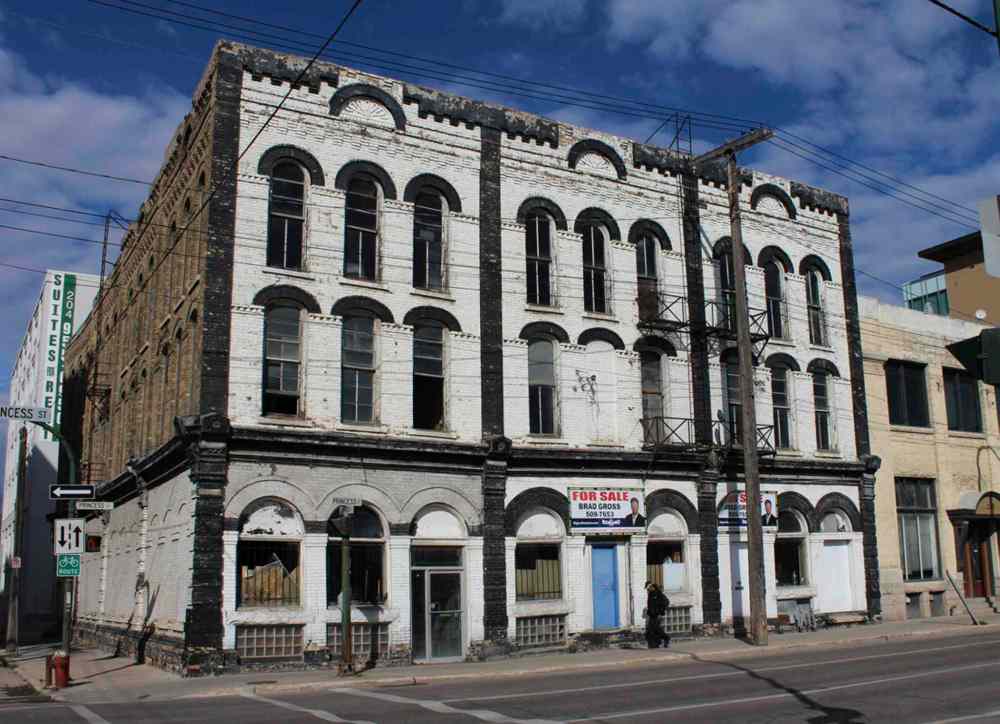
Of the dozens of building he designed between 1882 and 1884, most have been demolished. They included St. Paul’s College on Ellice Avenue at Vaughan Street, St. John’s College on Main Street at Church Avenue, the city’s Police Court on James Street and the Leland Hotel on William Avenue. The only works that remain are the facades of the Bawlf, Benson and Utility blocks, which make up part of Red River College’s Princess Street Campus, and the Bathgate Block that sits intact, but abandoned, at 242 Princess St.
In September 1883, Barber and Barber won the contract for what would become their signature building: Winnipeg’s second city hall. The project, however, was a nightmare from the start.
After the contract was let, city councillors began to re-examine it to find cost savings. They then voted to add a 1,200-seat auditorium to the building, which they later decided to forgo. The original excavation was stopped when the contractor found a seemingly bottomless pit of soft clay near the intersection of Main and William. Instead of paying him to dig deeper, council decided the hole should be filled and the building relocated nearly five metres further back from Main Street.
Finally, in March 1884, work on the building began. Around this time, a couple of contractors working on Barber’s Police Court publicly accused him of cutting corners on both the workmanship and quality of building materials being used. Barber stood by his work and invited anyone who wished to come examine what he was doing.
If council was worried about the accusations, they didn’t say it publicly, though they did keep Barber on a short leash on the city hall project.
They appointed city building inspector Thomas Fogg to supervise the construction, something Barber chafed at. In July 1884, Fogg submitted the first in a series of reports to council outlining the use of shoddy materials and poor construction practices. Barber reacted angrily and demanded an inquiry so he could prove his detractors wrong. He also threatened to sue the city for damage to his professional reputation.
Some of Barber’s other clients were not waiting for an inquiry. Both the Winnipeg and Protestant school boards halted work on their respective school projects so they could be thoroughly examined. There were no reports of any problems.
A further irritant between Barber and the city was the non-payment of his fees. Barber knew the city was broke, so he offered to take half up front and the rest later in the year. The city stalled, and Barber again threatened the city with legal action.
By October 1884, the city hall project had become so toxic the lead contractor, Robert Dewar, announced he was pulling out of the job immediately. One of his subcontractors was appointed to finish the construction.
Barber was also constructing the new Civic Offices complex at the rear of city hall, a building better known in later years as the Market Building. In November, the city brought in esteemed architect Charles Wheeler to review Barber’s work, and they got more than they bargained for.
Wheeler reported Barber was substituting substandard materials and likened him to “a thief… taking money from his employer’s till.” He also alleged Barber tried to “incite” him to submit false reports to council about some aspects of the work.
Despite everything, Barber still had supporters on council and among the public. A detailed, 84-page booklet published at the time called Plain Facts About the New City Hall: Its Inside History From the First Down to the Present pinned much of the blame for the fiasco on the city for its constant meddling and insistence it would pay no more than the original $80,000 contract price for what was clearly going to be an over-budget project. This, in turn, squeezed contractors to make up savings anywhere they could.
The Free Press, which had gone relatively easy on Barber, finally unloaded in a Dec. 4, 1884 editorial: “Why in the name of common sanity do not the alderman give (Barber) what he is worth — nothing to the Nth degree — dismiss him.” It concluded, “Council have shown themselves stupid and incapable enough on many occasions, but it is not to be credited that they are so inconceivably stupid and incapable as their course in this city hall affair.”
At the end of December 1884, Barber was finally fired and replaced by architect John Chisholm, though when he showed up for his first day of work, he discovered Barber had barricaded the building and instructed contractors not to let him inside.
Barber’s professional career was in serious trouble. In a bid to salvage his reputation, he launched a lengthy, $50,000 defamation lawsuit against the city, which he eventually offered to settle in exchange for $250 in architect’s fees he claimed he was owed.
In February 1887, Barber was arrested for allegedly offering a $500 bribe to a civic election scrutineer to look the other way while he brought in people to stuff the ballot box in favour of two candidates. The case went to trial, though after a number of delays, it appears the charges were quietly dropped.
Disgraced, Barber — along with his wife and brother — left the city and set up practice in Duluth, Minn., then Superior, Wis.
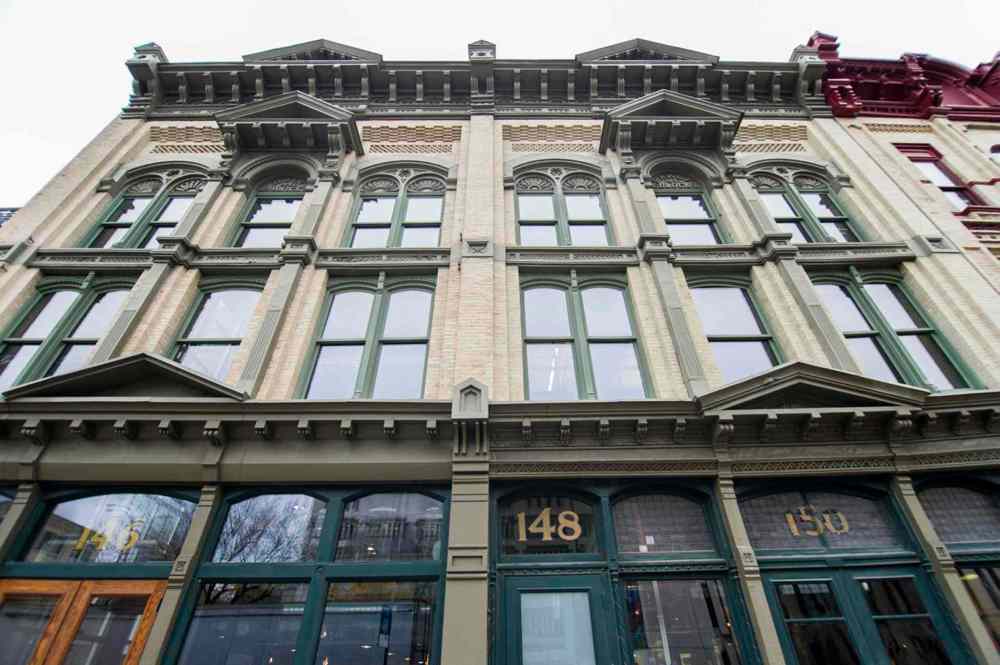
Barber returned to the city in 1892 to do a handful of projects, most notably the Utility Block on Princess Street for old friend Nicholas Bawlf. He returned again in 1898 to design the McIntyre Block, just off Portage and Main. Though this was a substantial building, its design and building methods were panned as being old-fashioned.
It was then off to Montreal for Barber, where he became an inventor and salesman. He received at least two U.S. patents, one for a type of fireproof door, the other for a fireproof, portable safe.
On May 1, 1903, Charles and Sarah Barber were arrested in a caper that made headlines around North America. Sarah lured a wealthy, 70-year-old Montreal businessmen to a home under the guise of arranging the sale of a safe. When he arrived, Charles attacked him and stabbed him in the leg. The man was bound, gagged and held hostage for 24 hours, all the while being threatened with death unless he handed over $30,000. Eventually, he gave them a cheque for $13,000.

The couple were arrested the next day and put on trial, where it came out they had successfully used this tactic on a Winnipeg businessman, though local papers did not print that section of the wire story, nor does it appear they followed up on the revelation.
It took the jury just 17 minutes to return a guilty verdict, and Charles and Sarah Barber were sentenced to seven and three years, respectively.
After their release, the couple headed west, first to Alberta, then to New Westminster, B.C., where Charles Barber died on Sept. 22, 1915.
Christian Cassidy writes about local history on his blog, West End Dumplings.