

Gutting RHAs won’t alleviate pressure on system

Advertisement
Read this article for free:
or
Already have an account? Log in here »
To continue reading, please subscribe:
Monthly Digital Subscription
$1 per week for 24 weeks*
- Enjoy unlimited reading on winnipegfreepress.com
- Read the E-Edition, our digital replica newspaper
- Access News Break, our award-winning app
- Play interactive puzzles
*Billed as $4.00 plus GST every four weeks. After 24 weeks, price increases to the regular rate of $19.95 plus GST every four weeks. Offer available to new and qualified returning subscribers only. Cancel any time.
Monthly Digital Subscription
$4.99/week*
- Enjoy unlimited reading on winnipegfreepress.com
- Read the E-Edition, our digital replica newspaper
- Access News Break, our award-winning app
- Play interactive puzzles
*Billed as $19.95 plus GST every four weeks. Cancel any time.
To continue reading, please subscribe:
Add Free Press access to your Brandon Sun subscription for only an additional
$1 for the first 4 weeks*
*Your next subscription payment will increase by $1.00 and you will be charged $16.99 plus GST for four weeks. After four weeks, your payment will increase to $23.99 plus GST every four weeks.
Read unlimited articles for free today:
or
Already have an account? Log in here »
Hey there, time traveller!
This article was published 06/12/2017 (3061 days ago), so information in it may no longer be current.
It has long been argued in certain political circles the biggest threat to a sustainable health-care system is bureaucracy.
Not the style of bureaucracy, but the amount of it that taxpayers support.
That argument was deeply ingrained in Progressive Conservative political attacks when the party was opposing the former NDP government; it remains a prevailing theory that the Tories are acting on now that they are in government.
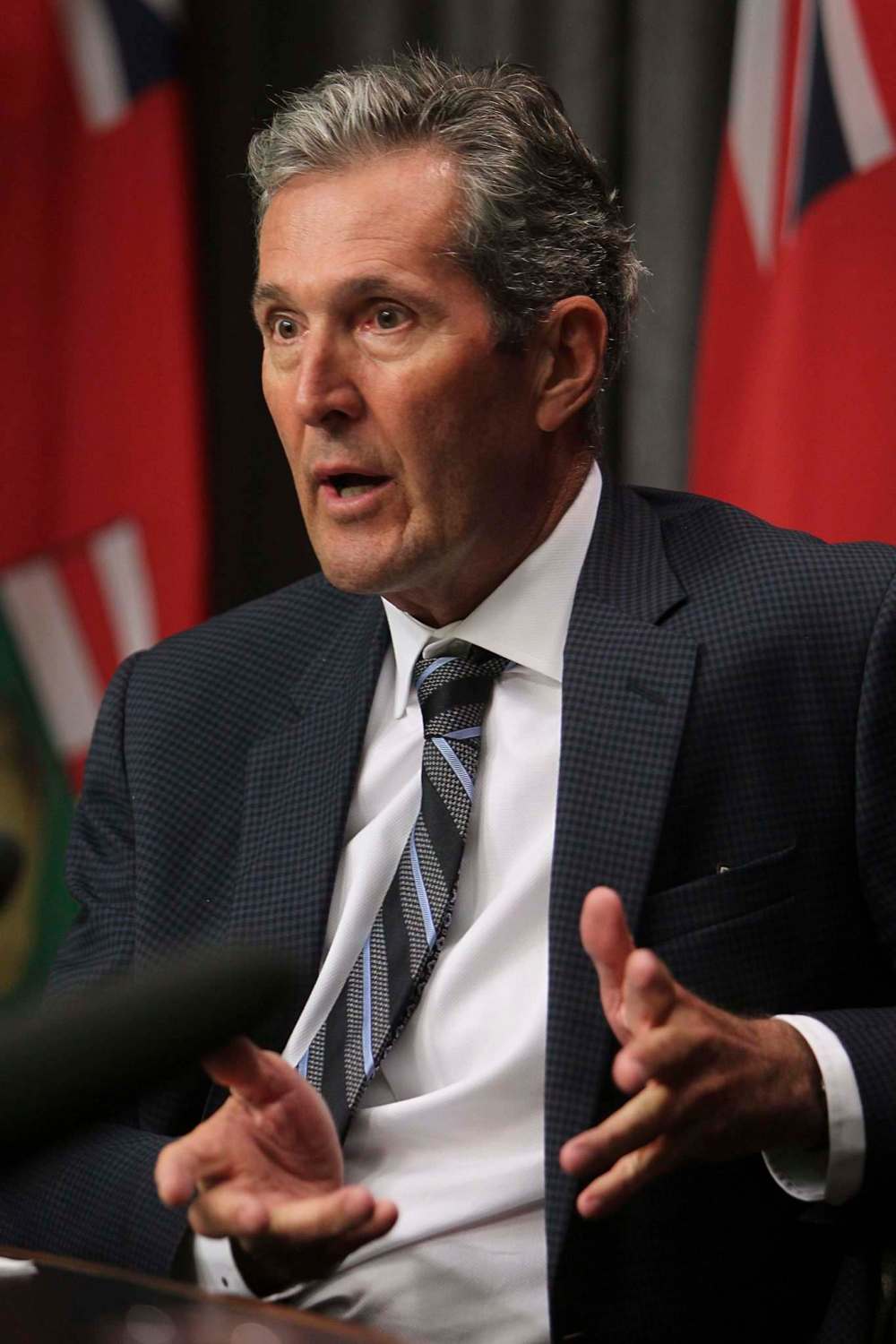
This was made clear when the province released a portion, less than one-quarter, of its much ballyhooed health-care sustainability audit, performed by accounting firm KPMG.
Although not explicit, the selected, and sometimes redacted, sections that were released certainly suggest there are savings to be had from reducing the number of organizations that, together, are responsible for delivering health care.
The audit itself is rife with management consultant speak, but the gist is clear. Government must “reset expectations and operating parameters for all stakeholders,” and create better “alignment” between health-care agencies, including CancerCare, the Addictions Foundation of Manitoba, Diagnostic Services, Manitoba eHealth and, ultimately, the regional health authorities.
The latter is the network of agencies that essentially ensure the delivery of health-care services.
The RHAs are, by their very nature, administrative oversight rather than front-line delivery of health care, a reality that has left them ripe for criticism.
Reducing the number of working parts, and consolidating the RHAs, could save the government as much as $5 million in its first full year.
What the report does not help us understand is the impact that a reduction in bodies at the RHAs, or an “alignment” of resources at the other agencies, will have on the overall quality of health-care services.
Ultimately, taxpayers deserve the best quality health care for the money government spends.
Hardly anyone wants the cheapest health-care system.
In pursuit of high-quality and financial sustainability, what then is the best model: more RHAs or fewer?
The debate over the best way to deliver universal health care is as old as medicare itself. Back in the 1990s, most provinces were tripping over themselves to implement an RHA model.
As was the case in other jurisdictions, the then-PC government of Manitoba billed RHAs as an opportunity for government to gain more insight into, and control of, health expenditures to eliminate waste and identify efficiencies.
Before the RHAs, the province largely funded health care with lump-sum funding to hospitals, and fees to individual physicians and private clinics. The RHAs were supposed to harken an era where government would be able to fund medical services more on what they actually cost, and not as part of the larger costs of operating a hospital.
And for the most part, the RHAs delivered on much of what was promised. Through the authorities, government became better acquainted with actual costs, and moved hospitals away from lump-sum budgets to more of a fee-for-service model.
That did help the province squeeze considerably more procedures out of the health system.
However, over the ensuing years, the RHAs became larger and more expensive, particularly the Winnipeg Regional Health Authority, which began to take on responsibility for finding and implementing innovation initiatives and managing many province-wide initiatives.
By the late 2000s, the RHAs began to become an object of derision for the Tories and for many Manitobans who were concerned about the escalating costs of health care.
As we back away from the multiple-RHA model, what can taxpayers expect in terms of fiscal returns?
It’s important to note that the savings from the gutting of the RHAs is modest.
Once changes have made, the KPMG audit says the province will save about $5 million.
That is not chump change, but it’s certainly not going to curb the relentless pressure on health-care expenditures. Nor does it represent the kind of windfall Premier Brian Pallister needs to keep some of his more ambitious fiscal pledges. Those start with the looming goal of cutting one point from the provincial sales tax by 2020, a policy that will cost the Pallister government more than $300 million in unrealized revenue.
The more important question, however, is whether it will lead to better health care, something that was fully and completely outside the scope of advice that can be provided by KPMG.
The quick answer is that gutting of RHAs will not, on its own, lead to a more sustainable health-care system. It’s not even remotely clear that it’s a step in the right direction.
Fortunately, the province is working on other fronts to improve its chances of achieving sustainability.
Front and centre in that campaign is the creation of Shared Health Services Manitoba.
Just as RHAs were all the rage in the 1990s, a central shared-services agency that can create clear, jurisdiction-wide standards of care and seek efficiencies is now the fashionable approach to curbing health expenditures.
Shared Health Services has not been around long enough to prove its worth, although there are early signs that it could have a very positive impact on the management of health-care delivery.
In the 2018-19 fiscal year, there are lofty expectations that this new central body will be able to identify opportunities for efficiency and effectiveness.

It’s important to note the province has not identified the cost of Shared Health Services.
To date, it has been supported through existing funds, although next year one expects that it will have its own line in the provincial budget. That means it will eat into the cost savings identified in the KPMG audit.
All of which brings us back to an important and fundamental truth: it doesn’t really matter how many people you employ or where they work.
What matters is how well they deliver the services.
dan.lett@freepress.mb.ca
Dan Lett is a columnist for the Free Press, providing opinion and commentary on politics in Winnipeg and beyond. Born and raised in Toronto, Dan joined the Free Press in 1986. Read more about Dan.
Dan’s columns are built on facts and reactions, but offer his personal views through arguments and analysis. The Free Press’ editing team reviews Dan’s columns before they are posted online or published in print — part of the our tradition, since 1872, of producing reliable independent journalism. Read more about Free Press’s history and mandate, and learn how our newsroom operates.
Our newsroom depends on a growing audience of readers to power our journalism. If you are not a paid reader, please consider becoming a subscriber.
Our newsroom depends on its audience of readers to power our journalism. Thank you for your support.
Dan Lett is a columnist for the Free Press, providing opinion and commentary on politics in Winnipeg and beyond. Born and raised in Toronto, Dan joined the Free Press in 1986. Read more about Dan.
Dan’s columns are built on facts and reactions, but offer his personal views through arguments and analysis. The Free Press’ editing team reviews Dan’s columns before they are posted online or published in print — part of the our tradition, since 1872, of producing reliable independent journalism. Read more about Free Press’s history and mandate, and learn how our newsroom operates.
Our newsroom depends on a growing audience of readers to power our journalism. If you are not a paid reader, please consider becoming a subscriber.
Our newsroom depends on its audience of readers to power our journalism. Thank you for your support.
Advertisement Advertise With Us
Advertisement Advertise With Us
History
Updated on Wednesday, December 6, 2017 8:09 AM CST: Photo added.