

Hey buddy, can you spare a vote?

Advertisement
Read this article for free:
or
Already have an account? Log in here »
To continue reading, please subscribe:
Monthly Digital Subscription
$1 per week for 24 weeks*
- Enjoy unlimited reading on winnipegfreepress.com
- Read the E-Edition, our digital replica newspaper
- Access News Break, our award-winning app
- Play interactive puzzles
*Billed as $4.00 plus GST every four weeks. After 24 weeks, price increases to the regular rate of $19.95 plus GST every four weeks. Offer available to new and qualified returning subscribers only. Cancel any time.
Monthly Digital Subscription
$4.99/week*
- Enjoy unlimited reading on winnipegfreepress.com
- Read the E-Edition, our digital replica newspaper
- Access News Break, our award-winning app
- Play interactive puzzles
*Billed as $19.95 plus GST every four weeks. Cancel any time.
To continue reading, please subscribe:
Add Free Press access to your Brandon Sun subscription for only an additional
$1 for the first 4 weeks*
*Your next subscription payment will increase by $1.00 and you will be charged $16.99 plus GST for four weeks. After four weeks, your payment will increase to $23.99 plus GST every four weeks.
Read unlimited articles for free today:
or
Already have an account? Log in here »
Hey there, time traveller!
This article was published 08/10/2018 (2753 days ago), so information in it may no longer be current.
Winnipeg municipal elections start out with such great promise.
Dozens of candidates vying for control of a municipal corporation with a $1-billion budget that is used to provide the most-direct of all government services: transit, recreation, infrastructure, public safety, water and sewer. Given the nature of the services provided by local government, there is no closer relationship between elected officials and citizens than there is at the municipal level.
And yet, despite the importance of the services and intimacy of the relationship with elected officials, voters are somehow more estranged from municipal elections than elections for any other level of government.
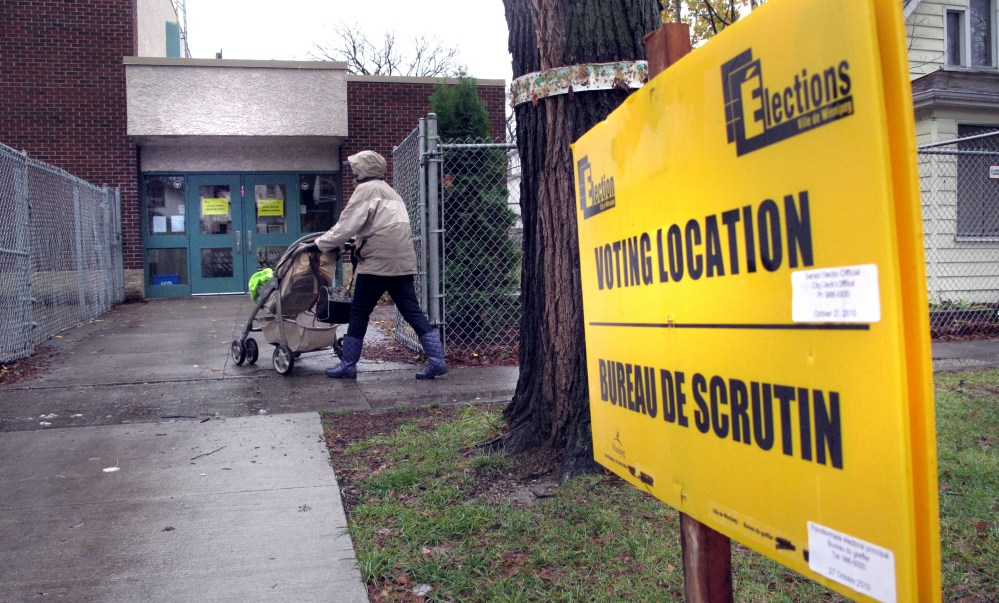
Voter turnout in municipal elections is, in a word, pathetic. In 2014, 50.2 per cent of all registered voters turned out to vote, which was actually up significantly from the previous two municipal elections when only 38 per cent (2006) and 47 per cent (2010) took the time to cast a ballot.
Compare that to turnout in the 2015 federal election (68 per cent) or the 2016 provincial election (57 per cent), and you can see the voters have less interest in the outcome of civic votes. Why they are so uninterested is a matter of considerable debate.
Some theorize that the absence of a party system in municipal politics is to blame. In Winnipeg, candidates do not assume party affiliation or run in slates. The Winnipeg Labour Council does endorse one council candidate in each of the 15 wards but beyond that, fewer and fewer organizations of any kind are offering endorsements.
The lack of party affiliation means voters cannot just vote along party lines, as they typically do in provincial and federal elections. In a municipal election, voters have to do a lot more work to learn about who is running and what they stand for.
As sad as it may seem, when you make those kinds of demands on voters, there are only two likely outcomes. Rather than putting in the effort to study and compare candidates, voters will just cast a vote for an incumbent. Or, they just won’t vote.
Further complicating matters is the fact that the candidates themselves do not do a very good job of commanding the attention and respect of voters.
Absent an overarching party platform, municipal candidates are woefully short on original ideas or informed positions. Most tend to gravitate to motherhood issues — accountability, infrastructure, public safety — with positions that are heavy on expectations but very light on details. All the candidates want to make city hall more efficient and effective, getting smoother roads, less crime and better outcomes from expenditures. But almost none of them has a single, concrete idea on how much their pledges will cost, or exactly how they’re going to accomplish any of those goals.
Perhaps this deficit of concrete ideas is why very few candidates take advantage of the tools of modern digital communication to reach voters.
Consider the Transcona Ward, which has a remarkable nine candidates vying for a single seat on council.
Of those nine candidates, seven do not have a website, and only four have an election-dedicated presence on Facebook, none of which contains anything more than a picture, and a few posts full of platitudes and general comments.
It’s a similar story across the other wards — few websites, hardly any social media presence, and few concrete ideas or plans for how they would serve the city. This condition is no doubt prompted by the fact so few candidates understand exactly how the city works. You’re not going to have much to say to voters if you don’t really understand the dynamics of city government and the nature of the problems it faces.
For example, a great preponderance of candidates want to reduce crime. The gross majority of those who identify it as a priority suggest that putting more police officers on the street, or increasing the frequency of patrols, will make the city safer. The reality is that more police does not equal lower crime, given that police are most often involved in crime after the criminal act has taken place.
That does not stop most candidates from promising they will reduce crime.
Now, it should be noted that city councillors generally do not win their seats via websites or Facebook pages. Victory is generally earned through a robust door-knocking campaign. Thus, most candidates probably believe that as long as they knock on every door in the ward at least twice, dropping a pamphlet or flyer every time they do, and hit most of the right notes in terms of issues, they will have a chance to win.
Perhaps. But what they won’t be doing is encouraging more Winnipeggers to actually vote.
Many things have to happen to result in higher voter turnout. In theory, we need more motivated voters and more informed candidates. But even then, there are no guarantees that more effort and attention will translate into more votes.
Local government could be better at prompting candidates to do their homework and take positions on major issues.
The city currently offers an excellent page on its website that lists every candidate in every ward, plus all the mayoral candidates. Voters can very easily compare basic information on each registered candidate— some background, website or social media accounts, and contact information.
But perhaps the city could also include a standard questionnaire for candidates, asking them to provide positions on some of the foremost challenges facing city council.

Even if the city provides more and better information on candidates, and candidates do a better job of figuring out the problems they want to solve, the onus still falls on the voter. How are we going to get people to live up to that civic duty?
How about a voter buddy system?
If you’re a dedicated voter, make yourself a promise that you’re going to drag one non-voter to the polls with you on election day. It could be a child of voting age, a spouse or other family member, or a close friend who has announced their intention to ignore the municipal election.
The voter buddy system won’t solve all of our problems with turnout. But it will get us closer to realizing the great promise that exists in every municipal election campaign.
dan.lett@freepress.mb.ca
Dan Lett is a columnist for the Free Press, providing opinion and commentary on politics in Winnipeg and beyond. Born and raised in Toronto, Dan joined the Free Press in 1986. Read more about Dan.
Dan’s columns are built on facts and reactions, but offer his personal views through arguments and analysis. The Free Press’ editing team reviews Dan’s columns before they are posted online or published in print — part of the our tradition, since 1872, of producing reliable independent journalism. Read more about Free Press’s history and mandate, and learn how our newsroom operates.
Our newsroom depends on a growing audience of readers to power our journalism. If you are not a paid reader, please consider becoming a subscriber.
Our newsroom depends on its audience of readers to power our journalism. Thank you for your support.
Dan Lett is a columnist for the Free Press, providing opinion and commentary on politics in Winnipeg and beyond. Born and raised in Toronto, Dan joined the Free Press in 1986. Read more about Dan.
Dan’s columns are built on facts and reactions, but offer his personal views through arguments and analysis. The Free Press’ editing team reviews Dan’s columns before they are posted online or published in print — part of the our tradition, since 1872, of producing reliable independent journalism. Read more about Free Press’s history and mandate, and learn how our newsroom operates.
Our newsroom depends on a growing audience of readers to power our journalism. If you are not a paid reader, please consider becoming a subscriber.
Our newsroom depends on its audience of readers to power our journalism. Thank you for your support.
Advertisement Advertise With Us
Advertisement Advertise With Us
History
Updated on Monday, October 8, 2018 9:59 PM CDT: Minor fixes