

Hydro pays for axing trees in park

Advertisement
Read this article for free:
or
Already have an account? Log in here »
To continue reading, please subscribe:
Monthly Digital Subscription
$1 per week for 24 weeks*
- Enjoy unlimited reading on winnipegfreepress.com
- Read the E-Edition, our digital replica newspaper
- Access News Break, our award-winning app
- Play interactive puzzles
*Billed as $4.00 plus GST every four weeks. After 24 weeks, price increases to the regular rate of $19.95 plus GST every four weeks. Offer available to new and qualified returning subscribers only. Cancel any time.
Monthly Digital Subscription
$4.99/week*
- Enjoy unlimited reading on winnipegfreepress.com
- Read the E-Edition, our digital replica newspaper
- Access News Break, our award-winning app
- Play interactive puzzles
*Billed as $19.95 plus GST every four weeks. Cancel any time.
To continue reading, please subscribe:
Add Free Press access to your Brandon Sun subscription for only an additional
$1 for the first 4 weeks*
*Your next subscription payment will increase by $1.00 and you will be charged $16.99 plus GST for four weeks. After four weeks, your payment will increase to $23.99 plus GST every four weeks.
Read unlimited articles for free today:
or
Already have an account? Log in here »
Hey there, time traveller!
This article was published 19/05/2021 (1799 days ago), so information in it may no longer be current.
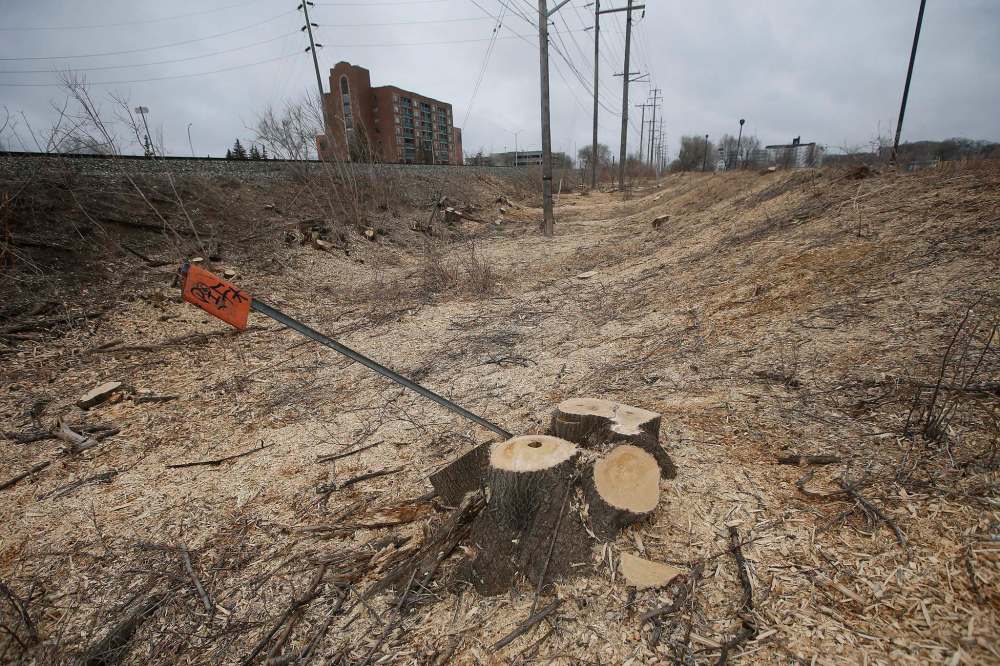
MANITOBA Hydro is trying to make amends for chopping down more than 200 trees in Omand Park in March.
Wolseley residents were incensed after Hydro axed the trees, mainly tall Manitoba maples, rather than prune them. The trees were next to a Hydro corridor at the edge of the park, which is nestled against the Assiniboine River and is popular with dog-walkers, cyclists and joggers.
Hydro had said the trees were growing into two circuits of overhead power lines.
“The residents association was of the opinion that they were overzealous…they should have been pruning and not cutting down the trees,” said Marianne Cerilli, chairwoman of the Wolseley Residents Association, Wednesday.
While many of the trees were on Hydro-managed property next to the rail tracks, the city found that 35 of them were on city property. Four of them were considered dead.
As a result, Hydro will compensate the city for 31 trees, and the money will be used to plant trees in the park.
Cerilli said city naturalists filed a complaint about the cleared trees, which led to negotiations between the city’s forestry department and Hydro.
“We are working with the City of Winnipeg to provide compensation for 31 trees; four other trees were listed as poor condition or dead and not included,” a spokesperson for Hydro said.
“The City of Winnipeg will use the funds to develop a replanting plan for the area which won’t encroach on our poles and power lines, but will be in keeping with other vegetation in the Omand’s Creek area.”
The city provided no comment.
Cerilli said the solution works for Wolseley residents, who will be involved in the planning.
“We’re really glad to see that there’s an agreement in place,” she said.

Now that the community will can weigh in on the type of trees planted, Cerilli said the association hopes to have fruit trees and berry bushes, as well as evergreens, fill in the cleared sites.
Cerilli is advocating for a “tree bylaw” that would make it challenging for utilities to chop down trees without considering other options.
She has joined a group that’s calling on the city to consider the cost and ecological benefits of urban tree cover during city planning. Shade cover, for example, reduces heating, electricity and air conditioner costs, she said.
julia-simone.rutgers@freepress.mb.ca
Twitter: @jsrutgers
Julia-Simone Rutgers is the Manitoba environment reporter for the Free Press and The Narwhal. She joined the Free Press in 2020, after completing a journalism degree at the University of King’s College in Halifax, and took on the environment beat in 2022. Read more about Julia-Simone.
Julia-Simone’s role is part of a partnership with The Narwhal, funded by the Winnipeg Foundation. Every piece of reporting Julia-Simone produces is reviewed by an editing team before it is posted online or published in print — part of the Free Press‘s tradition, since 1872, of producing reliable independent journalism. Read more about Free Press’s history and mandate, and learn how our newsroom operates.
Our newsroom depends on a growing audience of readers to power our journalism. If you are not a paid reader, please consider becoming a subscriber.
Our newsroom depends on its audience of readers to power our journalism. Thank you for your support.
Julia-Simone Rutgers is the Manitoba environment reporter for the Free Press and The Narwhal. She joined the Free Press in 2020, after completing a journalism degree at the University of King’s College in Halifax, and took on the environment beat in 2022. Read more about Julia-Simone.
Julia-Simone’s role is part of a partnership with The Narwhal, funded by the Winnipeg Foundation. Every piece of reporting Julia-Simone produces is reviewed by an editing team before it is posted online or published in print — part of the Free Press‘s tradition, since 1872, of producing reliable independent journalism. Read more about Free Press’s history and mandate, and learn how our newsroom operates.
Our newsroom depends on a growing audience of readers to power our journalism. If you are not a paid reader, please consider becoming a subscriber.
Our newsroom depends on its audience of readers to power our journalism. Thank you for your support.
Related Articles
Rooting for more tree replanting
Advertisement Advertise With Us
Advertisement Advertise With Us